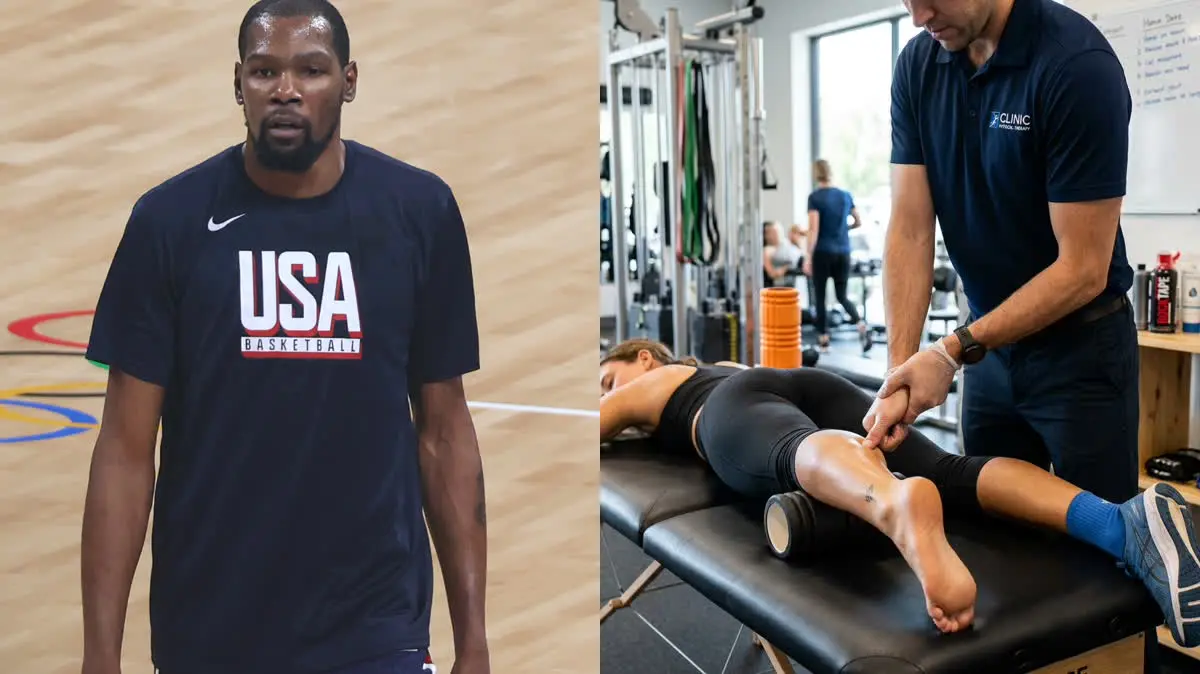
"Trying to rebuild a ruptured Achilles tendon by only doing standard calf raises is like trying to forge a steel sword without a hammer. Tendons only grow dense, resilient collagen fibers when subjected to heavy, slow, agonizingly controlled negative tension."
When Kevin Durant collapsed on the court during the 2019 NBA Finals, grabbing his lower calf, the basketball world collectively mourned. An Achilles tendon rupture is historically considered the death knell for an elite basketball player. The Achilles is the thickest, strongest tendon in the human body, acting as a massive biological spring that propels a seven-foot athlete into the air.
Historically, players who suffered this injury lost significant explosiveness, returning as shadows of their former selves. Yet, Durant returned 18 months later looking virtually identical to his MVP form, exhibiting the same lethal first step and effortless elevation.
His miraculous recovery was not magic; it was the triumph of modern surgical repair paired with aggressive, flawlessly executed sports trauma rehabilitation. The secret weapon in returning an athlete to the court after an Achilles tear is the brutal, systematic application of eccentric loading.
The Anatomy of the Snap
The Achilles tendon connects the massive gastrocnemius and soleus muscles of your calf to your heel bone (calcaneus). It is designed to endure extreme forces, absorbing up to ten times your body weight during a sprint.
Ruptures rarely occur from a direct blow. They occur during a sudden, violent transition from eccentric loading (lengthening under tension) to concentric contraction (shortening). When Durant planted his foot to drive forward, his calf muscles fired maximally while his ankle was still forced into a stretched position. The tendon could not handle the opposing forces and snapped, rolling up his calf like a broken window blind.
But most people miss the hidden catalyst for the post-surgical failure: once the tendon is surgically sutured back together, it heals as a disorganized, chaotic ball of scar tissue. If not loaded correctly, it remains thick, stiff, and highly prone to re-rupture.
My strong clinical opinion is that fear of re-rupture leads many therapists to under-load the recovering Achilles tendon, which is the worst possible outcome. If you do not apply heavy mechanical stress to the healing tendon, the collagen fibers will align randomly, creating a weak, inelastic scar.
We must implement Heavy Slow Resistance (HSR) and strict eccentric loading as early as safely possible. The downward, lengthening phase of a calf raise physically pulls the microscopic collagen fibers into parallel, organized lines, transforming chaotic scar tissue back into a functioning, explosive biological spring. We must load it to heal it.
By the Numbers: The Achilles Comeback
The data surrounding Achilles recovery illustrates the monumental mountain athletes must climb to restore their explosiveness.
- Following a surgical Achilles repair, the injured calf muscle can lose up to 30% of its total muscle volume within the first six weeks of immobilization in a walking boot.
- Athletes who prioritize aggressive eccentric loading protocols demonstrate a 15% greater increase in tendon stiffness and power transfer compared to those who focus solely on concentric (upward) movements.
- Historically, NBA players experienced an average decrease of 4.5 points per game and a 3-4 minute reduction in playing time following an Achilles tear. Durant defied this entirely, averaging 26.9 points in his return season.
The Arsenal of Recovery: Eccentric Protocols
Rebuilding the tendon requires a shift from basic stretching to heavy, controlled, negative resistance.
- Phase 1: The Alfredson Protocol. Stand on the edge of a step. Use both feet to press up onto your tiptoes (concentric). Lift the healthy leg off the step, and slowly lower your weight down on the repaired leg until your heel drops below the step (eccentric), taking a full 4 seconds. Repeat for 3 sets of 15 repetitions, twice daily.
- Phase 2: Heavy Slow Resistance (HSR). Utilizing a seated calf raise machine, load the muscle heavily. Take 3 seconds to push the weight up, and 4 seconds to lower it down. This heavy mechanical tension forces the tendon to adapt and thicken properly.
- Phase 3: Plyometric Spring Training. To restore the "snap," the athlete must perform rapid, reactive movements like pogo hops and drop jumps, training the tendon to absorb and release kinetic energy in milliseconds without failing.
The Patient: James, a 44-year-old recreational basketball player, ruptured his Achilles playing a pickup game. Eight months post-surgery, he still walked with a noticeable limp and felt intense stiffness every morning.
The Mistake: James had stopped his physical therapy early because he could walk without pain. He was completely neglecting the heavy eccentric loading required to align his surgical scar tissue, leaving his tendon thick and completely inelastic.
The Solution: We initiated a brutal, strict regime of weighted eccentric heel drops wearing a backpack, combined with deep cross-friction massage to break up the superficial adhesions.
The Outcome: After three months of heavy loading, the tendon remodeling was profound. James regained the spring in his step, lost his limp, and successfully returned to light jogging and shooting hoops without fear.
Forging the Spring
Kevin Durant’s return to dominance rewrote the medical expectations for an Achilles rupture. His journey proves that with world-class surgical intervention and a relentless commitment to proper biomechanical loading, the human body can rebuild its strongest structures.
If you are suffering from minor heel pain before it becomes a major rupture, read our protocols on Heavy Slow Resistance for Tendinitis to bulletproof your lower legs.
Featured image attribution: Portrait sourced from Wikimedia Commons, licensed under Creative Commons. Modified by cropping and compositing.
Dr. Dhanushika Dilshani
Expert Ayurvedic Wellness Doctor. Specialized in modern holistic wellness, optimizing dermal resilience, cosmetic radiance, and systematic diagnosis driven by traditional and evidence-based medical logic.
Medical Disclaimer
The information provided by AyurPhysio is for general educational and informational purposes only. It is not intended as a substitute for professional medical advice, diagnosis, or treatment. Always seek the advice of your physician or other qualified health providers with any questions you may have regarding a medical condition. Never disregard professional medical advice or delay in seeking it because of something you have read on this website.
Related Healing Guides
View All Guides →
Christian Eriksen's Cardiac Arrest and ICD Return to Play: The Biomechanics of Cardiorespiratory Reconditioning and Athletic Heart Rehabilitation

Selena Gomez's Lupus and Kidney Transplant: An Integrative Ayurvedic Approach to Systemic Autoimmunity, Dushi Visha, and Ojas Restoration