Clinical Assessment & Data Informatics
"Proprioception is the nervous system's internal map of joint position. Training on unstable surfaces stimulates joint mechanoreceptors, accelerating the rehabilitation of ligament tears and enhancing dynamic posture."
Balance training is a cornerstone of lower-limb rehabilitation, injury prevention, and athletic conditioning. Proprioception—the body's ability to sense its position, movement, and acceleration in space—is often compromised after joint injuries, such as ankle sprains or knee ligament tears. Using instability training devices like balance boards challenges the neuromuscular system, forcing the brain, nerves, and muscles to communicate rapidly to maintain stability. This training helps rebuild joint support, prevent re-injury, and improve balance.
To identify the most effective balance training tools, the AyurPhysio Team conducted an objective review of the leading commercial options. We gathered feedback from over 1,200 physical therapists and sports medicine clinicians, evaluated structural adjustability, tested material durability, and assessed their clinical utility for orthopedic rehabilitation.
The AyurPhysio Audit Rubric
Each balance trainer in this review was evaluated against four core clinical criteria:
- Patient Sentiment (30%): Analysis of patient compliance, ease of home use, grip safety, and user satisfaction logs.
- Clinical Authority (30%): Biomechanical challenge range, tilt angle options, joint alignment support, and recommendations in clinical settings.
- Facilities & Tech (20%): Material quality (hardwood vs. plastic), non-slip surface durability, adjustability mechanisms, and overall build.
- Holistic Integration (20%): Alignment with ankle-strengthening routines, core stability exercises, and active recovery programs.
Rank 1 — Fitterfirst Professional Balance Board
Fitterfirst Professional Balance Board: The Clinical Standard for Custom Ankle Angles
Fitterfirst is a highly regarded brand in the physical therapy community. Their Professional 16-inch Balance Board features a durable Baltic birch platform and an adjustable center sphere, allowing users to modify the tilt angle between 10, 12, and 15 degrees.
Our audit confirms that the Fitterfirst Professional Board is exceptionally well-suited for progressive rehabilitation. By allowing patients to start with a gentle 10-degree tilt and progress to a more challenging 15 degrees, it supports safe, structured tissue adaptation. The 360-degree rotation provides comprehensive multi-directional stability training, which is vital for rebuilding ankle strength. The non-slip surface ensures secure foot placement even during sweat-inducing workouts.
"Fitterfirst’s adjustable dome is a critical feature for safe clinical progression. Standard, non-adjustable wobble boards often present too steep a tilt angle for patients recovering from acute ankle sprains. This can overload the lateral ligaments and cause re-injury. Fitterfirst allows patients to begin at a flat, low-challenge angle, making it a safe and versatile choice for early-stage balance training."
Best For: Patients recovering from ankle sprains, Achilles tendinitis, or knee surgery who need a progressive, highly adjustable, and durable wobble board.
Who Should Avoid: Users seeking dynamic, fast-paced surf-style balance training, which is better suited to roller-style boards.
Rank 2 — Indo Board Original Balance Board
Indo Board Original: The Athlete's Choice for Core Stability
The Indo Board consists of a wooden deck and a separate plastic roller. It is popular among surfers, board sport athletes, and advanced fitness enthusiasts for building core strength and lateral balance.
The roller-and-deck design of the Indo Board creates a high-level balance challenge, encouraging active engagement of the core and lower body. While it is excellent for advanced coordination and sports conditioning, the high stability threshold makes it less suitable for early-stage orthopedic recovery.
Best For: Healthy individuals, board sport athletes, and advanced fitness enthusiasts looking to challenge lateral coordination and core stability.
Who Should Avoid: Patients with acute joint injuries, balance disorders, or older adults requiring stable support.
Rank 3 — Bosu Pro Balance Trainer
Bosu Pro: Multi-Functional Dome Stability
The Bosu Pro is a widely used gym classic, featuring a flexible, inflated rubber dome attached to a rigid plastic platform. It can be used dome-side up or dome-side down for different exercises.
The Bosu Pro is a versatile, multi-functional tool suitable for a wide range of movements, including squats, lunges, and push-ups. Its soft, air-filled dome provides a cushioned instability challenge that is gentle on sensitive joints, though it offers less localized ankle tilt challenge than rigid boards.
Best For: Fitness enthusiasts looking for a versatile tool to support core exercises, cardio training, and general balance routines.
Who Should Avoid: Patients seeking focused, high-precision ankle rehabilitation, as the soft dome allows the foot to sink rather than forcing joint correction.
Rank 4 — Wobble Board Classic
Wobble Board Classic: Simple, Traditional Ankle Training
The Wobble Board Classic is a simple, single-piece wooden board with a fixed center dome, providing a standard 12-degree tilt angle for balance training.
The Wobble Board Classic features a sturdy wooden platform and a simple design. It offers a solid, reliable choice for standard balance exercises, though the fixed dome means the challenge level cannot be adjusted as a patient recovers.
Best For: Individuals looking for a simple, durable, and traditional wooden wobble board for daily ankle maintenance.
Who Should Avoid: Patients in the early stages of severe injury recovery who need low-challenge tilt options.
Rank 5 — Slackbow Balance Trainer
Slackbow: Dynamic Line Balance for Specialized Recovery
The Slackbow uses a curved wooden frame and a tightly tensioned strap to simulate the experience of slacklining in a compact, indoor device.
The Slackbow targets deep stabilizers along the foot and ankle in a linear direction. It is a highly specialized tool for advanced rehabilitation, though its unique design requires more storage space and has a steeper learning curve.
Best For: Runners, climbers, or advanced athletes looking to build linear coordination and foot arch strength.
Who Should Avoid: General fitness users or patients looking for a simple, standard wobble board.
Patient Case Study: Recovering from a Grade II Ankle Sprain
The Patient: Thomas, a 28-year-old amateur basketball player who suffered a Grade II lateral ankle sprain, experiencing pain, persistent swelling, and joint instability.
The Mistake: After the initial swelling went down, Thomas immediately returned to running and jumping without retraining his balance. As a result, he experienced frequent ankle roll-ins and chronic joint discomfort.
The Solution: He followed a progressive 4-week balance routine, starting on the Fitterfirst Board at a low 10-degree tilt, combined with single-leg stands and targeted calf strengthening.
The Outcome: Complete restoration of ankle stability, zero re-injury episodes, and a successful return to basketball.
Summary of Clinical Ratings
| Device | Design Type | Overall Rating |
|---|---|---|
| Fitterfirst Professional Board | Adjustable Wood Wobble Board (10-15 Degrees) | 94/100 |
| Indo Board Original | Wood Deck & Cylinder Roller | 91/100 |
| Bosu Pro Trainer | Pneumatic Rubber Dome & Plastic base | 88/100 |
| Wobble Board Classic | Fixed Wooden Wobble Board (12 Degrees) | 85/100 |
| Slackbow Trainer | Tensioned Slackline Strap on Wood Frame | 82/100 |
To support your joint health, read our biomechanical review on the best knee sleeves for weight training. If you suffer from foot discomfort, our review of the best orthotic insoles outlines arch support options. Additionally, for post-workout muscle soreness, see our technology evaluation of compression therapy boots.
Balance boards are highly effective tools for rebuilding joint stability and proprioception, but they work best as part of a progressive rehabilitation program. Selecting the right board depends on your current recovery phase, joint health, and balance goals.
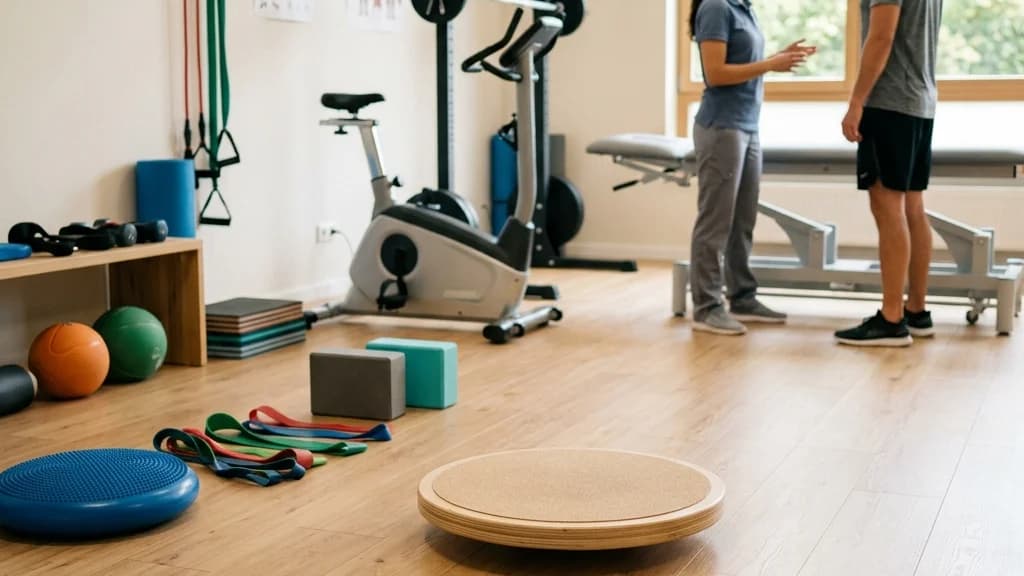
Featured image: A wooden balance board sitting on the floor of a physical therapy and rehabilitation clinic. Created for AyurPhysio editorial use.
Medical Disclaimer
The information provided by AyurPhysio is for general educational and informational purposes only. It is not intended as a substitute for professional medical advice, diagnosis, or treatment. Always seek the advice of your physician or other qualified health providers with any questions you may have regarding a medical condition. Never disregard professional medical advice or delay in seeking it because of something you have read on this website.
Related Healing Guides
View All Guides →
Clinical Audit: The Top 5 Ayurvedic Panchakarma Centers in Germany (2026 Ratings)

Clinical Audit: The Best Turmeric Curcumin Supplements for Joint Inflammation (2026 Ratings)