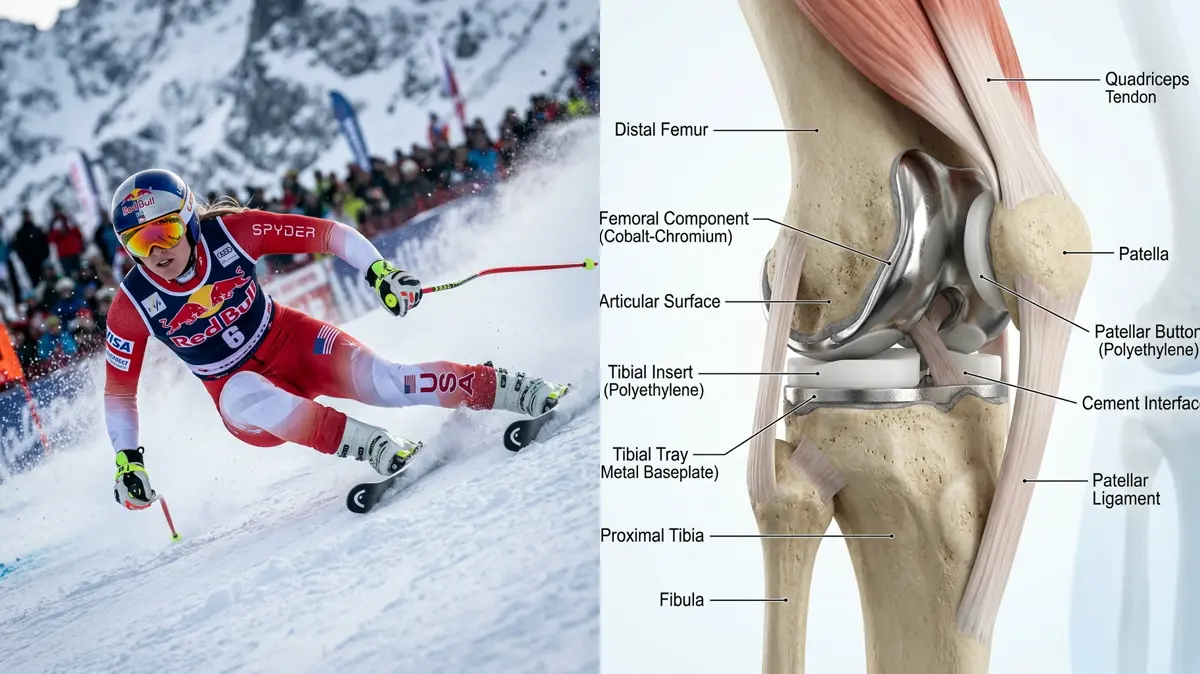
"Carving downhill turns at high speeds on a prosthetic knee is a monumental feat — it requires the quadriceps to act as a dynamic shock absorber when the body's natural joint receptors are gone."
In the winter of 2024, Olympic downhill skiing legend Lindsey Vonn stunned the sports world by announcing her return to active training. Having retired in 2019 due to severe joint degeneration and chronic pain, Vonn underwent a major surgical procedure: a total knee arthroplasty (TKA). At age 40, returning to the brutal G-forces of downhill skiing on an artificial joint defied traditional medical guidelines. It is a bold comeback that challenges everything we know about joint replacements.
The story of lindsey vonn knee surgery highlights the extreme physical demands of high-level skiing after joint replacement. In a healthy knee, ligaments and cartilage absorb vibrations and adjust alignment. With a prosthetic knee, those natural tissues are gone, leaving the muscles to absorb every shock. Carving downhill turns at 80 miles per hour on a prosthetic knee joint is like trying to execute high-speed drifting in a race car equipped with a rigid steel suspension instead of responsive shock absorbers. Only structured recovery makes this possible.
To safely manage skiing after TKA, orthopedic specialists must focus on rebuilding extreme quadriceps strength and dynamic joint alignment. Without these active stabilizers, the high impact forces can quickly loosen the implant. Let us dive into the biomechanical reality of artificial joints and look at how athletes rebuild stability under load.
The Artificial Hinge: Biomechanics of a Knee Replacement
During a total knee replacement, the worn ends of the thigh bone (femur) and shin bone (tibia) are shaved away. They are capped with metal alloy components, with a durable medical-grade polyethylene plastic insert placed between them to act as a smooth spacer. While this procedure resolves arthritis pain by removing damaged bone-on-bone contact, it changes the internal mechanics of the knee.
To place the implant, the surgeon must remove the anterior cruciate ligament (ACL) and, in most cases, the posterior cruciate ligament (PCL). These ligaments contain thousands of mechanoreceptors that feed joint position coordinates to the brain. Without them, the patient experiences a significant loss of joint proprioception. Rebuilding quadriceps control after knee replacement is like trying to drive a fly-by-wire fighter jet whose primary flight computers have had their control loops adjusted. The brain must learn to rely on surrounding muscles for feedback.
Additionally, an artificial knee does not absorb shock. The metal and plastic components transfer impact forces directly to the surrounding bone. If the surrounding muscles — particularly the quadriceps and gluteals — cannot decelerate the body, those forces concentrate at the bone-cement interface, risking early implant failure or local bone fractures.
- Prosthetic knee implants are engineered to withstand forces up to 4 to 5 times body weight, but high-impact alpine skiing can generate peak forces exceeding 6 times body weight.
- Rebuilding quadriceps strength to within 5% of the unaffected limb is required before returning to high-load recreational sports.
- Approximately 15% of knee replacement patients return to recreational skiing, with the majority choosing moderate, groomed slopes rather than competitive downhill courses.
- Over 90% of knee replacements last longer than 15 years under normal recreational loads, but high-impact activities can double the rate of plastic insert wear.
Why Standard Isometric Exercises Fall Short for Athletes
Standard recovery after a knee replacement focuses on basic movements: gentle leg raises, simple wall slides, and stationary cycling. While these exercises are excellent for restoring early range of motion, they are insufficient for the extreme demands of skiing. High-speed turns require the quadriceps to work eccentrically, absorbing impact while the muscle is lengthening.
My clear, clinician-led perspective is that relying on basic knee extensions to return to high-speed sports is a clinical error. High-impact movement demands fast muscle activation and eccentric control to decelerate the body. If you only train the knee in slow, static ranges, the joint will lack the dynamic stability needed to handle sudden changes in terrain, increasing the risk of implant damage.
Instead of static training, the rehabilitation must progress to eccentric loading. By performing slow, controlled descents on decline surfaces, we train the quadriceps to absorb force. This eccentric control is the key to protecting the artificial joint from excessive wear and tear.
"When Lindsey Vonn decided to return to downhill skiing on a replaced knee, she was entering uncharted territory. A knee replacement is designed to restore walking and light recreational activity — not to handle downhill forces at high speeds. In my clinic, the focus for a knee replacement return-to-sport athlete is 100% on eccentric deceleration and hip control. If the gluteus medius is weak, the knee will collapse inward, placing lateral force on the plastic spacer. We build a strong muscular sleeve around the implant, turning the leg muscles into the primary shock absorbers."
Rebuilding Stability: The Deceleration Protocol
Restoring stability after a joint replacement requires a structured knee joint replacement rehab program. The primary objective is to build quadriceps strength knee replacement patients need to protect the bone-implant interface, combined with hip control to keep the knee properly aligned.
Rehab begins with closed-chain exercises like leg presses, focusing on equal weight distribution. Gradually, we progress to eccentric squats, where the descent phase is slowed to five seconds. This builds the muscle's ability to absorb shock during impact.
Finally, we introduce proprioceptive retraining, using balance pads to challenge the foot and hip stabilizers. Since the knee's internal receptors are gone, the brain must rely on receptors in the ankle and hip to monitor leg alignment. This sensory training is crucial for maintaining stability on uneven snow.
Step-by-Step Knee Stabilization Protocol
Perform this active sequence daily under clinical supervision. Stop immediately if you experience swelling, heat, or deep pain in the prosthetic joint:
-
1Phase 1: Eccentric Decline Squats (3 sets of 8 repetitions) Stand on a 15-degree decline board, keeping your weight on your heels. Slowly lower your hips over 5 seconds until your knees are bent to 60 degrees, then return to the start. Slow lowering builds eccentric control, which is a key phase in total knee replacement recovery to absorb shock.
-
2Phase 2: Single-Leg Balance with Perturbations (3 sets of 30 seconds) Stand on your affected leg on a soft foam balance pad. Keep your knee slightly bent. Have a partner gently toss a light medicine ball to you from different angles, or perform light arm movements. This trains proprioceptive retraining knee replacement pathways by forcing the hip and ankle to maintain alignment.
-
3Phase 3: Hip Abduction Clamshells with Resistance (3 sets of 15 repetitions) Lie on your side with your knees bent, placing a resistance band around your thighs just above the knees. Keeping your feet together, slowly open your top knee against the band, hold for 2 seconds, and lower. This strengthens the gluteus medius, which keeps the knee aligned and prevents valgus collapse during movement.
Sustaining Prosthetic Joint Health
Protecting an artificial joint requires keeping the entire kinetic chain strong. If you are recovering from a surgical procedure, check out our guide on choosing the best post-operative knee braces for recovery. If you want to improve your leg alignment, read our analysis of patellofemoral pain syndrome and hip rehabilitation. To learn more about knee support options, view our detailed review of the best knee sleeves for joint stability.
Your artificial knee is a durable mechanical hinge, but its longevity depends on the muscles that guide it. Build your decelerating muscles, keep your hips strong, and protect your joint.
Are you training your leg muscles to act as active shock absorbers, or are you expecting metal and plastic components to absorb the impact of your movements?
Dr. Dhanushika Dilshani
Expert Ayurvedic Wellness Doctor. Specialized in modern holistic wellness, optimizing dermal resilience, cosmetic radiance, and systematic diagnosis driven by traditional and evidence-based medical logic.
Medical Disclaimer
The information provided by AyurPhysio is for general educational and informational purposes only. It is not intended as a substitute for professional medical advice, diagnosis, or treatment. Always seek the advice of your physician or other qualified health providers with any questions you may have regarding a medical condition. Never disregard professional medical advice or delay in seeking it because of something you have read on this website.
Trending Guides
George Washington's Fatal Bloodletting: An Ayurvedic Reconstruction of Rakta Dhatu Depletion and Ojas Collapse
8 min readJack Grealish's stress fracture of the foot: Soccer Biomechanics, Fifth Metatarsal Load, and Surgical Rehab
8 min readBen White's Severe Knee Injury: A Biomechanical Analysis of Lateral Meniscus Shear and Joint Longevity
8 min readElly De La Cruz's Hamstring Strain: The Biomechanics of Sprint Deceleration
8 min readTotal Knee Replacement (TKR): Post-Op Protocols for Restoring Extension
9 min readWeekly Wellness
Don't miss the next guide
Join 5,000+ subscribers getting holistic health tips every Tuesday.
Related Healing Guides
View All Guides →
George Washington's Fatal Bloodletting: An Ayurvedic Reconstruction of Rakta Dhatu Depletion and Ojas Collapse
Jack Grealish's stress fracture of the foot: Soccer Biomechanics, Fifth Metatarsal Load, and Surgical Rehab