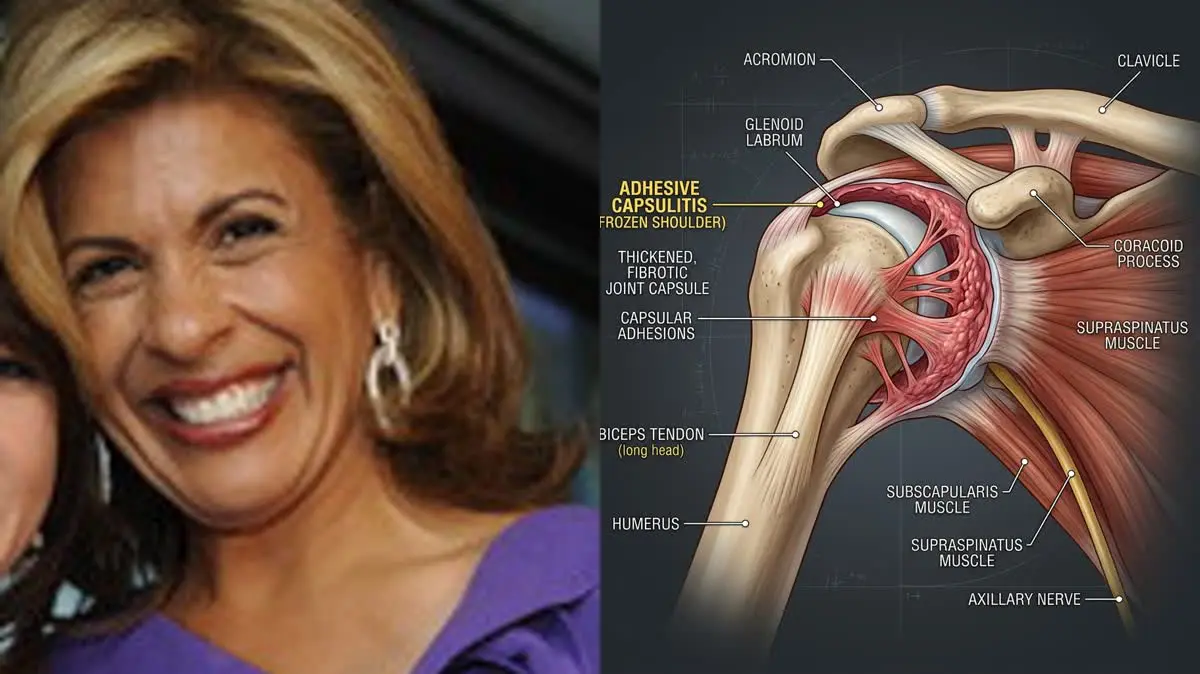
"Adhesive capsulitis is not a simple muscle tightness. It is a slow, inflammatory biological binding of the glenohumeral joint capsule. Reclaiming mobility requires understanding which phase the joint is in and utilizing precise mechanical mobilization without triggering a flare."
In May 2026, Today Show co-host Sheinelle Jones shared her personal struggle with frozen shoulder, a condition that has severely limited her arm movement and caused persistent pain. Her public disclosure shed light on a common, yet poorly understood, orthopedic condition that affects millions of people: adhesive capsulitis. The sudden onset of stiffness and pain can disrupt daily life, turning simple tasks like dressing or reaching into a cabinet into agonizing struggles.
Recovering from a frozen shoulder is a test of patience, requiring a customized, phase-specific rehabilitation approach. In this clinical evaluation, we will analyze the pathophysiology of adhesive capsulitis, break down the three distinct phases of the condition, discuss joint mobilization mechanics, and outline the physical therapy recovery milestones.
The Pathology of the Joint Capsule: Adhesive Capsulitis
The glenohumeral (shoulder) joint is a ball-and-socket joint surrounded by a loose, flexible envelope of tissue known as the joint capsule. In a healthy shoulder, this capsule has redundant folds that allow the arm to rotate and lift through a wide range of motion. In adhesive capsulitis, this capsule becomes chronically inflamed, thickened, and fibrotic.
The pathology is characterized by several changes:
- Synovial Inflammation: The lining of the joint capsule becomes inflamed, presenting with intense redness and pain, particularly at night.
- Capsular Fibrosis: Collagen fibers within the capsule cross-link and thicken, leading to the formation of dense scar tissue and adhesion bands.
- Loss of Joint Volume: The volume of fluid the joint cavity can hold drops from roughly 15–20 milliliters down to less than 5 milliliters, physically locking the head of the humerus against the socket.
Clinically, adhesive capsulitis is identified by a distinct capsular pattern of restriction, where the loss of motion is greatest in external rotation, followed by abduction, and finally internal rotation.
- Adhesive capsulitis affects approximately 2% to 5% of the general population, with a higher prevalence in women aged 40 to 60.
- Individuals with diabetes or thyroid disorders have a significantly higher risk, with incidence rates reaching up to 20% to 30%.
- Up to 90% of cases resolve successfully with conservative management, though the natural timeline can span 12 to 24 months.
- Intra-articular corticosteroid injections combined with physical therapy reduce pain and improve range of motion in the early stages by over 70%.
The Three Phases of Frozen Shoulder: Timing is Everything
Adhesive capsulitis follows a predictable clinical course divided into three distinct phases. Structuring a treatment plan requires identifying the current phase, as applying aggressive stretching during the wrong phase will worsen inflammation and stiffness.
Phase 1: The Freezing (Painful) Phase (Months 1–9): This phase is dominated by progressive, severe pain, especially at night when lying on the affected shoulder. As the pain increases, the shoulder slowly loses range of motion. The primary goal is pain management, light active-assisted mobility within painless limits, and avoiding aggressive stretching that exacerbates capsular inflammation.
Phase 2: The Frozen (Stiff) Phase (Months 4–12): Pain begins to stabilize or decrease, but stiffness becomes profound. Daily activities are severely restricted. The joint capsule is now fibrotic and thick. The clinical focus transitions to manual joint mobilizations (Maitland or Kaltenborn glide techniques) and progressive stretching to remodel the collagen fibers and restore joint volume.
Phase 3: The Thawing Phase (Months 12–24+): The joint capsule slowly relaxes, and range of motion gradually returns. Pain is minimal. Physical therapy focuses on aggressive stretching, eccentric rotator cuff strengthening, and restoring normal scapulohumeral rhythm to return the shoulder to full function.
"One of the biggest mistakes in treating frozen shoulder is trying to 'stretch' through the pain during the freezing phase. In this inflammatory stage, aggressive stretching triggers a protective muscle spasm and accelerates capsular scarring. We must treat the early phase with gentle pain-free mobility, potentially utilizing a corticosteroid injection to quiet the inflammation, and save the deep, structural joint glides for the frozen and thawing phases."
The Frozen Shoulder Physical Therapy Rehabilitation Milestones
Rehabilitation is structured to match the biological state of the joint capsule, ensuring progressive loading and mobility without triggering inflammatory flares.
- 1Phase 1: Pain Modulation and Inflammatory Quiet (Freezing Phase)Gentle range of motion is maintained using sub-maximal passive movements, pendulums, and pulley exercises within a pain-free range. Ice, heat, and electrical stimulation are used for pain control. Active stabilization of the scapula is introduced to prevent compensatory movement patterns.
- 2Phase 2: Capsular Stretching and Joint Mobilization (Frozen Phase)With the joint quieted, low-grade joint glides (anterior, posterior, and inferior) are introduced by a physical therapist to target specific restrictions in the capsule. The athlete performs home stretching using sticks or doorways, holding stretches for 30 seconds at the end of range. Rotator cuff isometrics begin.
- 3Phase 3: Active Range of Motion and Scapular Control (Early Thawing Phase)As joint mobility improves, active range of motion is progressed. Exercises focus on restoring the normal 2:1 ratio of humeral-to-scapular motion during arm elevation. Wall crawls, hand-behind-back stretches, and light resistance band exercises for the rotator cuff and scapular stabilizers are performed daily.
- 4Phase 4: Functional Strengthening and Integration (Late Thawing Phase)Full range of motion is finalized. Progressive eccentric strengthening of the rotator cuff and serratus anterior is performed. The athlete transitions to functional, multi-planar movements, push-ups, and overhead pressing, ensuring complete structural balance and strength symmetry between both shoulders.
The Patient: Linda, a 52-year-old school administrator who presented with severe right shoulder pain and stiffness, unable to reach her hand to her head or lower back.
The Mistake: Linda was advised by a trainer to perform aggressive chin-ups and overhead stretches, which triggered a severe inflammatory flare and worsened her pain to a 9/10.
The Solution: We diagnosed her in the late freezing phase. We stopped all aggressive stretching, utilized a targeted corticosteroid injection, focused on gentle pain-free pendulums, and introduced Maitland Grade I and II joint glides.
The Outcome: Linda's pain resolved within 4 weeks. We transitioned her to capsular stretching, and she recovered 95% of her shoulder mobility and full strength within 8 months.
Shoulder Mechanics and the Upper Extremity
Shoulder mobility is heavily dependent on thoracic spine mobility and muscular balance. To explore how manual therapy can assist neck and shoulder stiffness, read our guide on Griva Basti for neck stiffness and cervical spine care. If you are experiencing shoulder pain from postural compensations, check our analysis of postural corrections and deep neck flexor strengthening. Additionally, for a detailed look at how other individuals manage frozen shoulder using integrative therapies, check our clinical overview of frozen shoulder and passive mobilization protocols.
Sheinelle Jones' open discussion of her frozen shoulder highlights the reality of this challenging condition. By understanding the biological phases of adhesive capsulitis, avoiding aggressive early stretching, and utilizing precise joint glides and progressive strengthening, individuals can navigate this recovery successfully. With time and a structured, physical therapy-led protocol, the shoulder will thaw, restoring complete, pain-free mobility and strength.
Featured image: Clinical side-by-side composite showing a Today Show anchor representative (left) and an anatomical 3D rendering of a human shoulder joint showing an inflamed, thickened joint capsule characteristic of adhesive capsulitis (right). Created for AyurPhysio editorial use. Wikimedia Commons attribution: Hoda Kotb image by Anthony Quintano licensed under CC BY 2.0. Modified by cropping and compositing.
Dr. Dhanushika Dilshani
Expert Ayurvedic Wellness Doctor. Specialized in modern holistic wellness, optimizing dermal resilience, cosmetic radiance, and systematic diagnosis driven by traditional and evidence-based medical logic.
Medical Disclaimer
The information provided by AyurPhysio is for general educational and informational purposes only. It is not intended as a substitute for professional medical advice, diagnosis, or treatment. Always seek the advice of your physician or other qualified health providers with any questions you may have regarding a medical condition. Never disregard professional medical advice or delay in seeking it because of something you have read on this website.
Related Healing Guides
View All Guides →
Christian Eriksen's Cardiac Arrest and ICD Return to Play: The Biomechanics of Cardiorespiratory Reconditioning and Athletic Heart Rehabilitation

Selena Gomez's Lupus and Kidney Transplant: An Integrative Ayurvedic Approach to Systemic Autoimmunity, Dushi Visha, and Ojas Restoration