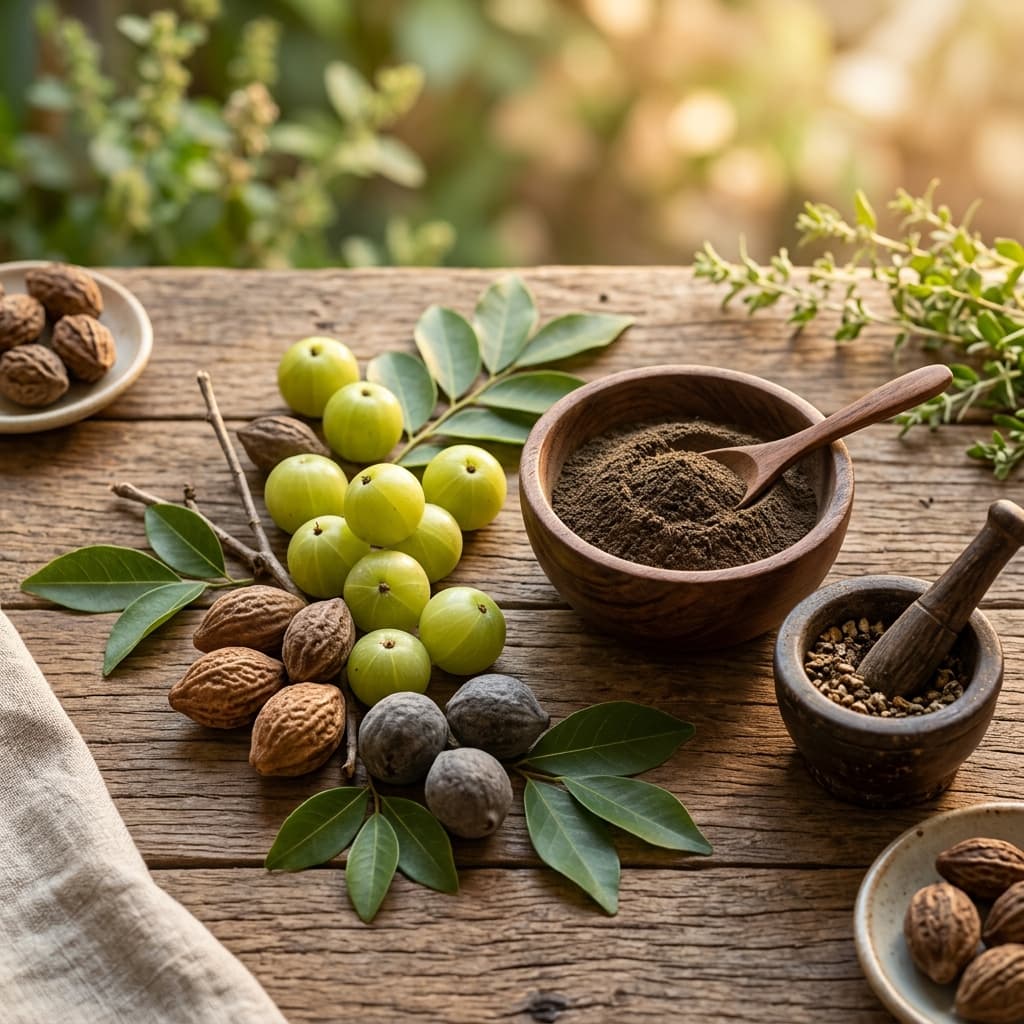
"Triphala is not a laxative. It is a rasayana — a rejuvenating intelligence in botanical form that cleanses the colon on Monday, nourishes your liver on Tuesday, and begins repairing your optic nerve tissue by Wednesday. No single pharmaceutical compound can claim that breadth of therapeutic action."
You have likely encountered Triphala as a supplement marketed primarily as a "gentle laxative" or "digestive cleanser." If that is your only understanding of this formula, then you are holding a masterpiece and seeing only the frame.
Triphala is among the most researched and clinically validated herbal formulas in any traditional medicine system in the world. Over 700 peer-reviewed studies have investigated its constituents. Its documented pharmacological actions include antioxidant, immunomodulatory, anti-inflammatory, anti-carcinogenic, and adaptogenic effects — all from a simple blend of three dried fruits.
Understanding why it works requires going beyond the ingredient list and into the precise Ayurvedic intelligence that governs its formulation.
The Three Fruits: An Ayurvedic Trifecta
The name "Triphala" literally means "three fruits" in Sanskrit. Each of the three components is a complete medicine in its own right, targeting a specific dosha and a specific layer of the body's tissue systems (dhatus).
- 1Amalaki (Emblica officinalis) — The Pitta PacifierThe richest natural source of bioavailable Vitamin C, with levels up to 20 times higher than an orange. Amalaki cools excess Pitta, nourishes Rasa (plasma) and Rakta (blood) dhatu, and is the primary rejuvenating (rasayana) component of the formula. Modern research confirms its potent hepatoprotective and anti-diabetic actions.
- 2Haritaki (Terminalia chebula) — The Vata ControllerCalled the "King of Medicines" in Tibetan healing traditions. Haritaki acts on all seven dhatus simultaneously, regulates downward-moving Apana Vata to ensure complete bowel evacuation, and carries powerful antifungal and antiviral properties validated in clinical research against E. coli and Staphylococcus aureus strains.
- 3Bibhitaki (Terminalia bellirica) — The Kapha DissolverThe formula's primary mucus-clearing agent. Bibhitaki breaks down excess Kapha deposited in the respiratory, urinary, and digestive channels. Clinical studies confirm its efficacy in reducing total cholesterol and LDL levels by up to 18% over 8 weeks, making it a powerful cardiovascular adjunct.
How Triphala Actually Cleanses the Colon
Most people assume Triphala cleanses the colon by stimulating muscle contractions (like senna or cascara). This is incorrect, and it is why Triphala does not cause the dependency or electrolyte depletion associated with stimulant laxatives.
Triphala works through three distinct, gentler mechanisms. First, its high tannin content tones the intestinal wall, improving peristaltic muscle contractility over time rather than forcing a single evacuation. Second, its anti-inflammatory gallic acid and chebulinic acid reduce intestinal mucosal inflammation, allowing the gut lining to absorb nutrients it was previously too inflamed to process. Third, its prebiotic fiber fractions selectively feed Bifidobacterium and Lactobacillus strains, rebuilding your microbiome from the bottom up.
"The most common error I encounter with Triphala is patients taking it at breakfast expecting immediate laxative results. Triphala is a nighttime formula. Take it on an empty stomach, 30–60 minutes before bed, dissolved in warm water at a dose of 1–2 grams. This aligns with Ayurvedic chronobiology — the colon's cleansing activity peaks between 2 AM and 4 AM, and Triphala consumed at bedtime optimally supports this biological window."
The Tridoshic Advantage
What makes Triphala exceptionally rare in herbal medicine is its tridoshic nature — it balances all three doshas simultaneously. This is because each of the three fruits carries a different dominant rasa (taste) and vipaka (post-digestive effect). Unlike single-herb formulas that may aggravate one dosha while pacifying another, Triphala can be safely used year-round by virtually any constitutional type without creating new imbalances.
The Patient: Priya, a 44-year-old teacher, presented with chronic constipation (one bowel movement every 2–3 days), persistent fatigue, and recurring skin breakouts for over two years.
The Mistake: She had been taking OTC stimulant laxatives intermittently for six months, which had created increasing dependency and made her constipation worse on off days.
The Solution: Dr. Dilshani prescribed Triphala churna at 1.5g in warm water nightly for 12 weeks, combined with a Kapha-reducing morning diet protocol.
The Outcome: Daily, effortless bowel movements by week 3. Skin breakouts cleared completely by week 8. Energy levels rated 80% improved at the 12-week follow-up consultation.
Correct Dosage, Forms, and Timing
- 1Churna (Powder) — Most Potent1–2 grams dissolved in 150ml warm water 30 minutes before bed. The powder form contains the complete spectrum of active tannins and gallic acid esters. Stir well and drink promptly to avoid oxidation.
- 2Tablet / Capsule — Most Convenient500mg–1g (1–2 tablets) at bedtime with warm water. Slightly less potent than churna but acceptable for those sensitive to the intensely astringent taste of the powder.
- 3Triphala Ghrita — For Deep Tissue NourishmentTriphala prepared with medicinal ghee is the classical rasayana formulation for long-term rejuvenation, specifically targeting the nervous system and eyes. Indicated when the primary goal shifts from cleansing to tissue rebuilding.
Beyond the Colon: Triphala's Systemic Benefits
Recent ophthalmic research published in the Journal of Ethnopharmacology found that Triphala eye drops significantly reduced intraocular pressure and protected retinal ganglion cells — a finding consistent with classical Ayurvedic texts prescribing Triphala for eye disorders for over two millennia. Additionally, its potent antioxidant polyphenols (primarily chebulinic acid and ellagic acid) have demonstrated selective cytotoxicity against five cancer cell lines while leaving healthy cells unharmed in laboratory studies.
For a complete foundation in digestive wellness, pair your Triphala practice with our guide on nourishing your Agni digestive fire and explore how Ama accumulation drives chronic inflammation. For constitutional support, learn how daily Ayurvedic routines amplify the long-term benefits of Triphala.
The colon, in Ayurveda, is not merely a waste-disposal organ. It is the primary seat of Vata — the governing intelligence of all movement in the body. When the colon is clear, Vata moves freely, and the entire system — from your joints to your cognition — begins to function with a clarity that no isolated supplement can replicate. So when was the last time you truly cleaned your foundation?
Featured image: Triphala three-fruit flatlay with Amalaki, Haritaki, and Bibhitaki berries and traditional churna. Created for AyurPhysio editorial use.
Dr. Dhanushika Dilshani
Expert Ayurvedic Wellness Doctor. Specialized in modern holistic wellness, optimizing dermal resilience, cosmetic radiance, and systematic diagnosis driven by traditional and evidence-based medical logic.
Medical Disclaimer
The information provided by AyurPhysio is for general educational and informational purposes only. It is not intended as a substitute for professional medical advice, diagnosis, or treatment. Always seek the advice of your physician or other qualified health providers with any questions you may have regarding a medical condition. Never disregard professional medical advice or delay in seeking it because of something you have read on this website.
Related Healing Guides
View All Guides →
Turmeric & Golden Milk: The Bioactive Anti-Inflammatory Ayurvedic Elixir

Osteoporosis: Asthi Dhatu Nourishing Ghee and Bone-Loading Physical Therapy