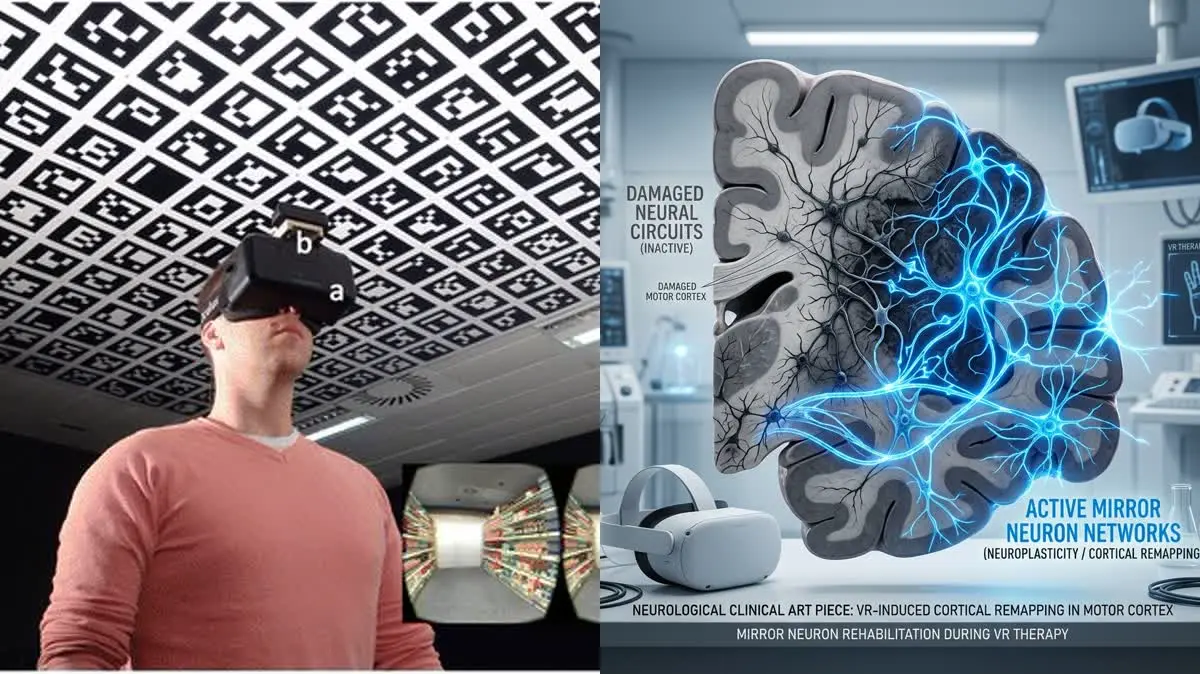
"The brain does not directly feel the world; it constructs an internal map based on sensory predictions. When a stroke destroys a motor channel or an amputation leaves a limb missing, the brain's map falls into a state of chaotic visual-proprioceptive conflict. Virtual Reality allows the therapist to 'hack' the eyes, feeding the brain the exact visual data it needs to bypass damaged tissue and rebuild its internal map."
For decades, the core paradigm of physical therapy relied on direct physical interaction—stretching tissues, applying manual pressure, and executing repetitive mechanical exercises. However, the front line of modern neuro-rehabilitation has expanded into a fully digital frontier: Virtual Reality (VR) and immersive clinical therapeutics.
Once dismissed as a niche consumer gaming technology, VR is rapidly proving to be one of the most authoritative tools in a physical therapist's arsenal. By completely isolating the visual and auditory environments, specialized clinical VR headsets allow us to directly target the central nervous system.
The most profound clinical application of this technology is the digitalization of Mirror Therapy. Whether treating the debilitating, agonizing sensations of phantom limb pain in amputees or accelerating gait restoration in post-stroke hemiplegia, VR operates by stimulating the brain’s innate capacity for neuroplasticity—rewiring undamaged cortical networks to execute lost physical tasks.
Hacking the Motor Cortex: Mirror Neurons
To appreciate how digital goggles can relieve physical pain, one must understand the Mirror Neuron System (MNS). Discovered in the 1990s, mirror neurons are a unique subset of brain cells in the motor cortex that fire not only when an individual performs an action, but also when they simply observe someone else performing that identical action.
In traditional physical therapy, classic "Mirror Box Therapy" involves placing a physical mirror between a patient's limbs. When they move their healthy hand, they look into the mirror and see a reflection that their brain perceives as their paralyzed or missing hand moving perfectly.
Clinical VR elevates this basic optical illusion into a hyper-immersive, interactive 3D reality. The patient puts on the headset, and specialized motion sensors track the healthy limb, rendering a perfectly synchronized, lifelike 3D avatar limb in the virtual space. This creates three profound neurological impacts:
-
1Resolving Sensory-Proprioceptive Mismatch In phantom limb pain, the brain commands a missing limb to move, but receives no sensory feedback. The brain interprets this silent signal as extreme pain or a "cramping" sensation. By visually seeing their virtual arm open and close in VR, the brain registers the sensory confirmation it was craving, immediately suppressing the phantom pain pathway.
-
2Cortical Remapping According to Hebbian Theory ("neurons that fire together, wire together"), observing the avatar limb moving fires the mirror neurons adjacent to the damaged motor cortex. Over repetitive sessions, these active adjacent regions adapt and "take over" the motor commands for the affected side, a process called cortical remapping.
-
3Overcoming Learned Non-Use Following a stroke, patients often give up trying to move a weak limb, leading to rapid muscle atrophy and neural silencing. Seeing their virtual arm successfully hitting targets in a game-like environment dissolves the psychological barrier of learned non-use, stimulating spontaneous attempts at movement.
Recent randomized controlled clinical trials evaluating VR-based physical therapy reveal highly encouraging data:
• Pain Reduction: Over 60% of phantom limb patients reported a clinically significant reduction in daily pain intensity following four weeks of immersive VR mirror sessions.
• Accelerated Stroke Gait: Stroke survivors utilizing gamified VR balance boards exhibited up to 35% faster improvement in walking speed and stride symmetry compared to standard gait training alone.
The Core Engine: Gamification and Real-Time Biofeedback
Standard physical rehabilitation is often mentally exhausting. Reaching for a wooden block 200 times can feel tedious, leading to a drop in patient compliance and engagement. This is where gamification acts as a powerful therapeutic agent.
Inside a VR environment, reaching for a block is transformed into dodging virtual lasers, catching colorful balloons, or climbing a digital rock wall. By gamifying the therapeutic movement, the clinician leverages the dopaminergic reward pathway. The release of dopamine in response to hitting a virtual target acts like neural cement, accelerating motor learning and cementing the newly formed neuroplastic connections.
Furthermore, the VR system provides real-time clinical biofeedback. If a patient leans too far to their unaffected side while trying to grab an object, the virtual environment can gently slant or highlight their center-of-gravity marker in red, immediately prompting a subconscious, active postural correction.
While VR is an incredible asset, it requires careful supervision by a qualified physical therapist. Approximately 10-15% of patients, particularly those recovering from strokes or vestibular disorders, may experience cyber-sickness—a form of motion sickness caused by a minor mismatch between the eyes seeing movement and the inner ear sensing stillness. Therapists must carefully modulate immersion times, starting at just 5-10 minutes, and progressively build the patient's tolerance.
Step Into the Future of Neurological Rehab
Virtual Reality is far more than a technological toy; it is a powerful, non-invasive window into the functional architecture of the human brain. By merging the ancient science of mirror-neuron stimulation with high-velocity digital rendering, we are finally able to treat complex pain and paralysis at its source: the motor cortex.
If you or a loved one are undergoing recovery for a neurological event, severe chronic regional pain syndrome (CRPS), or an amputation, do not assume that traditional tables and bands are your only options. Ask your clinic about advanced, immersive neuro-rehabilitation options. By leveraging VR, we can bypass damaged pathways, retrain your brain, and build an incredibly robust bridge back to your full physical potential.
Featured image attribution: "Setup of the walking virtual reality system" by Platonov et al., licensed under CC BY 3.0. Modified by side-by-side horizontal compositing with a clinical 1:1 neurological illustration mapping active mirror neuron networks and cortical remapping.
Dr. Dhanushika Dilshani
Expert Ayurvedic Wellness Doctor. Specialized in modern holistic wellness, optimizing dermal resilience, cosmetic radiance, and systematic diagnosis driven by traditional and evidence-based medical logic.
Medical Disclaimer
The information provided by AyurPhysio is for general educational and informational purposes only. It is not intended as a substitute for professional medical advice, diagnosis, or treatment. Always seek the advice of your physician or other qualified health providers with any questions you may have regarding a medical condition. Never disregard professional medical advice or delay in seeking it because of something you have read on this website.
Related Healing Guides
View All Guides →
Christian Eriksen's Cardiac Arrest and ICD Return to Play: The Biomechanics of Cardiorespiratory Reconditioning and Athletic Heart Rehabilitation

Selena Gomez's Lupus and Kidney Transplant: An Integrative Ayurvedic Approach to Systemic Autoimmunity, Dushi Visha, and Ojas Restoration