Ankle Sprains: Restoring Proprioception and Joint Stability (Grade I & II)
"Stretching an ankle ligament is like overextending a rubber band—it loses its elasticity. But the real danger is the severed 'wi-fi connection' between your ankle joint receptors and your brain's central computer."
Stepping off a sidewalk and feeling your ankle roll violently outward is a painful sensation that almost every active individual has experienced. Within hours, your outer ankle swells to the size of a small tennis ball, and the joint develops a deep purple discoloration.
For most people, the immediate reaction is to limp home, throw a bag of frozen peas on the joint, and prop it up on a stack of pillows. This traditional "rest, ice, compress, elevate" approach has been the golden standard of home care for decades.
But here is the hidden tragedy: once the swelling subsides and you can walk without a noticeable limp, you assume the injury is fully resolved. You return to the court, the field, or your daily run, completely unaware that the underlying structural stability and neural wiring of your ankle have been severely compromised.
The clinical reality is that failing to actively restore your neural positioning system—known as proprioception—drastically elevates your risk of permanent joint damage. To break the cycle of "weak ankles," you must move past passive resting and commit to clinical ankle sprains rehabilitation strategies built on progressive loading.
The Three Grades: Defining Your Ligamentous Injury
Ankle sprains primarily affect the lateral ligament complex, specifically the Anterior Talofibular Ligament (ATFL). Grade I sprains represent mild stretching of the ligament fibers without macro-tearing. Grade II sprains indicate partial tearing of the ligament, accompanied by localized joint instability and swelling.
Understanding the precise injury mechanism is vital to establishing a safe recovery timeline. When you sprain your ankle, you don't just damage the collagen structure; you physically destroy the mechanoreceptors—the specialized nerve endings that send position data back to your brain.
Without these receptors, your brain effectively loses its visual map of where your foot is placed in space. This loss of spatial awareness is the number one driver behind the chronic "giving way" sensation seen in grade I and II ankle sprain recovery profiles.
My bold and authoritative clinical opinion is that indefinitely icing your ankle beyond the first 48 hours and refusing to bear weight is actively delaying your ligamentous healing. While ice numbs pain, it restricts local blood flow and hinders the release of essential inflammatory growth factors required to synthesize new collagen fibers.
Clinical research reveals that up to 40% of individuals who suffer a first-time ankle sprain will develop Chronic Ankle Instability (CAI) within 12 months. This astonishing statistic is almost entirely driven by inadequate neuromuscular retraining and premature return to activity.
Furthermore, biomechanical studies indicate that performing active wobble board ankle rehab routines within 2 weeks of injury reduces the risk of recurrent sprains by up to 50%, vastly outperforming conservative brace-wear routines alone.
Why Strengthening Your Muscles Won't Protect a "Stretched" Ligament
Many fitness enthusiasts believe that building strong calf muscles and shin muscles is enough to prevent future rolls. They perform thousands of repetitive calf raises and banded ankle pulls, assuming strength is the ultimate shield.
However, muscular strength without rapid reaction speed is useless. When your foot hits an uneven patch of grass, a sprain occurs in less than 120 milliseconds. A standard muscle contraction takes upwards of 200 milliseconds to fire under conscious control.
To prevent an injury, your brain must "predictively brace" the joint before impact. This requires a pristine "internal GPS signal" that is only forged via dedicated restoring proprioception after ankle sprain protocols.
Understanding how structural imbalances radiate upward is essential. For example, reviewing how hip weakness contributes to runner's knee reveals the connected nature of the lower body's kinetic chain.
The Patient: Sarah, a 28-year-old recreational netball player, suffered four separate Grade I lateral ankle sprains on her right leg within a single calendar year.
The Mistake: Following each roll, Sarah simply rested for two weeks and wore a stiff external brace, assuming the brace would replace her ligament's native function.
The Solution: We eliminated the stiff brace, introduced bare-foot balance drills, and progressed her to dynamic single-leg catching exercises on an unstable foam surface to wake up her hip rotators.
The Outcome: Within 8 weeks of targeted proprioceptive training, Sarah reported complete trust in her ankle. She returned to competitive netball and has remained 100% sprain-free for over two seasons.
Three Steps to Rewire Your Brain's Ankle GPS
To rebuild robust, active ankle joint stability exercises into your routine, you must progressively challenge your nervous system. Begin with these clinical steps:
-
1The Single-Leg Stance Balance (Static Calibration) Stand bare-foot on a firm surface next to a wall for safety. Lift your non-injured foot off the ground and balance on your injured leg for 30 seconds. Once this becomes easy, close your eyes completely. Removing visual input forces your brain to rely 100% on the ankle's native receptors. Perform 3 sets daily.
-
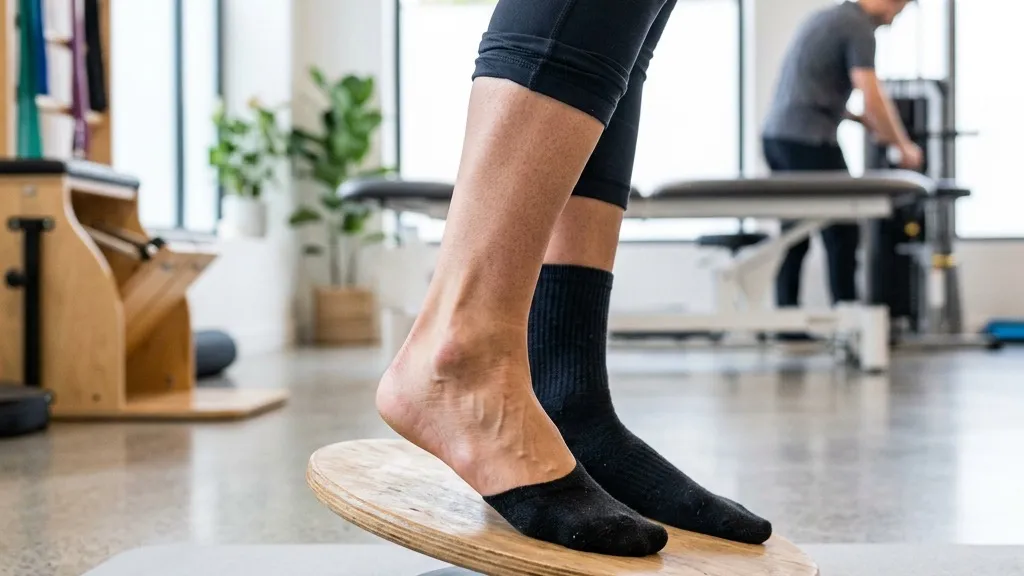
2Dynamic Wobble Board Tilting (Controlled Motion) Place your bare foot squarely in the center of a wooden wobble board. Slowly and with absolute control, tilt the board forward to touch the edge to the floor, then backward, then side-to-side. Complete 20 controlled "around-the-clock" circles. This builds dynamic strength in the peroneal muscles, which actively resist ankle rolling.
-
3Y-Balance Reach Drills (Functional Range) Balance on your injured leg. With your opposite foot, reach forward as far as possible, lightly tapping the floor, then return to center. Repeat this by reaching backward-left and backward-right in a 'Y' pattern. Perform 3 sets of 6 circuits. This dynamically integrates your hip stability and knee tracking with your ankle control.
Rebuild Your Connection to the Ground
A healed ankle ligament provides the scaffold, but a rewired nervous system provides the protection. By transitioning from passive resting to active proprioceptive training, you stop hoping your ankle won't roll and start ensuring it has the dynamic capability to protect itself. Are you ready to restore the electrical connection to your feet and step onto the field with absolute confidence today?
Irushi Abeywardhana
Senior Physiotherapist & Founder of Physio Pulse. Senior Clinical Physiotherapist passionate about blending advanced movement science with functional resilience.
Medical Disclaimer
The information provided by AyurPhysio is for general educational and informational purposes only. It is not intended as a substitute for professional medical advice, diagnosis, or treatment. Always seek the advice of your physician or other qualified health providers with any questions you may have regarding a medical condition. Never disregard professional medical advice or delay in seeking it because of something you have read on this website.
Related Healing Guides
View All Guides →
Spinal Stenosis: Flexion-Based Rehab Protocols for Pain-Free Walking

Pelvic Organ Prolapse: Pelvic Floor Stabilization and Safe Lift Mechanics