Pelvic Tilting Exercises for Anterior Pelvic Tilt Correction
"Anterior pelvic tilt is not a flexibility problem. It is a coordination problem — a failure of timing between the muscles that pull the pelvis and the muscles that anchor it. Fix the coordination first, and the flexibility will follow."
You've been stretching your hip flexors every morning for six months. You've added glute bridges to every workout. And yet you still stand in front of the mirror with a lower back that curves like an overripe banana and a stomach that protrudes with absolutely no anatomical justification.
The fault is not your effort — it's the strategy. The conventional approach to anterior pelvic tilt correction treats the pelvis as a simple two-joint hinge. In reality, it is a dynamic, three-dimensional ring governed by ten muscle groups simultaneously. Treating it with a single stretch is like trying to fix a misaligned car wheel by polishing the hood.
The Real Mechanics of Anterior Pelvic Tilt
Anterior pelvic tilt (APT) occurs when the front of the pelvis drops downward while the sacrum rises. Think of your pelvis as a bucket of water: APT tips the bucket forward, spilling its contents — and your lower back absorbs every drop of that misaligned force.
The clinical threshold for significant APT is a pelvic inclination angle exceeding 13 degrees in women and 10 degrees in men. At these angles, lumbar disc compressive forces increase by up to 35%, and the posterior facet joints of the lumbar spine absorb chronic loads they were never designed for.
- 1Overactive: Iliopsoas & Rectus FemorisThese hip flexors originate on the lumbar spine. Sitting 8+ hours chronically shortens them, pulling the front pelvis downward with relentless mechanical force.
- 2Overactive: Thoracolumbar Erector SpinaeLower back extensors amplify the lumbar curve by pulling the spine into hyperextension — acting as the rear anchor of the tilt.
- 3Inhibited: Gluteus MaximusThe primary posterior pelvic tilter. Chronic sitting causes "gluteal amnesia," leaving hip flexors unchecked and the tilt uncorrected.
- 4Inhibited: Rectus Abdominis & ObliquesThese abdominals pull the front pelvis upward. Their weakness removes the anterior anchor, completing the dysfunctional loop.
The Clinical Opinion: Stop Stretching Your Hip Flexors First
"The single biggest mistake in APT rehab is leading with passive hip flexor stretching. Your hip flexors are tight as a protective response to an unstable lumbar spine. Stretch them before your core can stabilize, and your nervous system will re-tighten them within twenty minutes. You must earn the mobility by building the stability first."
The Correct Pelvic Tilting Exercise Protocol
The pelvic tilting exercise is often taught passively — just rocking the pelvis. The key is deliberate neuromuscular activation, recruiting the right muscles in the right sequence to reprogram your body's control system.
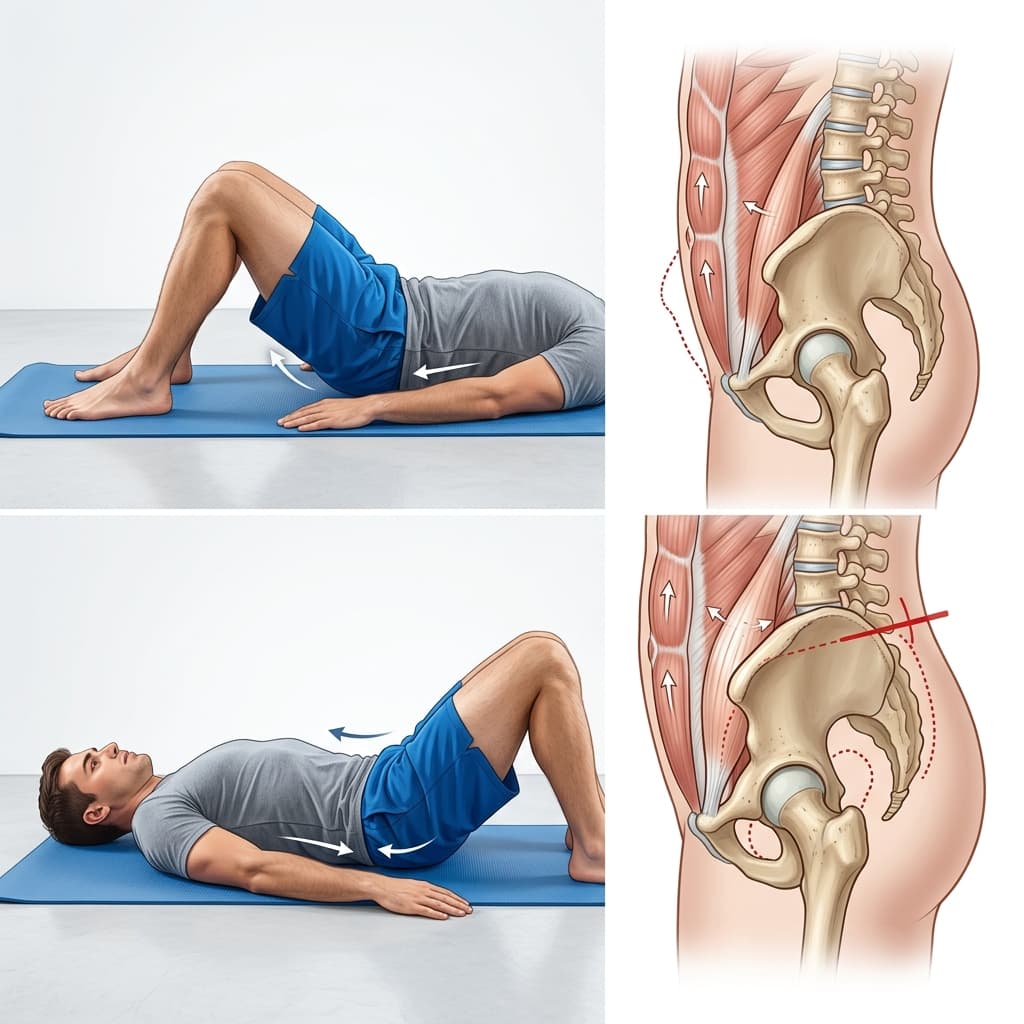
- 1Supine Posterior Pelvic Tilt with TVA ActivationLie on your back with knees bent. Draw your lower abdomen gently inward (transversus abdominis). Then flatten your lower back against the floor by contracting your abdominals and glutes simultaneously. Hold 5 seconds. Repeat 15 reps, 3 sets.
- 2Standing Wall Pelvic TiltStand with back flat against a wall. Eliminate the gap between your lumbar spine and the wall by posteriorly rotating your pelvis. Maintain 10 seconds. This trains the correction in the exact position it must hold throughout your day.
- 3Dead Bug with Posterior Pelvic Tilt MaintenanceThe gold-standard progression. In the supine position, maintain a flat back while alternately extending opposite arm and leg. This trains anti-extension core control under real dynamic load — exactly what your spine needs during walking and lifting.
Phase 2: The Hip Flexor Stretch (Done Correctly)
Only after two weeks of active stabilization is it appropriate to introduce stretching. The kneeling hip flexor stretch with a posterior pelvic tilt bias — squeezing the glute of the back leg during the stretch — is dramatically more effective than a generic lunge stretch. It lengthens the iliopsoas while the pelvis is held in its corrected position.
The Patient: Marcus, a 31-year-old software engineer with 18 months of chronic lower back tightness and visibly exaggerated lumbar lordosis, sitting over 10 hours daily.
The Mistake: He had been performing aggressive hip flexor stretches daily from a YouTube routine for four months with zero improvement.
The Solution: A 6-week protocol: TVA activation, dead bug progressions, and glute bridges before introducing any stretching. His pelvic inclination angle reduced from 16° to 9°.
The Outcome: 85% reduction in lower back tightness within 6 weeks, with zero pain during his entire workday for the first time in over a year.
Integrating the Correction Into Daily Life
The real test of correction is what happens during walking, standing in a queue, and sitting at your desk — not on the exercise mat. A simple "pelvic check" every time you stand from a chair does more for long-term correction than an entire set of glute bridges. Before your first step, fire your glutes and posteriorly tilt your pelvis for two seconds. This one micro-habit, done consistently, reprograms your resting posture faster than any passive stretch.
For complementary spinal alignment work, explore our guide on thoracic mobility exercises and our deep dive into core stability for lower back injury prevention. If your APT is combined with sciatic symptoms, our clinical breakdown of sciatica vs. piriformis syndrome is your essential next read.
Featured image: Clinical composite illustration of pelvic tilting exercise and pelvic anatomy. Created for AyurPhysio editorial use.
Irushi Abeywardhana
Senior Physiotherapist & Founder of Physio Pulse. Senior Clinical Physiotherapist passionate about blending advanced movement science with functional resilience.
Medical Disclaimer
The information provided by AyurPhysio is for general educational and informational purposes only. It is not intended as a substitute for professional medical advice, diagnosis, or treatment. Always seek the advice of your physician or other qualified health providers with any questions you may have regarding a medical condition. Never disregard professional medical advice or delay in seeking it because of something you have read on this website.
Related Healing Guides
View All Guides →
Spinal Stenosis: Flexion-Based Rehab Protocols for Pain-Free Walking
Pelvic Organ Prolapse: Pelvic Floor Stabilization and Safe Lift Mechanics