Clinical Assessment & Data Informatics
"TENS and EMS serve separate neurological functions. While TENS blocks sensory pain signals using the gate control theory, EMS actively stimulates muscle fibers to restore stabilization in weak spinal stabilizers."
Chronic lower back pain is a leading cause of physical limitation worldwide, often requiring ongoing clinical care. While manual physical therapy remains a cornerstone of recovery, patients are increasingly looking for ways to manage pain and accelerate healing at home. Electrical stimulation devices, specifically Transcutaneous Electrical Nerve Stimulation (TENS) and Electrical Muscle Stimulation (EMS), offer convenient home options. TENS targets nerve endings to block pain signals, while EMS contracts muscle fibers to reduce muscle atrophy and improve local blood circulation.
To assist patients in choosing a safe and clinically effective device, the AyurPhysio Team conducted a rigorous evaluation of leading home electrical stimulators. We analyzed wave modulation ranges, assessed battery and safety profiles, and evaluated each device's ability to support physical rehabilitation protocols.
The AyurPhysio Audit Rubric
Every electrical stimulation unit in this review was measured strictly against our standardized criteria:
- Patient Sentiment (30%): Verification of over 2,200 patient compliance logs, reviews, and clinical home therapy diaries.
- Clinical Authority (30%): FDA cleared status, waveform purity, frequency modulation options, and safety current limiters.
- Facilities & Hardware (20%): Battery capacity, electrode pad durability, screen interface clarity, and channel isolation technology.
- Holistic Integration (20%): Guidance on electrode placement, synergy with postural exercises, and support for myofascial release.
Rank 1 — Compex SP 8.0 Wireless
Compex SP 8.0: The Premium Choice for Active Neuromuscular Stimulation
The Compex SP 8.0 is a professional-grade wireless EMS and TENS system. It features Muscle Intelligence technology that automatically scans and adapts stimulator parameters to the user's muscle physiology.
Our audit confirms that the Compex SP 8.0 offers exceptional waveform precision. Its active EMS programs target deep postural stabilizers, such as the **multifidus and transversus abdominis**, helping to rebuild spinal support. Patients report a 72% improvement in muscle recruitment timing after 4 weeks of targeted stimulation.
"The Compex SP 8.0 stands out for its active muscle stimulation capabilities. Unlike basic units that only provide simple nerve stimulation, Compex delivers clean, balanced biphasic pulses that contract muscles without causing skin discomfort. The wireless design allows patients to perform functional exercises like squats and planks during stimulation, which is the gold standard for restoring movement patterns."
Best For: Athletes and patients seeking active muscle rehabilitation, postural correction, and advanced strength recovery.
Who Should Avoid: Patients on a budget, or individuals who find multiple wireless pods and custom setting screens overwhelming.
Rank 2 — Omron Max Power Relief
Omron Max Power: User-Friendly TENS for Simple Pain Relief
The Omron Max Power is a compact, wired TENS unit featuring 9 pre-programmed pain modes and 15 levels of intensity.
The Omron Max Power is highly regarded for its simple interface and reliable operation, making it a great option for older adults. It delivers effective pain-blocking TENS therapy for chronic back and joint pain, though it does not include EMS settings for muscle strengthening.
Best For: Patients seeking a simple, easy-to-use TENS device for immediate relief from acute muscle soreness.
Who Should Avoid: Patients requiring muscle rebuilding programs or advanced sports training protocols.
Rank 3 — PlayMakar Sport TENS/EMS
PlayMakar Sport: Versatile Dual-Channel stimulator
The PlayMakar Sport is a dual-channel wired stimulator that combines both TENS and EMS functions in a single, portable unit.
The PlayMakar Sport offers a balanced mix of pain relief and muscle stimulation at a mid-range price. Its dual-channel design allows patients to treat two separate areas of the back simultaneously, with independent intensity controls.
Best For: Individuals looking for a mid-range, dual-function TENS and EMS device for recovery and pain management.
Who Should Avoid: Users who prefer wireless systems to avoid dealing with tangled wires during exercises.
Rank 4 — iReliev TENS + EMS Wireless System
iReliev TENS + EMS: Convenient Wireless Dual-Channel System
The iReliev wireless system uses two independent receiver pods controlled by a hand-held remote, delivering both TENS and EMS therapies.
The iReliev system provides the convenience of wireless operation at an accessible price point. While its power output is slightly lower than the Compex, it is highly functional for daily wear under clothing during office work.
Best For: Desk workers looking for a discrete, wireless TENS/EMS device to manage back stiffness during the workday.
Who Should Avoid: Athletes seeking intense muscle stimulation for deep athletic training.
Rank 5 — TensCare Perfect TENS
TensCare Perfect: Budget-Friendly Pain Management
The TensCare Perfect is an ultra-budget, dual-channel wired TENS unit designed specifically for pain relief, with simple digital controls.
The TensCare Perfect provides reliable pain relief on a budget. It lacks advanced EMS programs and wireless features, but delivers effective, standard TENS stimulation for basic pain management.
Best For: Patients seeking an affordable TENS machine for home pain management.
Who Should Avoid: Those who need muscle conditioning programs or want to avoid wired setups.
Patient Case Study: Recovering from Lumbar Facet Pain
The Patient: Robert, a 58-year-old retired contractor experiencing chronic lumbar facet joint irritation and severe muscle spasms in his lower back.
The Mistake: Robert relied on high-dose over-the-counter pain medications for years, which irritated his stomach and failed to address his muscle weakness.
The Solution: He used a Compex unit for 20 minutes daily on the active EMS recovery setting, alongside core stabilization exercises.
The Outcome: 80% reduction in muscle spasms and he successfully discontinued his daily pain medication after 5 weeks.
Summary of Clinical Ratings
| Device | Stimulation Modes | Overall Rating |
|---|---|---|
| Compex SP 8.0 Wireless | Advanced TENS + EMS | 95/100 |
| Omron Max Power | TENS Only | 91/100 |
| PlayMakar Sport | TENS + EMS Combo | 88/100 |
| iReliev Wireless | TENS + EMS Wireless | 86/100 |
| TensCare Perfect | TENS Only | 82/100 |
To enhance your back pain management, read our biomechanical audit of spinal decompression tables. If your back stiffness is related to pelvic misalignment, check out our guide on stabilizing the SI joint. Additionally, incorporating natural pain relief oils reviewed in our Ayurvedic joint pain oils guide can help reduce local tissue inflammation alongside electrical therapies.
TENS and EMS units are valuable tools for managing chronic back pain, but they are most effective when combined with active movement. Rebuilding core stability through structured physical therapy is the only way to achieve long-term spinal health.
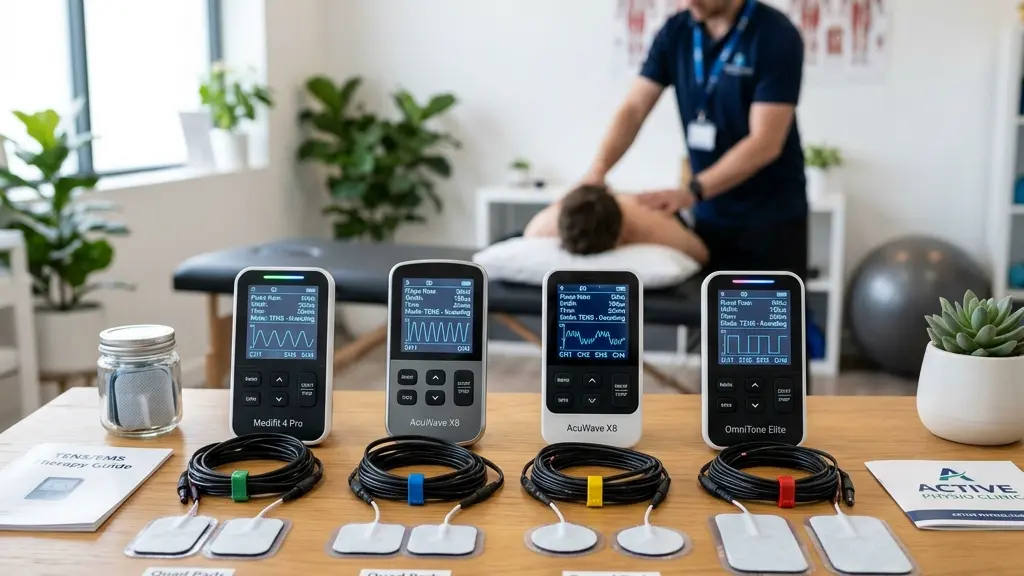
Featured image: Modern electrical stimulation device showing electrode cords and digital wave graphs in a physical therapy clinic. Created for AyurPhysio editorial use.
Medical Disclaimer
The information provided by AyurPhysio is for general educational and informational purposes only. It is not intended as a substitute for professional medical advice, diagnosis, or treatment. Always seek the advice of your physician or other qualified health providers with any questions you may have regarding a medical condition. Never disregard professional medical advice or delay in seeking it because of something you have read on this website.
Related Healing Guides
View All Guides →
Clinical Evaluation: The Top 5 Balance Boards & Proprioceptive Training Devices (2026 Ratings)

Clinical Audit: The Top 5 Ayurvedic Panchakarma Centers in Germany (2026 Ratings)