Sacroiliac (SI) Joint Dysfunction: Stabilizing the Pelvic Ring
"Hypermobility in a weight-bearing joint is a cry for stability. When the sacroiliac joint loses its rigid ligamentous lock, stretching is no longer therapy—it is self-sabotage."
If your lower back feels like a loose car bumper rattling over potholes after a long drive, you might be dealing with more than simple muscle stiffness. Many individuals treat this deep, one-sided lower back ache by aggressively stretching their glutes and rotating their spine in search of a loud pop. Yet, that fleeting relief is almost immediately replaced by a dull, throbbing ache that spreads into the hip.
The sacroiliac joint is like the structural keystone of a Roman arch—if it slips, the entire pelvic bridge crumbles. Sacroiliac (SI) joint dysfunction occurs when the joint that connects your sacrum to your pelvic bones becomes either too loose (hypermobile) or too locked (hypomobile). In the vast majority of chronic cases, hypermobility is the true culprit, leaving the surrounding ligaments vulnerable to micro-tears and chronic inflammatory cycles.
To achieve lasting unilateral lower back pain relief, we must shift our clinical focus from stretching the lower back to stabilizing the pelvic ring. In this guide, we will break down the biomechanics of SI joint dysfunction and outline a high-precision stabilization protocol designed to clamp the joint in place.
The Biomechanics of Pelvic Ring Stability
Your pelvic ring is the heavy-duty transmission system of your body. It is responsible for transferring 100% of your upper body weight downward into your lower limbs while absorbing the ground reaction forces pushed upward with every step you take.
The SI joint only moves 2 to 4 millimeters and rotates less than 2 degrees under normal load. Unlike your knee or hip, it is not designed for movement; it is engineered for absolute force closure. Up to 30% of all chronic lower back pain cases are actually driven by undiagnosed SI joint dysfunction, where loose ligaments allow the sacrum to shear against the ilium.
When these ligaments lose their tautness, the surrounding muscle systems go into a state of panic. A pelvic shear force spike of just 5% can trigger a cascade of protective spasms in the piriformis, gluteus medius, and lower lumbar extensors. This is why SI joint dysfunction is so frequently misdiagnosed as lumbar disc herniations or muscle strains.
- 1The Transversus Abdominis (TVA)This deep abdominal muscle acts as a wide, natural weight-lifting belt. Squeezing your stomach inward activates the TVA, which directly compresses the front of the pelvic ring.
- 2The Gluteus MaximusAs the largest posterior muscle, its vertical and diagonal fibers run perpendicular to the SI joint line, acting as a muscular clamp across the back of the sacrum.
- 3The Latissimus DorsiThrough the thick thoracolumbar fascia, the opposite latissimus dorsi and gluteus maximus form a diagonal sling that compresses the pelvic ring during walking and running.
- 4The Adductor GroupYour inner thigh muscles pull upward on the pubic symphysis, stabilizing the front of the pelvic ring and balancing the lateral pull of the glutes.
The Clinical Opinion: Stop Stretching a Loose Joint
"The single most common mistake in managing SI joint pain is performing aggressive, twisting lower back stretches. If your SI joint is hypermobile, stretching it feels good temporarily because it numbs the local sensory nerves, but it further stretches the already loose ligaments. You must stop stretching and instead build dynamic compression. The solution to hypermobility is rigid muscle clamping."
The Pelvic Ring Stabilization Protocol
This progressive protocol bypasses general hip stretches and focuses exclusively on building coordinate muscle contraction to restore force closure across the pelvic ring.
- 1Isometric Adductor Squeezes with TVA LockLie on your back with knees bent and feet flat on the floor. Place a firm ball or foam roller between your knees. Gently draw your lower abdomen inward, then squeeze the ball with 50% of your maximum effort. Hold for 10 seconds. Repeat 10 times, 3 sets. This recruits the adductors and deep abdominals to compress the pelvic ring from the front.
- 2Supine Glute Bridges with Loop Band TensionPlace a resistance loop band just above your knees. Lie on your back, push your knees outward against the band to activate the gluteus medius, and squeeze your glutes to lift your hips. Maintain a completely flat, neutral lower back throughout. Hold for 5 seconds at the top. Perform 12 repetitions, 3 sets. This strengthens the posterior clamping sling of the SI joint.
- 3Single-Leg Wall Press (Anti-Shear Drill)Stand parallel to a wall, about 6 inches away. Lift the knee closest to the wall to a 90-degree angle, and press the side of your knee firmly into the wall. Squeeze the glute of your standing leg to maintain a completely level pelvis. Hold for 15 seconds. Repeat 5 times on each side, 3 sets. This trains your hip stabilizers to prevent horizontal shear during single-leg loading.
Managing Acute SI Joint Inflammation
During an acute flare-up of pelvic girdle pain treatment, the joint is physically shifting, which inflames the highly sensitive joint capsule. Utilizing a temporary sacroiliac belt (SI belt) positioned snugly between the anterior superior iliac spines (ASIS) and the greater trochanters can provide immediate mechanical support. This artificial compression stabilizes the bone interfaces, allowing the microscopic tears in the sacral ligaments to heal without constant disruption from daily walking.
The Patient: Clara, a 36-year-old amateur runner who experienced sharp, stabbing pain on the right side of her lower back and glutes, which spiked immediately after her weekly 10k runs.
The Mistake: Clara believed she had tight glutes, so she spent 30 minutes daily performing aggressive pigeon stretches and deep spinal twists, which only made the sharp pain worse.
The Solution: Clara discontinued all passive hip and spinal stretching. She began a 4-week protocol of isometric adductor squeezes, banded glute bridges, and wore a snug SI belt during daily household activities.
The Outcome: Clara experienced a **90% reduction in stabbing pelvic pain within 4 weeks** and successfully returned to running with zero post-run pelvic achiness.
Integrating Pelvic Integrity Into Your Movement Patterns
Building pelvic ring stability requires mindful coordination during your daily activities. Every time you roll over in bed, step out of a car, or stand up from a chair, your pelvic stabilizers must fire before your limbs move. Keeping your knees together when exiting a vehicle, for example, avoids the unilateral shearing forces that frequently provoke SI joint irritation.
To further optimize your lower limb biomechanics, explore our guide on anterior pelvic tilt correction exercises and our core strengthening principles in core stability exercises. If you are struggling to distinguish between pelvic and sciatic nerve symptoms, our complete diagnostic breakdown of sciatica vs. piriformis syndrome is your next essential clinical resource.
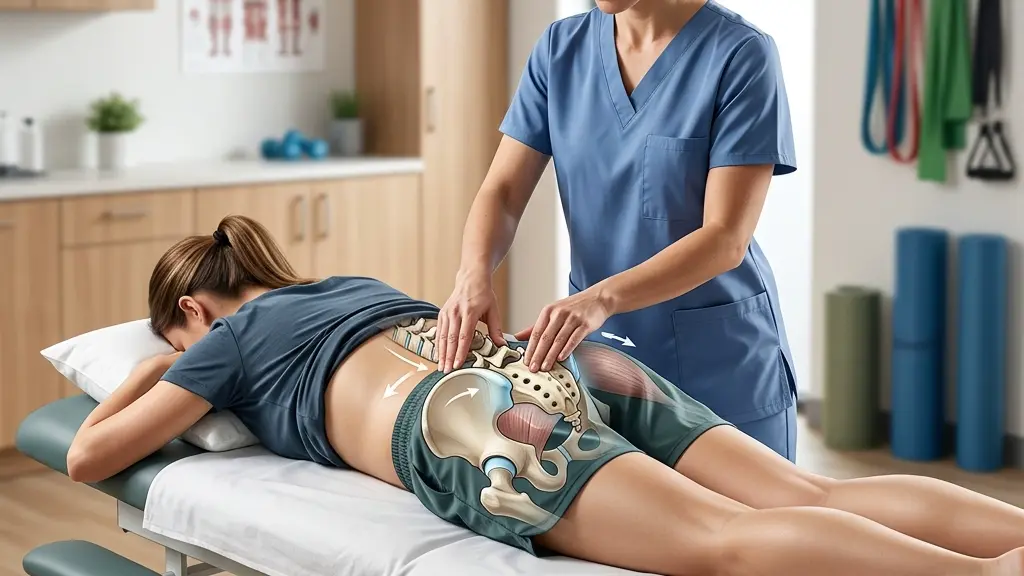
Featured image: High-resolution clinical illustration demonstrating sacroiliac joint pelvic ring stabilization assessment. Created for AyurPhysio editorial use.
Irushi Abeywardhana
Senior Physiotherapist & Founder of Physio Pulse. Senior Clinical Physiotherapist passionate about blending advanced movement science with functional resilience.
Medical Disclaimer
The information provided by AyurPhysio is for general educational and informational purposes only. It is not intended as a substitute for professional medical advice, diagnosis, or treatment. Always seek the advice of your physician or other qualified health providers with any questions you may have regarding a medical condition. Never disregard professional medical advice or delay in seeking it because of something you have read on this website.
Related Healing Guides
View All Guides →
Spinal Stenosis: Flexion-Based Rehab Protocols for Pain-Free Walking
Pelvic Organ Prolapse: Pelvic Floor Stabilization and Safe Lift Mechanics