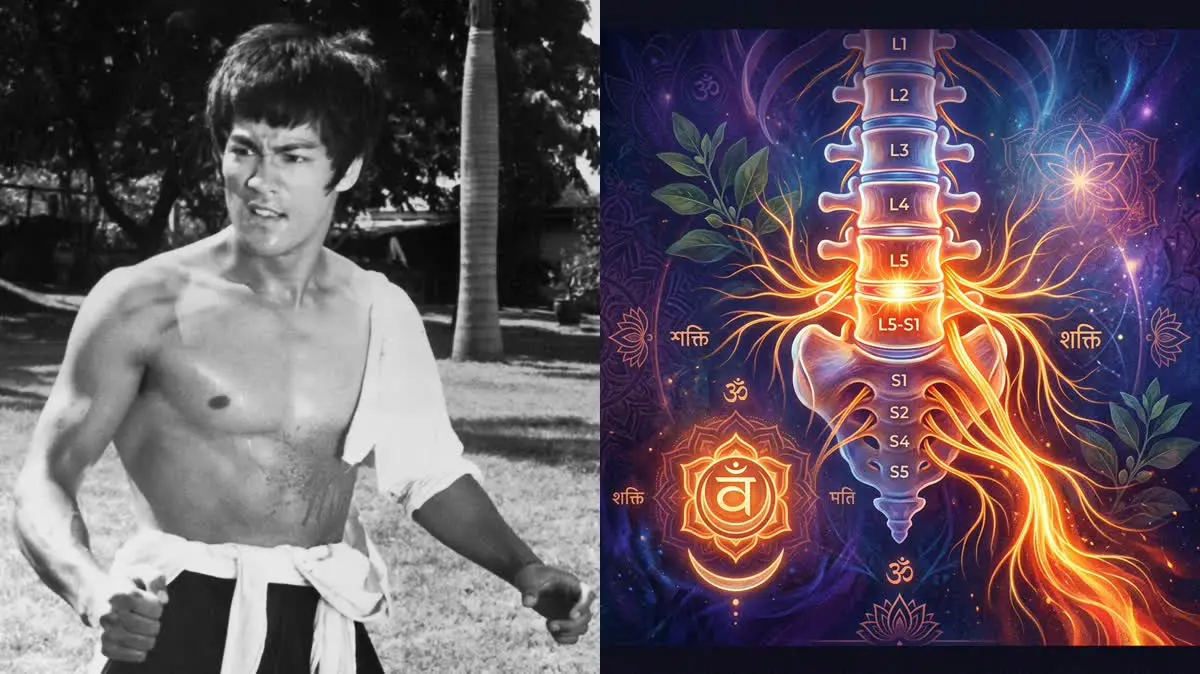
"Performing a heavy 'Good Morning' lift without perfect core bracing is the biomechanical equivalent of trying to bend a crowbar across a delicate glass fulcrum. The spine was never designed to handle maximum shear force in pure flexion."
Bruce Lee is universally celebrated as a paragon of human physical perfection, a man whose speed and power defied physics. Yet, one of the most defining moments of his life was not a fight, but a catastrophic failure of spinal biomechanics in his own garage in 1970.
While performing an exercise known as the "Good Morning" with 135 pounds (roughly his own body weight) across his shoulders, Lee heard a loud pop followed by excruciating, paralyzing pain. Doctors told him he had sustained severe damage to his sacral nerve and would likely never practice martial arts again.
To understand how the fittest man on earth broke his own back, we must examine the unforgiving physics of the lumbar spine. This historical injury serves as a masterclass in the dangers of spinal shear force and the incredible neuroplastic resilience of the human body.
The Anatomy of the "Good Morning" Disaster
The "Good Morning" exercise involves placing a barbell across the shoulders and hinging forward at the hips while keeping the legs relatively straight. When performed correctly, it strengthens the posterior chain (hamstrings and glutes). However, it places the spine in an extremely vulnerable position.
As you lean forward, gravity pulls the barbell downward, creating massive leverage against the lower back. The L5-S1 junction (where the lowest lumbar vertebra meets the sacrum) acts as the fulcrum.
But most people miss the hidden catalyst for this specific trauma: if the core muscles relax for even a fraction of a second, the spine shifts from a stable, neutral arch into flexion (rounding). In this rounded position, the compressive force shifts dangerously to the front of the intervertebral discs, violently squeezing the nucleus pulposus backward directly into the sacral nerve roots.
My strong clinical opinion is that the "Good Morning" exercise is fundamentally obsolete for 99% of athletes. The risk-to-reward ratio is abysmal. You are placing maximum load at the exact point of maximum mechanical disadvantage for the lumbar spine.
If an athlete wants to build bulletproof hamstrings and erector spinae, the Romanian Deadlift (RDL) is vastly superior. The RDL keeps the weight below the center of mass, drastically reducing the catastrophic shear forces that destroyed Bruce Lee's L5-S1 disc. We must choose exercises that respect the anatomical limits of the spine.
By the Numbers: Spinal Shear Force
The physics of spinal loading explain exactly why this specific exercise is so hazardous.
- When bending forward at a 90-degree angle with 135 lbs on the shoulders, the compressive force on the L5-S1 disc exceeds 1,500 lbs due to the long lever arm of the torso.
- A healthy lumbar disc can withstand significant vertical compression, but it fails rapidly under shear force (horizontal sliding). The Good Morning creates up to 4x more shear force than a standard deadlift.
- Clinical recovery from a severe sacral nerve crush injury (axonotmesis) takes nerves regenerating at a rate of roughly 1 millimeter per day, requiring months or years for full sensory and motor restoration.
The Long Road to Neuro-Recovery
Following the injury, Lee was confined to bed rest for six months—a treatment protocol that was standard at the time, though modern physiotherapy highly discourages prolonged immobility. Despite the grim prognosis, Lee systematically rebuilt his body.
Modern rehabilitation for this type of severe disc herniation and nerve root compression involves precise directional loading. Through exercises like McKenzie extensions, the goal is to centralize the displaced disc material away from the nerve. Slowly, the athlete must rebuild deep core stiffness using anti-rotation and anti-flexion drills (like the McGill Big 3) to create a muscular corset around the damaged joint.
The Patient: David, a 28-year-old powerlifter, suffered a massive L5-S1 disc extrusion while performing heavy Good Mornings. He lost sensation in his left foot and developed severe, burning sciatica.
The Mistake: David attempted to "stretch out" the pain by aggressively touching his toes, which only forced the disc further into the sacral nerve root, worsening his numbness.
The Solution: We banned all spinal flexion. We implemented a rigorous protocol of prone press-ups (extensions) and nerve flossing to gently glide the sciatic nerve through the inflamed tissue without stretching it.
The Outcome: Over 8 months, the disc naturally reabsorbed. David regained full motor control of his foot and returned to heavy lifting, completely replacing Good Mornings with safer hip-hinge variations.
Respecting the Biological Limits
Bruce Lee's tragic injury is a stark reminder that sheer willpower cannot override biomechanics. True strength training requires respecting the architectural limits of the human body and selecting movements that build resilience without inviting catastrophic failure.
If you are suffering from radiating back pain, learn how to safely manage your symptoms with our complete guide to McKenzie Method Exercises.
Featured image attribution: Portrait sourced from Wikimedia Commons, licensed under Public Domain. Modified by cropping and compositing.
Dr. Dhanushika Dilshani
Expert Ayurvedic Wellness Doctor. Specialized in modern holistic wellness, optimizing dermal resilience, cosmetic radiance, and systematic diagnosis driven by traditional and evidence-based medical logic.
Medical Disclaimer
The information provided by AyurPhysio is for general educational and informational purposes only. It is not intended as a substitute for professional medical advice, diagnosis, or treatment. Always seek the advice of your physician or other qualified health providers with any questions you may have regarding a medical condition. Never disregard professional medical advice or delay in seeking it because of something you have read on this website.
Related Healing Guides
View All Guides →
Christian Eriksen's Cardiac Arrest and ICD Return to Play: The Biomechanics of Cardiorespiratory Reconditioning and Athletic Heart Rehabilitation

Selena Gomez's Lupus and Kidney Transplant: An Integrative Ayurvedic Approach to Systemic Autoimmunity, Dushi Visha, and Ojas Restoration