McKenzie Method Exercises for Herniated Disc: The Complete Self-Treatment Guide
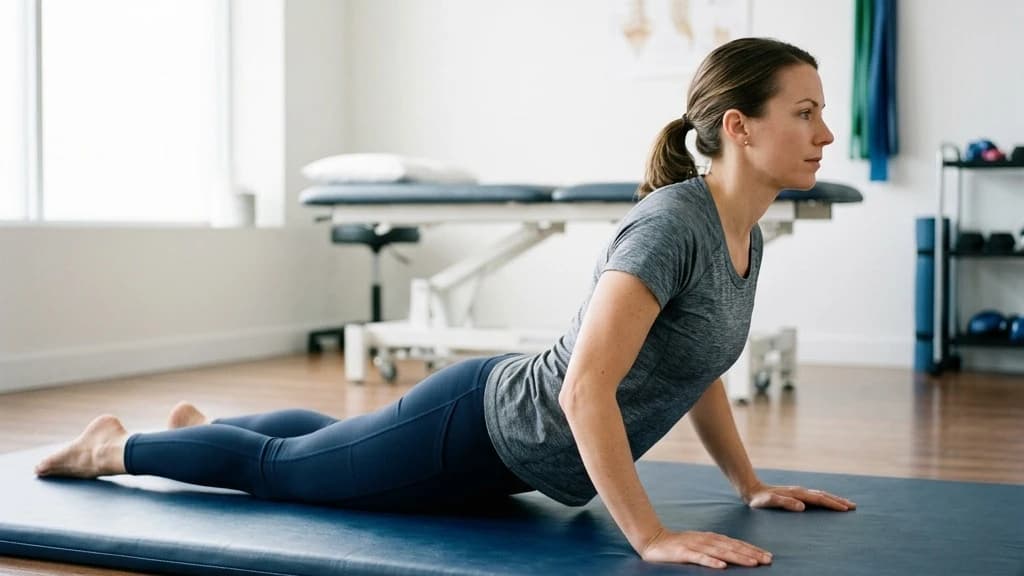
"Treating a herniated disc with random stretching is like squeezing the front of a wet bar of soap and expecting it not to shoot out the back. To truly reverse spinal nerve compression, we must apply precise mechanical force to push the disc back home."
If you are currently suffering from a herniated disc, your life has likely ground to an agonizing halt. Whether it is an electrical jolt shooting down your arm or a relentless ache paralyzing your lower back, every movement feels like navigating an unpredictable minefield. The standard recommendation of popping pain pills and waiting weeks for an MRI often leaves patients feeling utterly helpless.
However, your spine is not a fragile porcelain tower that requires immediate surgical intervention or permanent bed rest. Clinical mechanical therapy offers a powerful path to reclaim control over your movement. By utilizing targeted mckenzie method exercises for herniated disc recovery, you can use your body's own mechanics to decompress trapped nerves safely.
Understanding how to find your "directional preference" is the ultimate secret to achieving lasting lumbar disc herniation relief and escaping the cycle of chronic flare-ups. Let's explore the science of mechanical loading and how you can safely implement these protocols at home.
The Anatomy of Displacement: What is a Herniated Disc?
To understand why directional exercises work, we must first visualize what is actually happening inside your spinal joints. Imagine your intervertebral discs as small, highly resilient jelly donuts sitting between rigid bony vertebrae. The outer wall is composed of tough, fibrous cartilage, while the inner core consists of a gelatinous material.
When a disc herniates, the inner gel breaks through a tear in the outer wall and presses directly onto nearby spinal nerves. This direct pressure and the accompanying chemical inflammation generate the radiating symptoms known as sciatica or radiculopathy. Most people treat this as a chemistry problem, but in reality, it is primarily a structural displacement issue.
Fortunately, medical data provides strong reassurance for sufferers seeking natural healing. Biomechanical research indicates that up to 66% of herniated discs successfully undergo spontaneous reabsorption without any surgical cutting. By applying correct repetitive pressures, we can mechanically assist this natural healing cycle.
My strong clinical opinion is that the standard practice of recommending absolute bed rest for a disc herniation is not only outdated but actively detrimental to recovery. Your spinal discs have very poor direct blood supply; they rely entirely on a process called imbibition, which is the pumping action of movement, to receive nutrients and flush out metabolic waste.
By remaining completely static, you are essentially starving your injured disc and allowing inflammatory toxins to pool around the sensitive nerve roots. Active mechanical loading, done in the correct directional preference, acts as a nutritional pump that accelerates structural tissue repair. We must move to heal.
The Golden Metric of Recovery: Centralization of Pain
Before starting any exercise program, you must understand the foundational rule of the McKenzie Method: the centralization of pain. Centralization occurs when repeated movements cause your radiating limb symptoms to retreat back toward the midline of your spine. Even if the pain temporarily intensifies in your spine as it leaves your foot or hand, this is the single most positive indicator of clinical success.
Conversely, "peripheralization" is when pain travels further down your arm or leg toward your extremities. If a movement causes your calf or foot to go numb, that direction is structurally harmful and must be stopped immediately. Clinical studies show that patients who achieve rapid centralization within their first few assessment sessions have an 80% surgical avoidance rate.
To accurately target this phenomenon, we divide exercises based on the anatomical location of the herniation. While approximately 90% of clinical disc herniations occur in the lumbar spine, addressing the remaining 10% that strike the neck requires specialized cervical disc herniation exercises.
Phase 1: McKenzie Exercises for Lumbar Herniations (Lower Back)
For the vast majority of individuals, lower back herniations bulge toward the posterior or rear side of the disc. Because modern life forces us into endless forward-folding postures, we must combat this by utilizing controlled backward-bending forces to migrate the displaced nucleus pulposus back into the center of the joint.
-
1Prone Lying with Direct Support Lie face down on a firm, supportive surface with your arms comfortably at your sides. Focus entirely on allowing your abdominal muscles and glutes to sag deeply into the floor. Remain in this static, fully relaxed position for 3 to 5 minutes, allowing the natural force of gravity to gently reduce internal disc pressure.
-
2Extension in Lying (Prone Press-Ups) Place your palms flat on the floor beneath your shoulders, mimicking a standard push-up position. Keeping your hips and legs completely relaxed and glued to the ground, use your arm strength to press your upper torso upward. Lock your elbows if pain allows, exhale deeply to let your lower back sag at the top, then lower immediately. Perform 10 to 15 smooth repetitions every two waking hours.
-
3Standing Lumbar Extension Stand upright with your feet spread shoulder-width apart. Place your hands flat against your lower back just above your hips for support. Gently lean backward from the waist, using your hands as a fulcrum, and hold for one second before returning to center. This is an excellent maintenance drill to perform every hour while working at a desk.
If your lower back pain is in the hyper-acute phase where you cannot even lie flat without intense spasms, consider exploring our specialized guide to McKenzie exercises for acute lumbar disc herniation for gentle micro-progressions.
When your lower back feels tight, your immediate lizard-brain instinct is to bend forward to touch your toes or pull your knees into your chest. This is a critical biomechanical trap!
Bending forward increases the internal compressive load on the front of your discs by up to 200% compared to standing. This additional front-side pressure physically forces the herniated jelly further out the back wall, directly crushing the nerve roots. Do not trade temporary muscular stretching sensations for long-term structural damage.
Phase 2: McKenzie Exercises for Cervical Herniations (Neck)
Cervical disc herniations often result from the chronic "tech neck" postures associated with computer and smartphone use. To achieve sciatica pain relief and upper extremity decompression, we must restore the natural lordotic curve of the neck.
-
1Cervical Retraction (The Chin Tuck) Sit upright in a chair with your shoulders relaxed. Look straight ahead and pull your head directly backward, making a prominent "double chin" while keeping your eyes level with the horizon. Hold the end-range tension for 2 seconds, then release. Perform 10 repetitions to pull the cervical vertebrae back into optimal structural alignment.
-
2Retraction with Extension Begin by performing a full cervical retraction. Once your head is pulled fully back, slowly tilt your head backward as if looking up at the ceiling, keeping the retraction active. Return to the retracted starting position, then relax. Repeat 10 times to apply therapeutic compression to the rear aspect of the cervical discs.
The Patient: Alex, a 42-year-old avid cyclist, presented with sharp, burning pain traveling down his left arm to his thumb, alongside a dull ache in his lower lumbar spine. He could not ride his bike for more than 10 minutes without his fingers going completely numb.
The Mistake: Alex assumed he had tight upper traps, so he spent weeks doing aggressive neck circles and pulling his head toward his opposite shoulder, which only aggravated the nerve root further.
The Solution: We introduced hourly chin tucks and standing lumbar extensions to offset the prolonged hunched posture of cycling. We completely eliminated all side-bending stretches.
The Outcome: Within 14 days of consistent mechanical loading, Alex's hand numbness disappeared entirely. By Week 6, his spinal range of motion was fully restored, and he successfully completed a 50-mile charity ride pain-free.
Building Permanent Spinal Resilience
The ultimate goal of the McKenzie system is independence. You do not need to rely on an endless series of passive adjustments to feel whole. By closely monitoring the behavior of your symptoms and applying repetitive directional loading, you become the active mechanic of your own physical health.
For those seeking an integrated, holistic pathway to speed up cellular recovery, combining these mechanical exercises with ancient warm oil therapies can deliver profound relief. Explore the deep nourishing benefits of our Kati Basti warm oil treatment for herniated discs to soothe local tissues while you rebuild your structural alignment.
Are you ready to stop managing symptoms and start curing the root mechanical cause? Start with 10 gentle prone press-ups today and track exactly how far your pain retreats.
Irushi Abeywardhana
Senior Physiotherapist & Founder of Physio Pulse. Senior Clinical Physiotherapist passionate about blending advanced movement science with functional resilience.
Medical Disclaimer
The information provided by AyurPhysio is for general educational and informational purposes only. It is not intended as a substitute for professional medical advice, diagnosis, or treatment. Always seek the advice of your physician or other qualified health providers with any questions you may have regarding a medical condition. Never disregard professional medical advice or delay in seeking it because of something you have read on this website.
Related Healing Guides
View All Guides →
Spinal Stenosis: Flexion-Based Rehab Protocols for Pain-Free Walking
Pelvic Organ Prolapse: Pelvic Floor Stabilization and Safe Lift Mechanics