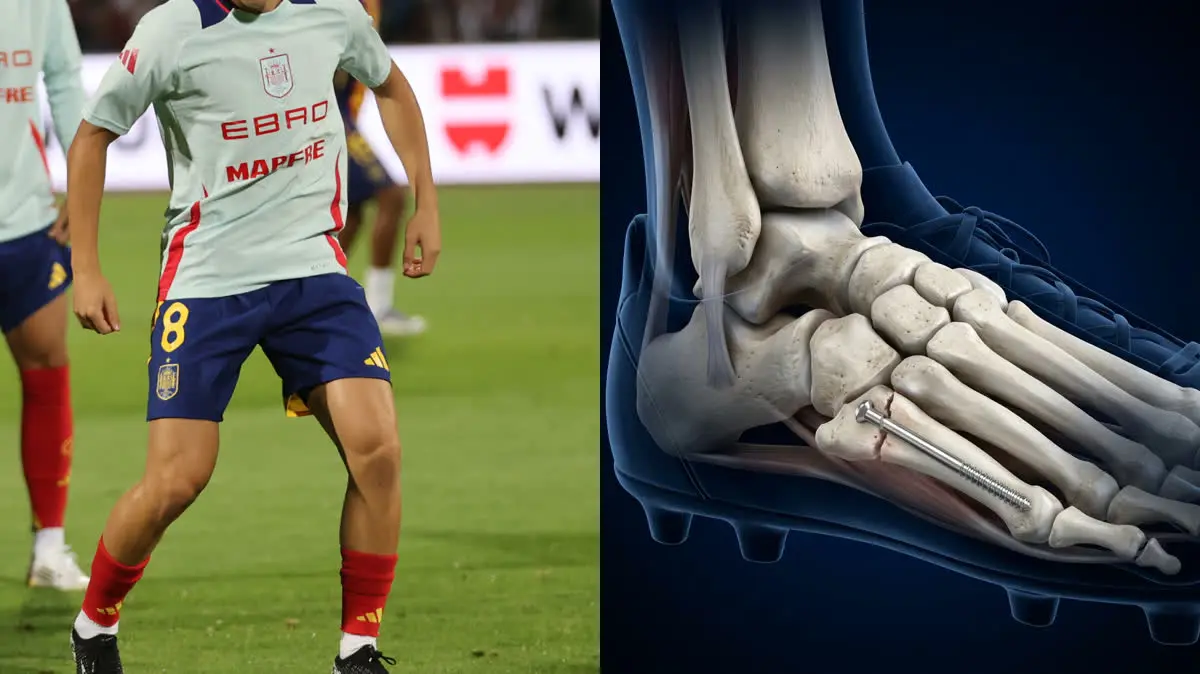
"A 5th metatarsal fracture in an elite winger is never just a bone injury. It is a failure of the foot's lateral column under high-velocity torsional load. Rebuilding it requires absolute precision in both surgical fixation and progressive mechanical reloading."
On May 17, 2026, FC Barcelona and Spain national team winger Fermín López suffered a devastating blow, sustaining a 5th metatarsal fracture during their La Liga match against Real Betis. This injury officially rules him out of the upcoming 2026 FIFA World Cup. Missing a career-defining tournament is a tragedy for any young athlete, but it highlights a recurring nemesis in modern football: the lateral foot fracture.
Fermín's injury is not an isolated occurrence. Football wingers are uniquely susceptible to metatarsal stress fractures due to the repetitive, high-velocity deceleration and cutting movements required by their playstyle. In this clinical reconstruction, we will examine the biomechanics of 5th metatarsal fractures, analyze the debate between surgical screw fixation and conservative casting, and outline the elite return-to-play rehabilitation protocol.
Anatomy of the 5th Metatarsal: Understanding the Zones
The fifth metatarsal is the long bone on the outer edge of the foot, connecting the little toe to the tarsal bones. From a clinical perspective, injuries to this bone are classified into three distinct zones based on blood supply and prognosis:
- Zone 1 (Avulsion Fracture): Occurs at the proximal tuberosity, typically triggered by an acute inversion injury where the peroneus brevis tendon or lateral plantar fascia pulls a fragment of bone away. These heal exceptionally well due to rich blood perfusion.
- Zone 2 (Jones Fracture): Located at the metaphyseal-diaphyseal junction, roughly 1.5 to 2.5 centimeters from the base. This area has a notorious "watershed" blood supply, making it highly prone to delayed healing or non-union.
- Zone 3 (Proximal Diaphyseal Stress Fracture): Located distal to the Jones fracture line, usually occurring as a result of chronic repetitive stress and microtrauma in elite athletes.
Initial medical reports suggest Fermín has suffered a Zone 2/3 injury—a classic sports injury that demands aggressive intervention to ensure complete structural integrity before returning to the pitch.
- Jones fractures account for approximately 25% of all metatarsal fractures in professional athletes.
- Without surgical intervention, Zone 2 Jones fractures carry a non-union rate of up to 44% due to poor local vascularity.
- Primary surgical fixation with an intramedullary screw reduces the non-union rate to less than 5% and slashes recovery times by half.
- The average return-to-play time for professional footballers following screw fixation is 8 to 12 weeks, though premature loading can lead to refracture.
Biomechanical Triggers: The Modern Winger's Cut
Why are modern wingers like Fermín López so vulnerable to this fracture? The answer lies in the physics of change-of-direction movements. When a player cuts sharply to the opposite side, the foot is placed in a position of inversion and plantarflexion. As the player pushes off, the lateral column of the foot absorbs the majority of the shear stress.
Additionally, modern hybrid pitches and ultra-lightweight boots with aggressive stud configurations lock the foot firmly into the ground. When the boot remains anchored while the leg pivots, the torque is transferred directly up the kinetic chain, concentrating shear force at the base of the fifth metatarsal. Over a grueling season, this repetitive microtrauma leads to stress shielding and micro-fractures, eventually culminating in a complete structural failure under acute load.
"In professional football, we almost always opt for primary intramedullary screw fixation for Zone 2 and 3 fractures. While conservative management (casting and non-weight-bearing) is viable for non-athletes, the risk of non-union or refracture in an elite athlete is simply too high. A solid compression screw provides immediate mechanical stability, allows early mobilization, and prevents the muscle wasting and joint stiffness that occurs with prolonged immobilization in a plaster cast."
The Winger's Return-to-Play Rehabilitation Protocol
Recovering from a 5th metatarsal fracture requires a structured, multi-phase rehabilitation plan that prioritizes progressive bone loading while preserving cardiovascular fitness.
- 1Phase 1: Early Mobilization and Cardiovascular Maintenance (Weeks 1–3)Following surgery, the foot is protected in a walking boot. The athlete remains non-weight-bearing on the affected side but immediately begins upper-body conditioning, core work, and single-leg cycling on the unaffected side to prevent cardiovascular deconditioning. Isometric hip and knee exercises are performed daily.
- 2Phase 2: Progressive Loading and Gait Normalization (Weeks 4–6)Once follow-up X-rays confirm early callus formation, partial weight-bearing is initiated in the boot, progressing to full weight-bearing as tolerated. Intrinsic foot muscle strengthening (short-foot exercises, towel curls) is introduced alongside calf raises and balance board training to restore proprioception.
- 3Phase 3: Linear Running and Dynamic Control (Weeks 7–9)The athlete transitions to normal footwear. Alter-G (anti-gravity) treadmill training starts at 50% bodyweight, gradually increasing to full weight-bearing linear running. Eccentric calf exercises and closed-kinetic-chain ankle strengthening build lateral stability.
- 4Phase 4: Sport-Specific Agility and Cutting (Weeks 10–12)Linear running transitions to lateral shuffling, figure-eight runs, and controlled cutting maneuvers. Sport-specific ball drills are introduced on turf. Return to full training is permitted only when radiographic union is complete, the athlete is pain-free, and lateral force-production tests match the uninjured limb.
The Patient: Marcus, a 19-year-old academy winger who sustained a Zone 2 Jones fracture during a tournament.
The Mistake: Marcus chose conservative management initially but suffered a non-union after 8 weeks in a cast. He then underwent surgery, delaying his overall recovery by nearly three months.
The Solution: Following delayed screw fixation, we utilized a progressive rehabilitation protocol incorporating anti-gravity treadmill training and comprehensive hip-stability work to unload the foot.
The Outcome: Marcus returned to competitive play 10 weeks post-surgery, with complete radiographic healing and zero pain during lateral cutting maneuvers.
Connecting the Kinetic Chain: The Ayurvedic Perspective
While Western sports medicine focuses on surgical stability and local tissue loading, traditional healing systems look at the systemic factors that influence bone healing. In Ayurvedic medicine, bone tissue is governed by Asthi Dhatu, which is heavily influenced by Vata dosha. An excess of Vata leads to dryness, brittleness, and delayed bone mineralization.
To optimize healing, athletes can combine advanced surgical rehabilitation with Ayurvedic systemic support. For a comprehensive look at how systemic tissue regeneration can accelerate injury recovery, see our guide on healthy aging and tissue nourishment. Furthermore, understanding the pelvic foundations is key for lower extremity alignment; our analysis of stabilizing the SI joint and pelvic ring offers critical insights. For athletes recovering from other severe lower limb trauma, our reconstruction of Tiger Woods' leg fracture rehabilitation serves as a key comparison.
Fermín López face a challenging recovery period, but with the right surgical and physiotherapeutic support, he is highly likely to make a full recovery. The modern football calendar is demanding, but rushing back from a metatarsal fracture is a risk no elite player should take. The focus must remain on ensuring the bone is fully consolidated, the lateral kinetic chain is restored, and the player is biomechanically prepared to handle the extreme demands of La Liga once more.
Featured image: Clinical side-by-side composite showing Fermín López in action (left) and an anatomical 3D rendering of a 5th metatarsal Jones fracture with compression screw fixation (right). Created for AyurPhysio editorial use. Wikimedia Commons attribution: Fermín López image licensed under CC BY 4.0.
Dr. Dhanushika Dilshani
Expert Ayurvedic Wellness Doctor. Specialized in modern holistic wellness, optimizing dermal resilience, cosmetic radiance, and systematic diagnosis driven by traditional and evidence-based medical logic.
Medical Disclaimer
The information provided by AyurPhysio is for general educational and informational purposes only. It is not intended as a substitute for professional medical advice, diagnosis, or treatment. Always seek the advice of your physician or other qualified health providers with any questions you may have regarding a medical condition. Never disregard professional medical advice or delay in seeking it because of something you have read on this website.
Related Healing Guides
View All Guides →
Christian Eriksen's Cardiac Arrest and ICD Return to Play: The Biomechanics of Cardiorespiratory Reconditioning and Athletic Heart Rehabilitation

Selena Gomez's Lupus and Kidney Transplant: An Integrative Ayurvedic Approach to Systemic Autoimmunity, Dushi Visha, and Ojas Restoration