Medically Reviewed byIrushi Abeywardhana
Lower Back Pain from Sitting Long Hours: The Complete Biomechanical & Ayurvedic Fix
I
Irushi AbeywardhanaAuthor & Expert
Audited OnApril 30, 2026
FormatComparison Directory
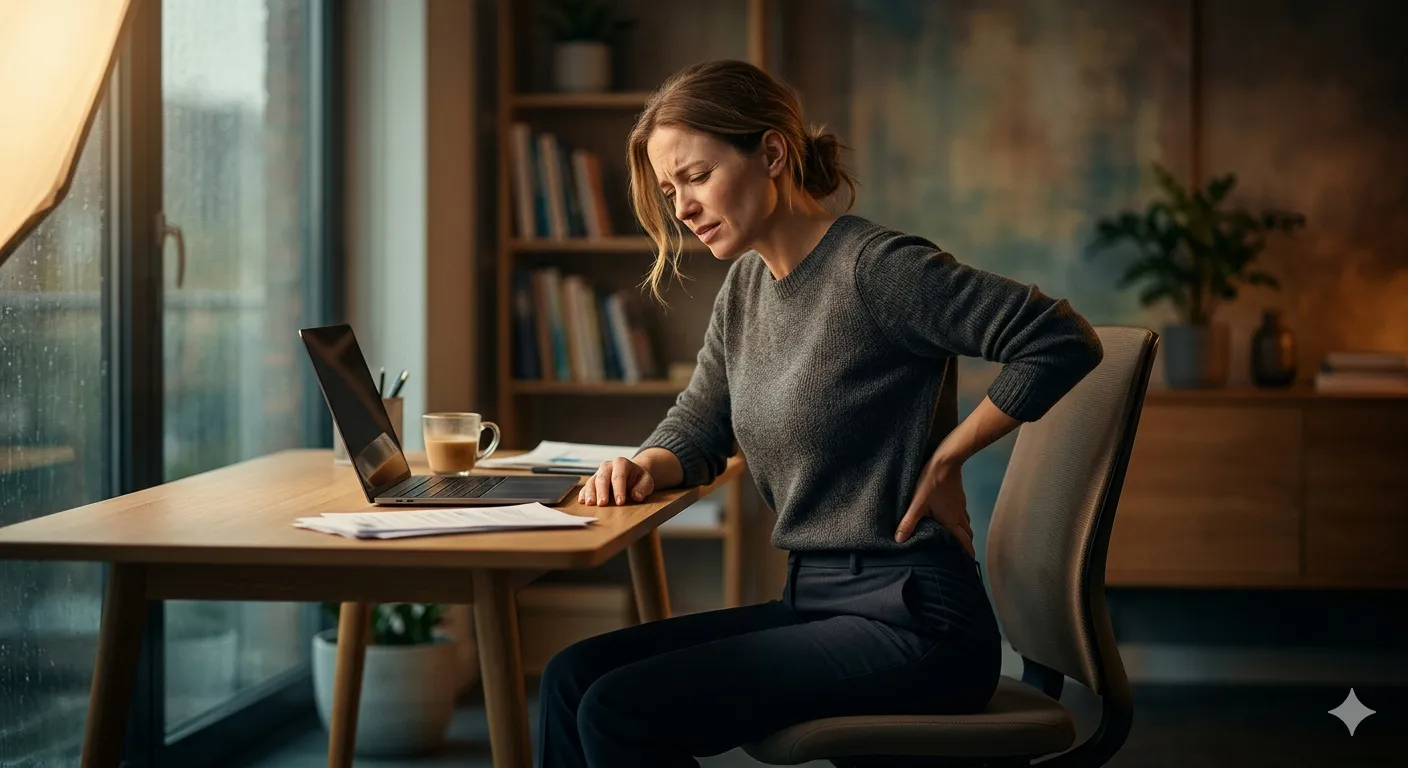
Sitting is often called the "new smoking," and for good reason. As a physiotherapist, one of the most frequent and debilitating complaints I treat is lower back pain caused by prolonged sitting. Whether you are an office worker, a student, or a remote professional tied to a laptop, spending 8 to 12 hours a day in a chair fundamentally alters your biology.
But why does an activity that feels physically "restful" cause so much structural damage? The answer lies at the intersection of modern biomechanics and ancient Ayurvedic understanding of energy flow. Let's break down exactly what happens to your spine when you sit for long hours, and how you can reverse the damage.
## The Biomechanics of Sitting: What Actually Happens?
When you stand, your spine maintains its natural "S" curve, distributing the weight of your upper body evenly across your lumbar discs. However, the moment you sit down—especially if you slouch—the biomechanical load on your lower back changes drastically.
### 1. Lumbar Disc Compression
Sitting increases the pressure on the intervertebral discs in your lower back (lumbar spine) by up to **40% to 90%** compared to standing. If you lean forward to stare at a screen, that pressure spikes even higher. Over time, this constant compression squeezes the water out of the discs, accelerating degeneration and increasing the risk of a herniated or bulging disc.
### 2. The "Short and Tight" Hip Flexor Syndrome
Your hip flexors (primarily the iliopsoas muscle) run from your lower spine to your upper thigh. When you sit, these muscles are maintained in a shortened position. After hours, days, and years of sitting, they become chronically tight. When you finally stand up, these shortened hip flexors yank on your lumbar spine, causing an exaggerated pelvic tilt and sharp lower back pain.
### 3. Gluteal Amnesia (Dead Butt Syndrome)
When you sit on your glutes all day, they undergo a process called "reciprocal inhibition." Because your hip flexors are tight, your brain essentially turns off the opposing muscles—your glutes. Weak glutes mean your lower back muscles have to work overtime to stabilize your pelvis and spine during movement, leading to muscle spasms and fatigue.
## The Ayurvedic Perspective: Vata Stagnation
In Ayurveda, movement is governed by **Vata dosha** (the element of air and space). The primary seat of Vata in the human body is the pelvic and lumbar region—the exact area most affected by sitting.
Prolonged sitting in a rigid posture creates stagnation. The natural flow of Vata is obstructed, leading to a condition called *Vata Prakopa* (aggravated Vata).
- **Dryness and Stiffness:** Aggravated Vata leads to dryness in the bodily tissues. In modern medical terms, this correlates directly with the dehydration of the spinal discs and the loss of synovial fluid in the facet joints.
- **Nerve Irritation:** Vata governs the nervous system. When Vata is compressed in the lumbar region, it often results in radiating pain, tingling, or sciatica-like symptoms down the legs.
## Symptoms You Might Notice
If your back pain is primarily sitting-induced, you will likely experience a specific pattern of symptoms:
- ✦ **A dull, deep ache** localized across the lower back, often wrapping around the top of the pelvis.
- ✦ **Pain that amplifies** after 30-45 minutes of continuous sitting.
- ✦ **Morning stiffness** that makes it difficult to bend over to put on socks or shoes.
- ✦ **"Catching" pain** when transitioning from sitting to standing.
- ✦ **Relief** when walking, lying down, or applying heat.
## Real Patient Case Study
A 32-year-old female software engineer presented to my clinic with 3 months of progressively worsening lower back pain. She worked from home, averaging 10 hours a day on a laptop, often migrating between a dining chair and her sofa.
**Clinical Findings:**
- Loss of the natural lumbar lordosis (flattened lower back curve).
- Severely restricted hip extension due to tight iliopsoas muscles.
- Poor core endurance.
**The Intervention:**
We didn't just focus on the back; we focused on the cause. I prescribed a strict regimen of hip flexor mobilization, gluteal activation exercises, and a mandatory 3-minute standing break every 45 minutes. Within 3 weeks, her pain levels dropped from a 7/10 to a 1/10.
## The Comprehensive Protocol to Fix Sitting Pain
Fixing sitting-induced lower back pain requires a multi-faceted approach. You cannot simply stretch a tight back and expect long-term relief. You must address the environment (ergonomics), the structure (physiotherapy), and the internal environment (Ayurveda).
### Phase 1: Clinical Physiotherapy Exercises
Do these daily to counteract the biomechanical stress of sitting:
1. **The McKenzie Extension (Cobra Pose / Bhujangasana)**
- *Why:* Reverses the forward-flexion of sitting and pushes disc material forward, away from the spinal nerves.
- *How:* Lie on your stomach. Place your hands under your shoulders and gently press your upper body up, keeping your hips on the floor. Hold for 2 seconds. Repeat 10 times.
2. **Kneeling Hip Flexor Stretch**
- *Why:* Lengthens the tight iliopsoas muscle that pulls on the spine.
- *How:* Kneel on one knee (use a pad for comfort) with the other foot flat on the floor in front of you. Squeeze your glutes and gently push your pelvis forward until you feel a stretch in the front of the kneeling leg. Hold for 30 seconds per side.
3. **Glute Bridges**
- *Why:* Wakes up the "amnesic" glute muscles to stabilize the pelvis.
- *How:* Lie on your back with knees bent and feet flat. Squeeze your buttocks and lift your hips until your body forms a straight line from knees to shoulders. Hold for 3 seconds. Repeat 15 times.
### Phase 2: Ergonomic Mastery
Your environment dictates your posture.
- **The 90-90-90 Rule:** Your elbows, hips, and knees should all be at roughly 90-degree angles.
- **Lumbar Support:** Your chair must support the natural inward curve of your lower back. If it doesn't, roll up a towel and place it just above your belt line.
- **Screen Height:** The top third of your monitor should be at eye level. Looking down causes "tech neck," which cascades down to affect the lower back.
- **Feet Flat:** Your feet must be flat on the floor. If they dangle, the weight of your legs will pull your pelvis forward, straining the lumbar spine. Use a footrest if necessary.
### Phase 3: Ayurvedic Vata-Balancing Practices
To address the internal dryness and stagnation caused by prolonged sitting, incorporate these Ayurvedic practices:
- **Kati Basti (Local Oil Pooling):** This is one of the most profound Ayurvedic treatments for lower back pain. Warm, medicated herbal oil (like *Mahanarayan thailam*) is retained over the lumbar spine using a dough ring. This deeply lubricates the dehydrated discs, soothes irritated Vata nerves, and relieves muscle spasms.
- **Daily Abhyanga (Self-Massage):** Before your morning shower, vigorously massage warm sesame oil into your lower back and hips. Sesame oil is the master remedy for Vata dosha, penetrating the skin to nourish the deeper fascial layers.
- **Hydration with Warm Water:** Cold water shocks the system and aggravates Vata. Sip warm water throughout your workday to hydrate the intervertebral discs from the inside out.
## The Ultimate Rule: The Next Posture is the Best Posture
The human body is an exquisite machine designed for movement, not for static loading. There is no such thing as a "perfect" sitting posture that you can hold for 8 hours without consequence.
The ultimate secret to preventing lower back pain from sitting is frequent, dynamic variation. **Set a timer for every 45 minutes.** When it rings, stand up. Walk to the kitchen, do a gentle back extension, or simply shake out your limbs. Break the stagnation.
Pain from sitting is entirely reversible if corrected early. Start small—implement one ergonomic change and one exercise today. Your spine will thank you.
IA
Expert AuthorMedical Fact-Checked
Irushi Abeywardhana
Senior Physiotherapist & Founder of Physio Pulse. Senior Clinical Physiotherapist passionate about blending advanced movement science with functional resilience.
University of Peradeniya
SLMC Registered Physiotherapist
Certified Dry Needling Practitioner
Diploma in Sports Physiotherapy
Medical Disclaimer
The information provided by AyurPhysio is for general educational and informational purposes only. It is not intended as a substitute for professional medical advice, diagnosis, or treatment. Always seek the advice of your physician or other qualified health providers with any questions you may have regarding a medical condition. Never disregard professional medical advice or delay in seeking it because of something you have read on this website.
Trending Guides
1
Clinical Audit: The Best Knee Unloader Braces for Osteoarthritis & Joint Compartment Unloading (2026 Ratings)
10 min read2
Usain Bolt's Elite Sprinting with Scoliosis: A Biomechanical Breakdown of Asymmetrical Kinetic Chain Compensation and Hamstring Strain Risk
8 min read3
Retrolisthesis: Understanding Posterior Vertebral Slippage and Rehab
6 min read4
Quadratus Lumborum Trigger Points: The Secret Driver of Deep Hip Pain
7 min read5
Nerve Flossing Techniques for Sciatic Nerve Mobilization
6 min readWeekly Wellness
Don't miss the next guide
Join 5,000+ subscribers getting holistic health tips every Tuesday.
Tags:back pain office workersback pain relief exercisesback pain treatmentback pain when sittingergonomics for back painhow to fix back painI Sit All Day… Why Does My Back Hurt?lower back pain causeslower back pain from sittingoffice worker back painphysiotherapy back painsitting posture correctionsitting posture tipswhy does my back hurtVata imbalancedesk job wellness
Related Healing Guides
View All Guides →
Physiotherapy
May 29, 20266 min read
Retrolisthesis: Understanding Posterior Vertebral Slippage and Rehab
Understand retrolisthesis (posterior vertebral slippage). Learn why extension stretches can be dangerous and discover safe flexion-biased rehab exercises.
Irushi AbeywardhanaRead Article →
Physiotherapy
May 29, 20267 min read
Quadratus Lumborum Trigger Points: The Secret Driver of Deep Hip Pain
Learn how quadratus lumborum (QL) trigger points refer deep pain to the outer hip. Discover targeted stretches, releases, and pelvic stability drills.
Irushi AbeywardhanaRead Article →
Physiotherapy
May 29, 20266 min read
Nerve Flossing Techniques for Sciatic Nerve Mobilization
Learn how nerve flossing techniques restore mobility to a pinched sciatic nerve. Discover clinical mobilization exercises for fast sciatic pain relief.
Irushi AbeywardhanaRead Article →