Patellar Tendinopathy (Jumper's Knee): Decline Squat Protocols
"If your knee joint feels like a dry leather strap trying to slide over a rusty, high-friction gear, resting it won't fix the mechanics. Treating an overloaded tendon with total rest is like trying to repair a frayed guitar string by simply putting the instrument back in its case."
Few sports injuries are as frustrating as patellar tendinopathy, commonly known as jumper's knee. That sharp, stabbing pain right below your kneecap can make jumping, running, or even walking down a flight of stairs feel like stepping on a nail. Many athletes try to ignore it, while others stop all activity, hoping the pain will fade away on its own.
Unfortunately, tendons are highly specialized tissues that do not respond well to simple rest. When you rest a tendon, it loses its capacity to handle load, making it weaker and more sensitive when you return to sport. To heal, the tendon must be exposed to controlled, progressive mechanical stress that stimulates cell remodeling.
The most effective tool to rebuild this load-bearing capacity is the patellar tendinopathy decline squat protocol. By performing specific eccentric decline squats on a slant board, you can target the tendon fibers directly while minimizing load on adjacent joints. This progressive work is key to returning to sport and can be paired with jumper's knee exercises to rebuild complete leg stability.
The Physiology of Tendon Overload: Why Rest Fails
The patellar tendon is a thick band of connective tissue that transmits the massive force of your quadriceps to your shin bone. During high-impact activities, this tendon acts like a high-tension spring, storing and releasing energy. In fact, landing from a jump spikes tendon forces up to a staggering 17 times your body weight.
When a tendon is repeatedly subjected to loads exceeding its capacity, it enters a state of tendinopathy. The collagen fibers become disorganized, tangled, and flooded with excess fluid. This structural failure causes the tendon to become highly sensitive to normal mechanical tension.
To reverse this, we must apply a mechanical load that signals cells to rebuild healthy collagen. Passive treatments like ice, ultrasound, or rest fail because they cannot restore structural strength.
My strong clinical opinion is that taking anti-inflammatory medications (NSAIDs) like ibuprofen is one of the worst things you can do for tendinopathy. This is because tendinopathy is not an inflammatory condition; it is a degenerative failure of tendon structure.
NSAIDs actively block the chemical signals that tell your body to repair collagen, meaning you are slowing down your own healing process. We must move away from masking the pain with pills and instead use progressive loading to physically rebuild the tendon's architecture. Load is the only language that a tendon understands, and eccentric decline squats are the perfect translator.
The Science of the Slant Board: Why the Decline Matters
When you perform a standard squat on flat ground, your calves and ankles absorb a significant portion of the load. This movement pattern reduces the demand on your quadriceps and the patellar tendon. For general fitness, this is fine, but it is not enough to stimulate a damaged tendon.
By placing your feet on a 25-degree decline slant board, you change the biomechanics of the squat. The decline shifts your center of gravity, preventing your shins from moving forward and isolating the quadriceps.
This isolation increases the load on the patellar tendon by approximately 40% compared to a flat squat. This extra stress is exactly what we need to trigger tendon remodeling, while keeping the rest of your body safe.
Unlike joint injuries, loading exercises for tendinopathy are allowed to be slightly uncomfortable. You can train through mild pain (up to a 3 or 4 out of 10), provided that the pain does not worsen after you finish.
If your pain spikes during the movement or leaves you limping the next morning, the load was too high. Always listen to the tendon's feedback, and reduce your squat depth or speed to keep the stimulus within a safe zone.
The Eccentric Decline Squat Protocol
To perform this protocol, you will need a sturdy 25-degree slant board. Integrate these three progressive exercises into your rehabilitation routine three times a week.
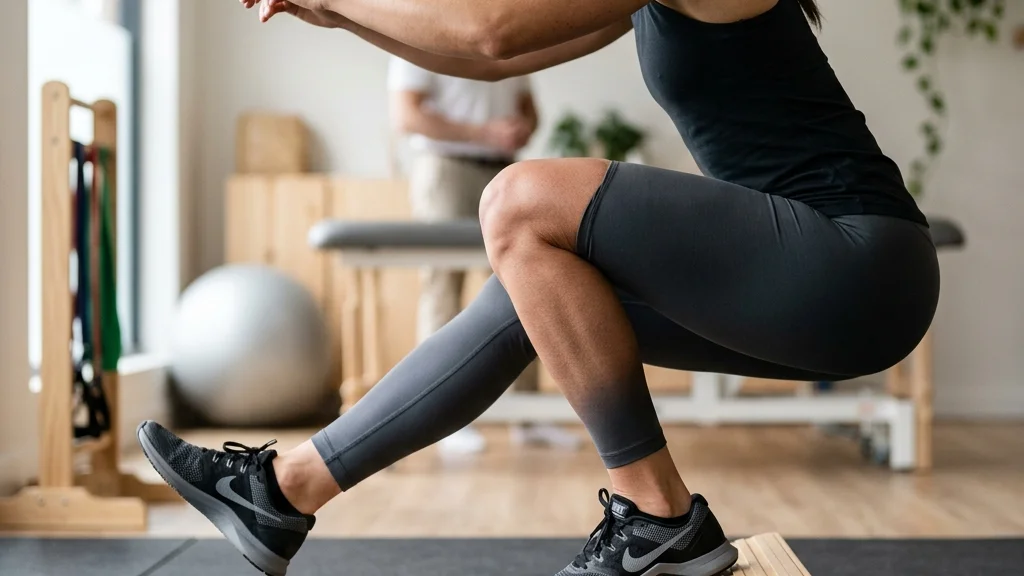
Stand on the slant board on your injured leg. Slowly lower your body over a count of 3 to 4 seconds, squatting down to about 70 degrees of knee flexion. Place your uninjured foot on the board and use both legs to push back up to the starting position, ensuring the injured leg only works during the downward (eccentric) phase. Perform 3 sets of 15 repetitions.
Stand on the slant board on your injured leg. Lower yourself down to a 45-degree angle and hold this position for 45 seconds, maintaining steady tension in your quadriceps. Slowly return to the top, rest for 2 minutes, and repeat 5 times to help reduce acute tendon pain.
Lie on your back with your heels placed on the top of the slant board, knees bent. Drive through your heels to lift your hips into a bridge, squeezing your glutes at the top to support the posterior chain. This helps balance the leg muscles, which is a key part of sacroiliac joint stabilizing stretches. Perform 3 sets of 12 repetitions.
If your knee pain is accompanied by lateral thigh tightness that pulls on your kneecap, you may also have an IT band issue. Check out our guide on why stretching your IT band does not work at IT Band Syndrome Treatment. Understanding how the whole leg chain interacts is key to recovery.
The Patient: Marcus, a 24-year-old competitive basketball player, was unable to play for 6 months due to severe patellar tendinopathy.
The Mistake: Marcus rested completely and took ibuprofen daily. Whenever he tried to play again, his knee pain returned instantly on his first jump, forcing him back to the bench.
The Solution: We stopped all anti-inflammatory drugs and resting protocols. We introduced single-leg eccentric squats on a 25-degree slant board, starting with body weight and slowly adding dumbbell weight over 8 weeks.
The Outcome: By week 12, Marcus' tendon had fully remodeled. He returned to competitive basketball, playing a full season with zero pain and improved jump height, proving that tendons thrive under load.
Restoring Dynamic Knee Strength
Recovering from patellar tendinopathy requires consistency and patience. Tendon tissue has a slow metabolic rate, meaning changes take time to occur.
By loading the tendon consistently and avoiding the rest trap, you can rebuild a stronger, more resilient knee. This work is also highly beneficial for addressing other front knee issues like runner's knee; read our guide on runner's knee hip rehabilitation to learn more.
Stay consistent with your decline squats, monitor your recovery, and let progressive load rebuild your path back to full athletic performance.
Irushi Abeywardhana
Senior Physiotherapist & Founder of Physio Pulse. Senior Clinical Physiotherapist passionate about blending advanced movement science with functional resilience.
Medical Disclaimer
The information provided by AyurPhysio is for general educational and informational purposes only. It is not intended as a substitute for professional medical advice, diagnosis, or treatment. Always seek the advice of your physician or other qualified health providers with any questions you may have regarding a medical condition. Never disregard professional medical advice or delay in seeking it because of something you have read on this website.
Related Healing Guides
View All Guides →
Managing Osteoarthritis of the Hands: Joint Protection and Dexterity Drills
The Deep Core: How to Correctly Activate the Transversus Abdominis