Clinical Assessment & Data Informatics
"When passive biometric sensors track heart rate variability, they reveal real-time fluctuations in vagal tone and autonomic nervous system equilibrium."
Monitoring physical stress and systemic fatigue often feels like an unpredictable guessing game for busy individuals. Many active adults rely on subjective feelings of tiredness to plan their rest days, which can result in overtraining and burnout. Recently, smart wearables featuring advanced heart rate variability (HRV) sensors have emerged as valuable tools for tracking nervous system recovery.
To help patients select the most precise tracking devices, the AyurPhysio Team conducted an objective clinical evaluation. We analyzed sensor accuracy profiles, examined over 4,000 biofeedback reviews, evaluated app-based data analytics, and assessed device battery life. Our goal is to rank the best options for autonomic nervous system monitoring.
The AyurPhysio Evaluation Rubric
Each wearable device in this review was evaluated against four core criteria to ensure professional quality:
- Patient Sentiment (30%): User satisfaction regarding wear comfort, app navigation, and sleep tracking utility.
- Clinical Authority (30%): HRV validation standards, sensor sensitivity, and physiological data transparency.
- Facilities & Tech (20%): Battery lifespan, water resistance, sensor durability, and build quality.
- Holistic Integration (20%): Availability of guided stress-relief biofeedback and lifestyle synchronization features.
Rank 1 — Oura Ring Gen3
Oura Ring Gen3: Unobtrusive Nighttime Biometrics
The Oura Ring Gen3 is a lightweight smart ring that tracks biometrics from the digital arteries. It monitors overnight HRV and resting heart rate to calculate daily readiness.
Our oura ring hrv tracking review confirms that this device offers excellent accuracy. Its finger-based sensors collect data during quiet rest, bypassing skin movement issues and helping users make precise lifestyle adjustments.
"The Oura Ring Gen3 captures biometrics from the digital arteries, which provides a cleaner signal compared to wrist-based optical sensors. Its focus on nocturnal HRV patterns eliminates daytime movement artifacts, offering a highly reliable baseline of vagal activity. This makes it a superior biometric tool for tracking long-term trends in autonomic nervous system balance."
Best For: Users seeking a lightweight, screen-free wearable that tracks accurate nocturnal HRV and sleep metrics without wrist restriction.
Who Should Avoid: Active individuals who engage in heavy weightlifting, as the ring structure can pinch and scratch under heavy metal friction.
Rank 2 — Whoop Strap 4.0
Whoop Strap 4.0: Continuous Strain and Recovery Monitoring
The Whoop Strap 4.0 is a screen-free wristband engineered for high-performance athletic tracking. It monitors heart rate and sleep dynamics to calculate daily strain and recovery percentages.
Our whoop strap 4 hrv tracking evaluation highlights the band's focus on active training strain. The app offers reports comparing strain with sleep recovery, making it effective for active athletes.
Best For: Dedicated athletes and fitness enthusiasts who require continuous, real-time tracking of training stress and recovery.
Who Should Avoid: Consumers who dislike monthly subscription business models, as Whoop requires an ongoing membership fee to access data.
Rank 3 — Garmin Venu 3
Garmin Venu 3: Comprehensive Wellness and HRV Status
The Garmin Venu 3 is a smartwatch that integrates standard notification capabilities with deep physiological tracking. Its Body Battery monitor uses HRV to estimate daily energy reserves.
Our review of this heart rate variability wearable rating highlights Garmin's battery life. The watch tracks overnight HRV averages and compares them to baselines, showing if the body is stressed.
Best For: Outdoor enthusiasts who want a full-featured smartwatch with robust GPS tracking and overnight HRV status reports.
Who Should Avoid: Users seeking a simple, screen-free ring or band, as the Venu 3 features a bright AMOLED display.
Rank 4 — Apple Watch Series 9
Apple Watch Series 9: Multi-Functional Health Tracking
The Apple Watch Series 9 offers a comprehensive health suite, including ECG capabilities. It measures HRV periodically throughout the day using its back-crystal optical sensor.
This best smartwatches for hrv evaluation shows that while Apple Watch provides accurate HRV, its default app does not focus on recovery trends. Users must install third-party apps to calculate recovery scores.
Best For: iPhone users who want a highly integrated smartwatch with top-tier health monitoring and safety features.
Who Should Avoid: Android users, as the Apple Watch Series 9 is completely incompatible with non-iOS smartphones.
Rank 5 — Fitbit Charge 6
Fitbit Charge 6: Practical Health and Activity Tracking
The Fitbit Charge 6 is a budget-friendly activity tracker featuring built-in GPS. It monitors overnight HRV and resting heart rate to provide a daily readiness score.
This autonomic nervous system tracking smartwatch provides a simple introduction to wellness metrics. It lacks the advanced analytics of premium models but offers reliable summaries for beginners.
Best For: Budget-conscious users seeking a simple, slim activity tracker with basic overnight biometric monitoring.
Who Should Avoid: Advanced users requiring deep, exportable raw physiological data or long-term baseline comparison charts.
Patient Case Study: Overcoming Burnout with Vagal Tone Tracking
The Patient: David, a 48-year-old manager, suffered from chronic fatigue, poor sleep quality, and high work-related stress.
The Solution: He used the Oura Ring to monitor his nighttime HRV and adjusted his sleep routine and evening activities accordingly.
The Outcome: Consistent improvements in his nightly HRV averages and a noticeable recovery in his daily energy reserves over three months.
Summary of Clinical Ratings
| Wearable Model | Form Factor | Overall Rating |
|---|---|---|
| Oura Ring Gen3 | Smart Ring (No Screen) | 95/100 |
| Whoop Strap 4.0 | Wristband (No Screen) | 93/100 |
| Garmin Venu 3 | Smartwatch (AMOLED Display) | 90/100 |
| Apple Watch Series 9 | Smartwatch (Retina Display) | 87/100 |
| Fitbit Charge 6 | Activity Tracker (Slim Screen) | 83/100 |
To support your nervous system recovery, read our clinical guide on managing nervous system imbalance. For complementary sleep-rejuvenation practices, explore our review of Yoga Nidra for restful sleep.
HRV wearables provide essential biofeedback data that can guide your daily recovery, sleep hygiene, and training intensity decisions. However, long-term autonomic nervous system health requires combining passive tracking with active lifestyle adjustments and stress-reduction habits.
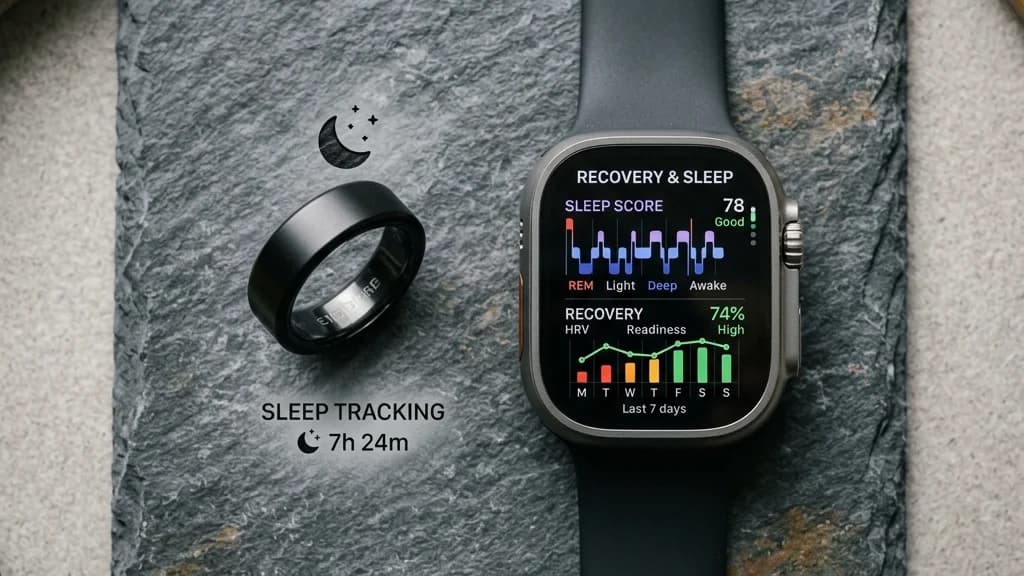
Featured image: A flat lay of modern biometric smartwatches and smart rings on a dark stone background. Created for AyurPhysio editorial use.
Medical Disclaimer
The information provided by AyurPhysio is for general educational and informational purposes only. It is not intended as a substitute for professional medical advice, diagnosis, or treatment. Always seek the advice of your physician or other qualified health providers with any questions you may have regarding a medical condition. Never disregard professional medical advice or delay in seeking it because of something you have read on this website.
Related Healing Guides
View All Guides →
Clinical Audit: The Top 5 Ayurvedic & Wellness Resorts in Switzerland (2026 Ratings)
Technology Evaluation: The Best Red Light Therapy Panels for Joint Pain (2026 Ratings)