"When a man of such extraordinary global responsibility — who traveled to over 50 countries, stood for hours, and bore the physical weight of the Papacy — ends his years in a wheelchair, we must ask not just what failed medically, but what layers of Vata imbalance accumulated silently for decades before the joints finally announced themselves."
Pope Francis, who passed away on April 21, 2025, at the age of 88, spent the final years of his papacy in a visibly diminished physical state — increasingly reliant on a wheelchair, a cane, and the careful arms of attendants to navigate a world that once accommodated his boundless energy.
The Vatican documented his primary musculoskeletal complaints as an inflamed right knee ligament, with clinical observers identifying underlying gonarthrosis (knee osteoarthritis) and coxarthrosis (hip osteoarthritis), compounded by a long-standing sciatica that had given him a pronounced limp for years. He received therapeutic injections, daily physiotherapy reportedly lasting up to two hours, and periodic rest — yet the decline continued.
Through an Ayurvedic clinical lens, this trajectory is not only explainable — it was, to a significant degree, predictable.
The Ayurvedic Diagnosis: A Decade of Advancing Sandhigata Vata
In Ayurveda's framework, the Pope's condition maps to Sandhigata Vata — the pathological lodging of aggravated Vata dosha in the synovial joints (sandhis). Vata, when chronically elevated by irregular schedules, high cognitive stress, air travel, cold European winters, and insufficient oily nourishment, progressively desiccates the body's lubricating tissues — the synovial fluid, the articular cartilage, and the intervertebral disc hydration.
The clinical hallmarks of Sandhigata Vata — crackling joints (crepitus), pain worse in the morning, stiffness that loosens with movement, and gradual structural deformation — are precisely what medical observers described in Francis from 2015 onward.
- 1Vata Vriddhi (Vata Accumulation) — Pre-2010Years of global travel, irregular meal timing, disrupted circadian rhythms, and continuous mental demands created the foundational Vata excess. Ayurveda recognizes that Vata increases with age (Jara), but is dramatically accelerated by these lifestyle factors.
- 2Sthana Samshraya (Vata Lodging in Joints) — 2015–2019The first documented sciatica and knee complaints. Excess Vata, finding its way into the Asthi vaha srotas (bone-tissue channels) and the Sandhi (joint spaces), began manifesting as pain, stiffness, and progressive cartilage desiccation — the Ayurvedic equivalent of the early radiographic changes of gonarthrosis.
- 3Vyakti (Full Disease Manifestation) — 2022Public wheelchair use began. By this stage in Ayurvedic pathology, the Asthi dhatu itself is compromised — bone tissue is losing its Sneha (internal oiliness), and the structural integrity of the joint is in active degeneration. Conservative management can still slow this phase, but cannot reverse the tissue damage accumulated over the preceding decade.
What Ayurvedic Medicine Would Have Prescribed
"The tragedy in Pope Francis's case is not that his joints deteriorated — that is inevitable with aging and the extraordinary demands of his role. The tragedy is that the Vata-nourishing interventions that Ayurveda has refined over 5,000 years were almost certainly never part of his care protocol. Daily Abhyanga with Ksheerabala taila, weekly Janu Basti treatments, and Basti (medicated enema) for systemic Vata regulation — these are not luxuries. They are the clinical tools that Ayurveda has used to keep Sandhigata Vata from progressing to structural destruction for millennia."
- 1Daily Ksheerabala Taila AbhyangaA medicated sesame oil preparation with Bala root (Sida cordifolia) — specifically formulated for degenerative joint conditions and nervous system Vata. Applied daily by gentle self-massage, it penetrates the Asthi dhatu channels to restore the lubricating Sneha that gonarthrosis strips away.
- 2Weekly Janu BastiThe classical Ayurvedic warm oil pool treatment for the knee joint. A ring of black gram dough retains warm Mahanarayan taila directly over the joint for 30–45 minutes, penetrating the capsular tissue, reducing synovial inflammation, and nourishing the periarticular cartilage through sustained thermal osmosis. Clinical research confirms statistically significant pain reduction in knee OA with consistent Janu Basti protocols.
- 3Tikta Ghrita (Bitter Ghee) for Asthi Dhatu NourishmentMedicated ghee preparations with bitter herbs — particularly Guduchi and Nimba — penetrate the deepest tissue layers in Ayurvedic pharmacology. They specifically target the Asthi dhatu (bone tissue), reducing inflammation at the cellular level while providing the lipid matrix needed for cartilage matrix maintenance.
- 4Anuvasana Basti (Medicated Oil Enema)The ultimate Vata-pacifying therapy. Monthly medicated oil enema treatments — the classical Ayurvedic "root therapy" for systemic Vata disorders — address the constitutional excess at its origin rather than treating joint symptoms in isolation. Research at Ayurvedic institutions documents significant improvement in Sandhigata Vata symptom scores following Basti protocols.
The Subject: Pope Francis — documented right knee gonarthrosis, bilateral coxarthrosis, and sciatica, managed conservatively with injections and physiotherapy from approximately 2015 until 2025.
The Critical Gap: No documented Ayurvedic Snehana (oleation therapy) or Vata-regulating systemic protocols within his care record. His physiotherapy was reportedly two hours daily — aggressive — but devoid of the deep tissue nourishment that Ayurveda specifically provides for degenerative bone conditions.
The Ayurvedic Reconstruction: A Sandhigata Vata protocol initiated in 2015, combining Janu Basti 2x weekly, daily Ksheerabala Abhyanga, and monthly Basti therapy could clinically have slowed the rate of cartilage degradation, reduced synovial inflammation, and preserved functional mobility significantly longer than a purely Western conservative management approach.
The Legacy: What His Mobility Journey Teaches Us
Pope Francis consistently approached his physical decline with remarkable equanimity — joking about his wheelchair, reducing his schedule gracefully, and continuing to lead from a seated position with undiminished intellectual and spiritual force. His attitude was his finest clinical asset. Research consistently demonstrates that psychological acceptance and continued social engagement are among the strongest predictors of quality-of-life preservation in degenerative joint disease.
But his physical trajectory also represents a missed opportunity for integrative medicine — the kind of collaboration between modern conservative management and classical Ayurvedic joint-nourishment protocols that AyurPhysio was built to champion.
For the complete Ayurvedic framework for bone-tissue health, our guide to Janu Basti for knee preservation provides the clinical detail. The constitutional Vata management that underpins all joint degeneration prevention is explored in our Vata imbalance and nervous system guide. And the systemic nourishment of Asthi dhatu through Rasayana therapy is covered in our Ayurvedic healthy aging guide.
Every person managing advancing joint degeneration is, in some sense, navigating the same territory Pope Francis walked. The question worth sitting with is: are you treating only the symptom, or are you nourishing the tissue from the inside out?
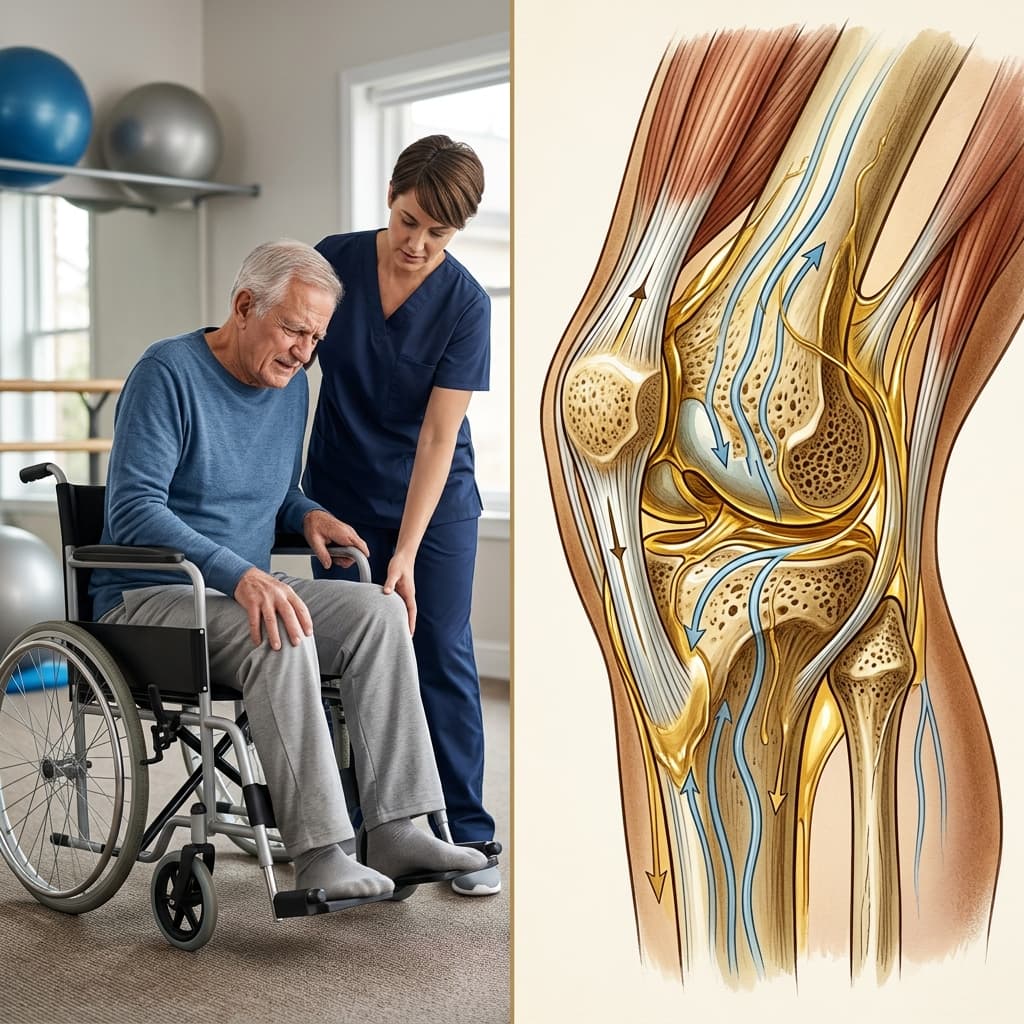
Featured image: Clinical composite illustrating elderly wheelchair mobility with physiotherapist (left) and Ayurvedic Vata channel anatomy of the knee joint (right). Created for AyurPhysio editorial use. This article presents a retrospective clinical analysis for educational purposes only.
Dr. Dhanushika Dilshani
Expert Ayurvedic Wellness Doctor. Specialized in modern holistic wellness, optimizing dermal resilience, cosmetic radiance, and systematic diagnosis driven by traditional and evidence-based medical logic.
Medical Disclaimer
The information provided by AyurPhysio is for general educational and informational purposes only. It is not intended as a substitute for professional medical advice, diagnosis, or treatment. Always seek the advice of your physician or other qualified health providers with any questions you may have regarding a medical condition. Never disregard professional medical advice or delay in seeking it because of something you have read on this website.
Related Healing Guides
View All Guides →
Christian Eriksen's Cardiac Arrest and ICD Return to Play: The Biomechanics of Cardiorespiratory Reconditioning and Athletic Heart Rehabilitation

Selena Gomez's Lupus and Kidney Transplant: An Integrative Ayurvedic Approach to Systemic Autoimmunity, Dushi Visha, and Ojas Restoration