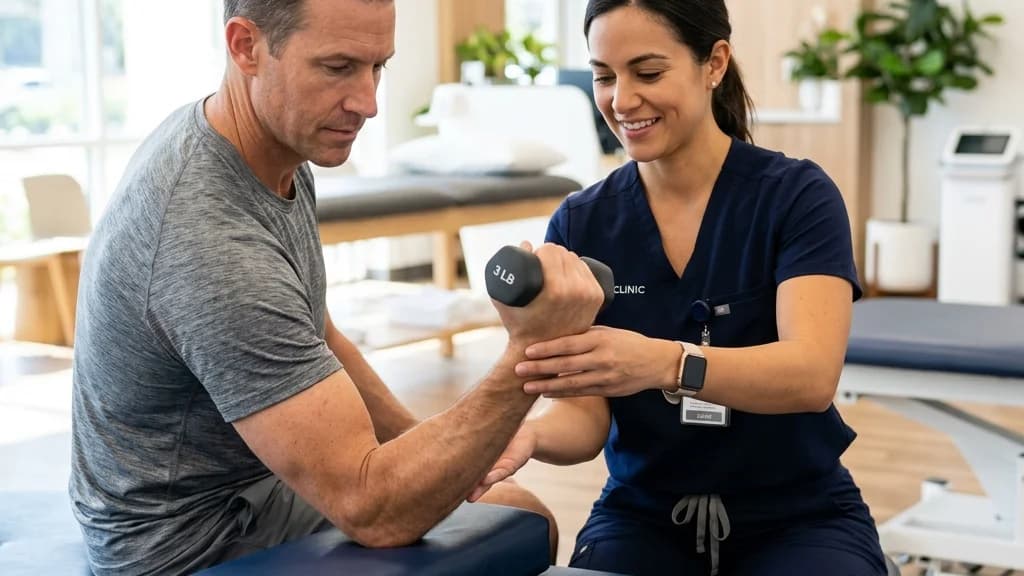
Rotator Cuff Tendinopathy: Eccentric Strengthening Exercises
"When a tendon becomes painful, it doesn't need rest—it needs resistance. Resting a degenerative tendon is like letting a weak bridge crumble further; we must apply controlled load to rebuild its structural steel."
If your shoulder feels like a rusty gate screeching with every overhead reach, or if sleeping on your side has become an exercise in managing sharp, throbbing joint pain, you are likely suffering from rotator cuff tendinopathy. Historically referred to as "tendonitis," we now know that chronic shoulder pain is rarely driven by simple, short-term inflammation. Instead, it is a micro-structural breakdown of the tendon fibers under persistent, unaligned mechanical loading.
To the average person, pain means stop moving. To a sports physiotherapist, pain means we need to change how we load. Complete rest is one of the most destructive things you can do to a painful shoulder joint.
By utilizing the proven scientific laws of eccentric shoulder strengthening, you can stimulate deep cellular healing, realign disorganized collagen fibers, and achieve a fast, permanent solution to your chronic shoulder stiffness.
The Anatomy of Tendon Failure: Why the Supraspinatus Breaks
Your rotator cuff is a highly integrated team of four key muscles: the supraspinatus, infraspinatus, teres minor, and subscapularis. Together, they function like a muscular sleeve, pulling your humerus (upper arm bone) tightly into the shallow socket of your shoulder blade (glenoid fossa) during overhead movements.
In clinical orthopedic sports medicine, statistical research reveals the heavy mechanical burden placed on the main shoulder tendon:
- Rotator cuff pathology accounts for over 70% of all clinical shoulder pain presentations.
- The supraspinatus tendon bears over 90% of the active mechanical load during any arm lifting or overhead reaching movement.
- Performing repetitive arm lifts with poor scapular control spikes local tendon friction, reducing subacromial space from a healthy 10mm down to a compressed 5mm or less.
When you perform repetitive reaching without stabilizing your shoulder blade, the supraspinatus tendon is squeezed under the bony roof of your shoulder (the acromion). This repetitive rubbing cuts off local blood supply, triggering a disorganized cellular response. Healthy, parallel collagen fibers are replaced by a weak, tangled web of tissues that cannot tolerate tension—leading to that characteristic sharp, pinching ache when you reach into your back pocket or lift a cup of coffee.
Why Cortisone Injections and Complete Rest are Restructuring Failures
When shoulder pain persists, many patients seek immediate medical "fixes," such as receiving a cortisone injection or resting their arm in a sling for several weeks to let it heal.
My strong, authoritative clinical opinion is that resting a painful tendon completely or relying on cortisone injections actively accelerates tendon degeneration and weakens your joint. Cortisone is a powerful anti-inflammatory, but it is also catabolic—meaning it physically breaks down healthy collagen tissue. Studies show that patients who receive cortisone have a significantly higher rate of recurrent tendon tears within 12 months.
Complete rest, on the other hand, causes rapid muscle wasting and deprives the tendon of the mechanical tension it desperately needs to rebuild. To heal a tendon, we must load it using controlled eccentric shoulder strengthening to force the body to lay down strong, parallel collagen fibers.
The Patient: Mark, a 42-year-old amateur tennis player, presented with severe, pinching shoulder pain that forced him to stop playing tennis and made it impossible to sleep on his right side.
The Mistake: Mark received two cortisone injections and rested his arm completely for six weeks, which resulted in severe shoulder stiffness and muscular wasting around his shoulder blade.
The Solution: We immediately stopped all passive rest, initiated a progressive rotator cuff tendinopathy rehab program focusing on heavy slow resistance eccentrics, and added scapular upward rotation drills using a light resistance band.
The Outcome: Within 4 weeks, Mark returned to pain-free side sleeping. By week 8, his shoulder strength exceeded his baseline, and he returned to tennis serving with zero pinching or discomfort.
Three Eccentric Exercises for Tendon Re-education
Eccentric exercises focus on the "lowering" phase of a movement, where the muscle is actively lengthening under load. This specific mechanical strain stimulates local tendon cells (tenocytes) to produce fresh, strong collagen. Perform these three exercises daily for active supraspinatus tendinitis recovery:
-
1The 5-Second Eccentric Dumbbell Lateral Lower Stand tall with a light dumbbell (2–4 lbs) in your hand. Lift your arm out to the side using your non-injured hand to assist. Once your arm is at shoulder height, release your assistant hand and slowly lower the dumbbell back to your side, taking a full 5 seconds to complete the descent. Perform 3 sets of 10 repetitions. This is the cornerstone of eccentric shoulder strengthening.
-
2Resisted Eccentric External Rotation Tie a resistance band to a doorknob. Stand with your side to the door, holding the band in your hand. Place a folded towel under your elbow to isolate the joint. Pull the band outward using both hands, then slowly let the band pull your hand back inward over a slow 5-second count using only your injured arm. Repeat 12 times for 3 sets.
-
3Scapular Wall Slides (Serratus Activation) Stand facing a wall with a light resistance band wrapped around your wrists. Place your forearms flat against the wall, keeping your elbows bent at 90 degrees. Maintain light outward tension against the band, and slowly slide your forearms up the wall as high as possible while keeping your shoulders relaxed. Slide back down slowly. This is crucial for shoulder impingement exercises as it clears subacromial space.
Load Your Shoulder for Life
Ultimately, tendon health is a reflection of consistent, progressive mechanical loading. By replacing passive rest with active, scientific eccentric strengthening, you can rebuild the structural resilience of your rotator cuff, eliminate shoulder pinching, and return to the sports and activities you love with absolute physical confidence.
Irushi Abeywardhana
Senior Physiotherapist & Founder of Physio Pulse. Senior Clinical Physiotherapist passionate about blending advanced movement science with functional resilience.
Medical Disclaimer
The information provided by AyurPhysio is for general educational and informational purposes only. It is not intended as a substitute for professional medical advice, diagnosis, or treatment. Always seek the advice of your physician or other qualified health providers with any questions you may have regarding a medical condition. Never disregard professional medical advice or delay in seeking it because of something you have read on this website.
Related Healing Guides
View All Guides →
Spinal Stenosis: Flexion-Based Rehab Protocols for Pain-Free Walking
Pelvic Organ Prolapse: Pelvic Floor Stabilization and Safe Lift Mechanics