Sciatica: Combining Nerve Flossing with Kati Basti for Double Nerve Decompression
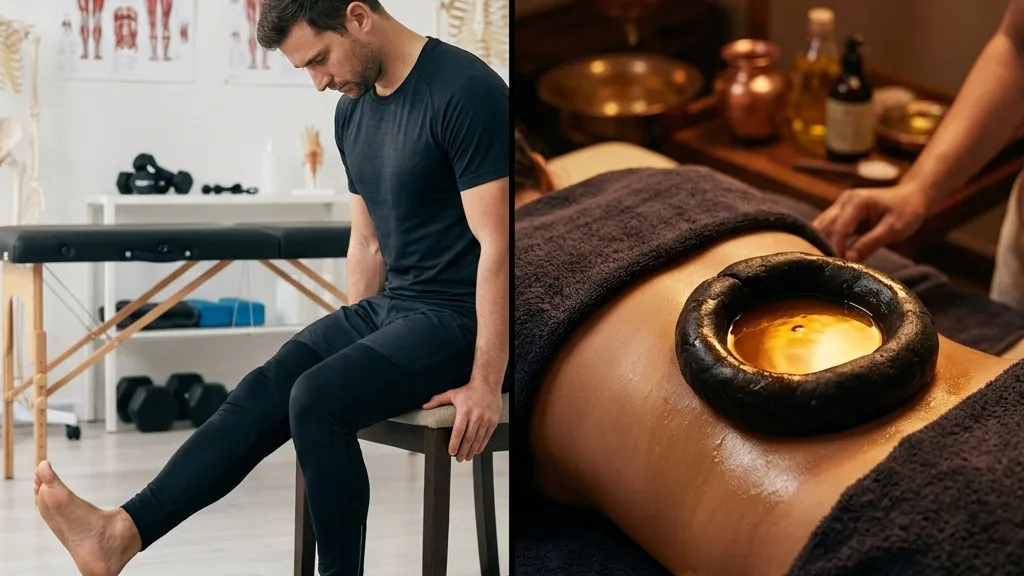
"Treating sciatica with only stretching is like trying to untie a knot by pulling on both ends—you're just making the problem tighter. To stop the 'electrical storm' in your leg, you must lubricate the conduit and slide the nerve, not pull it."
If you are currently experiencing the relentless "electrical storm" of sciatica, you know that ordinary pain is a distant memory. Whether it is a searing burn in your glute, a cold numbness in your calf, or a lightning bolt that shoots to your big toe, the sciatic nerve is the loudest communicator of distress in the human body.
Standard medical advice often focuses on anti-inflammatory pills and generic hamstring stretches. However, for most chronic sufferers, this approach fails because it ignores the fundamental biology of a trapped nerve. To achieve true sciatica relief combined therapy, we must address two distinct issues: the structural compression at the spine and the mechanical sensitivity of the nerve itself.
By combining the ancient Ayurvedic wisdom of **Kati Basti** with the modern clinical precision of **Nerve Flossing**, we can create a "double decompression" effect. One therapy nourishes and lubricates the local spinal tissues, while the other restores the nerve's ability to glide freely without irritation. Let's explore how to stop sciatic nerve pain by integrating these two powerful modalities.
Why Nerves Hate Stretches: The Mechanical Truth
The sciatic nerve is the longest and thickest nerve in your body, running from your lower back all the way to your foot. It is designed to slide up to 12 millimeters during movement. When a disc herniates or a muscle (like the piriformis) clamps down on the nerve, it loses this "glide."
When you perform a traditional "toe-touch" stretch, you are yanking on a nerve that is already tethered and inflamed. This is why many people feel worse after yoga or stretching classes. Nerves do not have the elastic properties of muscle; they are more like high-tension electrical cables. To heal, they need nerve flossing for sciatica—a technique that pulls the nerve from one end while relaxing it at the other, allowing it to "floss" through the tight spots.
My strong clinical opinion is that static stretching for a pinched nerve is a recipe for chronic neural inflammation. Nerves are incredibly sensitive to tension. If you pull an already irritated nerve, you trigger a protective "spasm" response in the surrounding muscles.
Nerve flossing is superior because it uses neural mobilization to desensitize the nerve root and improve the circulation of neural fluid (axoplasm). We are essentially cleaning the "conduit" of the nerve without ever putting it under dangerous tension.
From the Ayurvedic perspective, sciatica (Gridhrasi) is a classic Vata disorder characterized by dryness and coldness in the spinal joints. Without localized oleation, your spinal discs remain brittle and "rough," like rusty hinges.
Kati Basti for nerve decompression is vital because it creates a warm, pressurized pool of medicated oil that literally "soaks" into the intervertebral spaces. This hydrates the disc, calms the Vata-induced inflammation, and prepares the tissues for the mechanical sliding of PT.
The Protocol: Kati Basti + Nerve Flossing
The most effective recovery happens when these treatments are sequenced correctly. The warmth and oil of Kati Basti prepare the nervous system, which is then followed by the active movement of flossing.
Phase 1: The Tissue Soak (Kati Basti)
During a Kati Basti session, a ring of dough is placed over your L4-L5-S1 vertebrae and filled with warm Mahanarayan or Dhanwantharam oil. The heat and specific herbal compounds penetrate deep into the spinal ligaments. This holistic sciatica treatment reduces the "chemical" irritation of the nerve root, essentially turning down the volume on your pain signals.
Phase 2: The Neural Slide (Nerve Flossing)
Once the area is warm and hydrated, we introduce the "Slump Floss." While sitting in a chair, you slowly extend your painful leg while simultaneously looking up at the ceiling. Then, you bend your knee while tucking your chin to your chest.
By moving the head and leg in sync, you are pulling the nerve from the top while giving it slack at the bottom, and vice versa. This rhythmic motion helps "un-tether" the nerve from scar tissue or disc material without triggering a pain response.
Never push into pain during a nerve floss. Unlike a muscle stretch where you might aim for a "good ache," a nerve floss should feel relatively easy. If you trigger the "lightning bolt" or a tingle in your toes, you have gone too far. The goal is a gentle, pain-free oscillation.
The Patient: David, a 52-year-old carpenter, had been unable to work for three months due to severe L5-S1 sciatica. His surgeon had already scheduled him for a microdiscectomy.
The Mistake: David was trying to "power through" with aggressive hamstring stretches and heavy painkillers, which only made his leg numbness worse.
The Solution: We implemented three weeks of bi-weekly kati basti for nerve decompression followed by daily, pain-free nerve flossing sessions.
The Outcome: After the second week, David's leg pain retreated to his glute (centralization). By the end of month one, he was back to light work duties. He cancelled his surgery and has remained pain-free for over a year.
Mastering Your Recovery
Sciatica is a structural and chemical challenge that requires a multi-dimensional response. By integrating the lubrication of Ayurveda with the mobilization of Physiotherapy, you are giving your nervous system the best possible environment to heal.
If you're unsure whether your pain is truly coming from your spine or if it's a muscular trap, explore our diagnostic guide on Sciatica vs. Piriformis Syndrome.
For more on the specific oils and mechanics used in the oil pool treatment, read our full breakdown of Kati Basti for Herniated Discs.
Are you ready to stop pulling on the knot and start sliding the cable? Begin your nerve flossing today and feel the electrical storm finally start to subside.
Dr. Dhanushika Dilshani
Expert Ayurvedic Wellness Doctor. Specialized in modern holistic wellness, optimizing dermal resilience, cosmetic radiance, and systematic diagnosis driven by traditional and evidence-based medical logic.
Medical Disclaimer
The information provided by AyurPhysio is for general educational and informational purposes only. It is not intended as a substitute for professional medical advice, diagnosis, or treatment. Always seek the advice of your physician or other qualified health providers with any questions you may have regarding a medical condition. Never disregard professional medical advice or delay in seeking it because of something you have read on this website.
Trending Guides
Clinical Audit: The Best Knee Unloader Braces for Osteoarthritis & Joint Compartment Unloading (2026 Ratings)
10 min readUsain Bolt's Elite Sprinting with Scoliosis: A Biomechanical Breakdown of Asymmetrical Kinetic Chain Compensation and Hamstring Strain Risk
8 min readRetrolisthesis: Understanding Posterior Vertebral Slippage and Rehab
6 min readQuadratus Lumborum Trigger Points: The Secret Driver of Deep Hip Pain
7 min readNerve Flossing Techniques for Sciatic Nerve Mobilization
6 min readWeekly Wellness
Don't miss the next guide
Join 5,000+ subscribers getting holistic health tips every Tuesday.