Osteopenia in Young Women: Rebuilding Bone Density Through Weight-Bearing Physical Therapy
"Your bones are not static concrete blocks; they are like a dynamic smart grid that only allocates reinforcement to the areas experiencing active brownouts from mechanical stress."
You are twenty-eight, active, and eat a balanced diet. Yet, after a persistent shin splint prompts your physician to order a bone density scan, the results leave you shocked: your T-score is in the negative, classifying you with osteopenia. You feel betrayed by your own body, wondering how someone decades away from menopause could have the bones of a senior.
Osteopenia is often considered a disease of the elderly, but osteopenia in young women is a growing clinical reality. The peak years for building bone mass occur in your teens and twenties. If you do not hit your genetic bone potential during this critical window — or if you experience high stress and caloric restriction — you begin your adult life with a depleted skeletal reserve, accelerating your risk of early fractures.
Standard advice frequently focuses on gentle cardio or calcium pills. But bones are piezo-electric tissues; they require physical compression to build mineral structure. Reversing this condition and preventing bone loss requires targeted weight-bearing physical therapy and progressive overload to signal your osteoblasts to build new bone matrix.
The Peak Bone Mass Window and the Risk of Early Loss
In human development, bone mass accumulates rapidly during adolescence, reaching up to 90% of its peak value by age twenty. The remaining window for minor deposits closes by age thirty. From that point forward, the body enters a natural, gradual phase of bone remodeling where resorption slowly begins to outpace new bone construction.
If a young woman experiences nutritional deficits, chronic stress (which elevates cortisol, a bone-depleting hormone), or hormonal disruptions like amenorrhea (often seen in the Female Athlete Triad), her bone-building cells are starved of resources. She misses her chance to maximize peak bone density, leaving her with thin trabecular bone in the hips and spine.
Once this peak window closes, the goal shifts from passive growth to aggressive conservation. To stimulate bone remodeling in adulthood, the skeleton must be exposed to mechanical forces that bend and compress the bone crystals slightly. This bending generates a tiny electrical current (the piezoelectric effect) that calls osteoblasts to the area to pour fresh calcium minerals.
- Women accumulate up to 90% of their lifetime peak bone mass by age 20, leaving a narrow window to correct deficits before age-related decline begins.
- To trigger osteogenesis (new bone growth), the skeletal matrix must experience forces exceeding 1000 microstrain — a metric that cannot be reached by walking or light cardio.
- Clinical studies show that progressive resistance training at 80-85% of one-rep max increases lumbar spine bone mineral density by up to 2.8% over eight months in premenopausal women.
- Targeted weight-bearing physical therapy reduces the lifetime risk of osteoporotic hip fractures by up to 50% by maximizing early peak bone reserves.
Why Your Cardiovascular Routine is Not Saving Your Bones
Many young women with low bone density are dedicated runners, cyclists, or gym-goers who spend hours on the elliptical machine. They assume that because they are active, their skeleton is protected. However, from a bone-remodeling perspective, these repetitive, low-impact activities are highly inefficient.
My authoritative clinical opinion is that low-impact cardio, including cycling and elliptical training, is completely useless for building bone density and can lead to progressive osteopenia by failing to apply gravitational shock. Bones need impact and heavy compression. If your feet are locked into a machine or floating in water, your skeletal system is essentially on vacation.
To force the bones of the hip and spine to strengthen, you must lift heavy weights and safely introduce ground-reaction forces. Swimming might build cardiovascular health, but progressive weight training is the best exercise for bone density.
"Many young women with osteopenia come to my clinic terrified that lifting heavy weights will cause a fracture. They have been told to stick to light weights and high reps. This advice is clinically incorrect. To make a bone grow, you must apply a load that is heavy enough to bend the tissue slightly. This means lifting weights at 80% of your maximum capacity under strict supervision. Light pink dumbbells do not create enough mechanical strain to trigger bone growth. If you want to protect your skeleton, you must lift heavy."
The Progressive Mechanical Overload Protocol
To successfully reverse early bone loss, a clinical rehabilitation program must target the areas most vulnerable to osteopenic fractures: the hip (femoral neck) and the lower spine (lumbar vertebrae). This is achieved through a multi-joint loading protocol that places axial compression down the spine and through the pelvis.
The program begins with progressive squats and deadlifts. As the muscles pull on the bones at their insertion points, they apply localized tensile forces that stimulate bone remodeling. Gradually, light impact training is introduced, such as box drops and jumping, to generate high-velocity ground reaction forces that travel up the legs.
Finally, we must address nutritional and hormonal support. In young women, bone loss is often driven by low energy availability — consuming fewer calories than the body expends. Aligning energy intake with training volume is essential to restore healthy estrogen levels, which act as the body's natural bone stabilizer.
The Patient: Chloe, a 28-year-old competitive runner, presented with a femoral neck stress fracture that had failed to heal after three months of rest.
The Mistake: Chloe ran 50 miles a week on a restricted low-fat diet, avoiding strength training because she was afraid of 'bulking up' and losing her running speed.
The Solution: We stopped running. We introduced a structured weight-bearing physical therapy plan focusing on heavy barbell deadlifts, guided squats, and daily heel drops, while increasing her daily calorie intake.
The Outcome: Chloe's stress fracture healed completely. After 12 months of lifting twice a week, her DEXA scan showed a 2.4% increase in femoral neck density, and she returned to running stronger and faster than before.
Step-by-Step Bone Building Protocol
Perform this strength and impact sequence twice a week, allowing 48 hours of recovery between sessions. Ensure all heavy lifts are performed with neutral spinal alignment:
-
1Phase 1: Progressive Barbell Deadlifts (4 sets of 6 repetitions) Stand with feet hip-width apart, bar over mid-foot. Hinge at the hips, keeping your back flat, and lift the bar by extending your hips and knees. Use a weight that makes the last rep of each set challenging. This axial load places direct mechanical strain on both the lumbar spine and the femoral neck, serving as the best exercise for bone density in the body.
-
2Phase 2: Dynamic Box Drops (3 sets of 8 repetitions) Stand on a low box (15-20 cm high). Step off the box with one foot and land softly on both feet, absorbing the impact by bending your knees slightly. Do not jump off the box — simply step and drop. This controlled landing generates a high-velocity shockwave that travels up the lower limbs to stimulate bone growth.
-
3Phase 3: Standing Heel Drops (20 repetitions twice daily) Rise onto the balls of your feet, then drop down quickly, striking your heels sharply against the floor. This quick impact sends vibration signals through your heels to your hips. It is a simple, effective home drill for preventing bone loss that can be done anywhere.
Sustaining a Resilient Skeleton for Life
Your skeleton is a living, responsive organ that adapts directly to the demands you place on it. By incorporating heavy resistance and impact into your training during your twenties and thirties, you build a physical reserve that protects you for decades to come.
To understand the differences in managing bone loss later in life, read our guide on osteoporosis in postmenopausal women. If you want to ensure your core is stable before you begin heavy lifting, view our spinal warm-up routine in dynamic spine warm-ups for lifters. And to prevent injury during your squats, read our detailed guide on building deep core stability.
Failing to load your bones in your youth is like skipping deposits to a retirement account — you will find yourself structurally bankrupt when you need it most. Start lifting today, and build a frame that lasts.
Are you lifting heavy enough to bend your bone crystals, or are you hoping that light cardio will protect your spine?
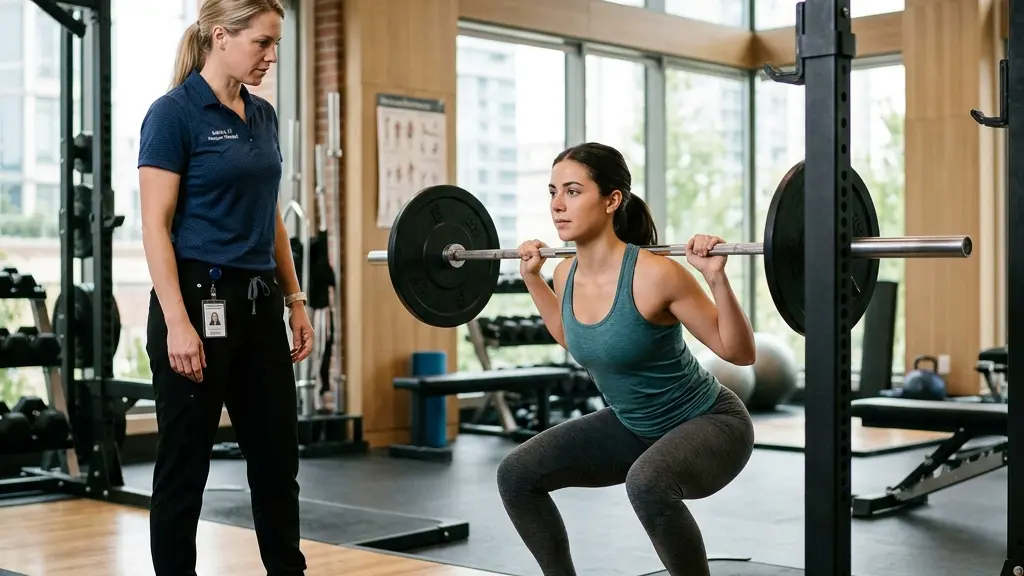
Featured image: A young female athlete performing guided squats in a physical therapy gym. Created for AyurPhysio bone-preservation education.
Irushi Abeywardhana
Senior Physiotherapist & Founder of Physio Pulse. Senior Clinical Physiotherapist passionate about blending advanced movement science with functional resilience.
Medical Disclaimer
The information provided by AyurPhysio is for general educational and informational purposes only. It is not intended as a substitute for professional medical advice, diagnosis, or treatment. Always seek the advice of your physician or other qualified health providers with any questions you may have regarding a medical condition. Never disregard professional medical advice or delay in seeking it because of something you have read on this website.
Trending Guides
George Washington's Fatal Bloodletting: An Ayurvedic Reconstruction of Rakta Dhatu Depletion and Ojas Collapse
8 min readJack Grealish's stress fracture of the foot: Soccer Biomechanics, Fifth Metatarsal Load, and Surgical Rehab
8 min readBen White's Severe Knee Injury: A Biomechanical Analysis of Lateral Meniscus Shear and Joint Longevity
8 min readElly De La Cruz's Hamstring Strain: The Biomechanics of Sprint Deceleration
8 min readTotal Knee Replacement (TKR): Post-Op Protocols for Restoring Extension
9 min readWeekly Wellness
Don't miss the next guide
Join 5,000+ subscribers getting holistic health tips every Tuesday.
Related Healing Guides
View All Guides →
Total Knee Replacement (TKR): Post-Op Protocols for Restoring Extension
The Gluteus Medius Connection: Preventing Lumbar Compensation