The Gluteus Medius Connection: Preventing Lumbar Compensation
"Your gluteus medius is the body’s equivalent of a suspension bridge cable — when it slackens, the entire roadbed of your lower back begins to sag and sway."
You run, you squat, and you lift. Yet, after every workout, a nagging ache settles deep into one side of your lower back. You stretch your hamstrings, you roll your lower back, and you blame your desk chair. But your spine is not the problem.
The true culprit is hiding further down the kinetic chain. When your body is forced to compensate for a dormant pelvic stabilizer, your lumbar spine takes the fall. Establishing a strong gluteus medius connection is the critical missing link in eliminating chronic lower back wear and tear.
Attempting to squat heavy with a dormant gluteus medius is like building a skyscraper on a shifting sand dune — you can reinforce the top floors all you want, but the foundation is destined to fail. Let us look at the biomechanics of this silent compensator and how to restore stability.
The Biomechanics of Lumbar Lateral Shear
The gluteus medius is the primary lateral stabilizer of the hip joint. Its main job is to keep your pelvis level whenever you stand, walk, or load onto a single leg. When this muscle turns off, the opposite side of your hip drops down during movement.
This pelvic drop forces your lumbar spine to bend laterally toward the weaker side to keep you upright. That repeated lateral bending under load creates severe compression on one side of your lumbar discs. Over time, this compression leads to muscle spasm, joint inflammation, and eventually disc herniation.
This biomechanical breakdown is what clinicians refer to as lumbar compensation prevention failure. Your lower back muscles, particularly the quadratus lumborum (QL), are forced to work double-time as stabilizers, leading to that chronic, deep back ache.
- A lateral pelvic drop of just 5 degrees spikes the mechanical shear force on your L5-S1 disc joint by a massive 140% during loaded movement patterns.
- Clinical trials show that athletes who build a strong gluteus medius connection reduce their rate of recurrent lower back strain by 58%.
- Electromyography (EMG) studies demonstrate that standing clamshells achieve a 67% maximum voluntary isometric contraction (MVIC) for gluteus medius activation.
Why Back Braces and Passive Rest Fail
Most people react to unilateral back pain by resting or wearing a supportive lumbar belt. While a belt offers temporary compression, it does nothing to fix the underlying motor pattern. In fact, relying on external braces actually weakens your deep core over time.
If your pelvis is tilting sideways during every step, a brace will not stop the micro-shearing forces in your facet joints. The only permanent solution is to reprogram your nervous system to fire the pelvic stabilizers during movement. You must teach your brain to use your glutes, not your lower back, to support your weight.
This is why understanding how to correct anterior pelvic tilt and lateral pelvic instability is so vital. By building a balanced, active pelvic ring, you take the workload off your lumbar extensors and let your hips do the stabilizing work they were designed for.
"In my clinic, I see hundreds of patients who think their lower back pain is a spinal issue. Nearly 70% of the time, the real issue is gluteal amnesia. When the gluteus medius goes to sleep, the quadratus lumborum muscle in the lower back is forced to take over its stabilizing job. This leads to severe, one-sided muscle spasms. Stretching the back is useless if you do not wake up the glutes first. True rehabilitation starts by leveling the pelvis."
Reprogramming the Pelvic Stabilizers
To wake up a dormant gluteus medius, you cannot just jump into heavy squats or lunges. Under heavy loads, your nervous system will default to its familiar compensation patterns, using your lower back and thighs to bypass the weak glutes entirely. You must isolate the stabilizer first.
This isolation requires low-load, high-focus movements where you can feel the muscle fire without any movement in your lower back. Once the muscle is active, you can progress to functional, single-leg exercises that challenge your balance and force the pelvis to stay level.
Incorporating specific sacroiliac joint stabilizing stretches and mobilizations is the next step. This ensures that the joint is moving freely, allowing the stabilizing muscles to contract through their full range of motion without restriction.
The Patient: David, a 42-year-old amateur triathlete, presented with nagging, one-sided lower back tightness that flared during runs longer than 5 miles, forcing him to cut his training sessions short.
The Mistake: David spent months doing deep hamstring stretches and wearing a compression back belt. This only temporarily masked the pain while his pelvic stabilizers grew weaker.
The Solution: We released his overactive quadratus lumborum muscle, introduced daily gluteus medius activation drills, and trained him to maintain a level pelvis during single-leg stance exercises.
The Outcome: David achieved an 85% reduction in lower back tightness within 4 weeks. He completed his next half-marathon pain-free and set a new personal record.
Your Daily Gluteus Medius Rehab Protocol
Perform this focused clinical sequence daily. Spend 60 to 90 seconds on each exercise, focusing entirely on muscle activation and avoiding any movement in your lower back:
-
1Phase 1: Side-Lying Clamshell with Band (15 reps per side) Lie on your side with your hips bent at 45 degrees and knees at 90. Place a resistance band above your knees. Keeping your feet together and your pelvis perfectly still, raise your top knee. Focus on feeling the contraction in the upper, outer part of your glute. Do not let your lower back arch or roll backward.
-
2Phase 2: Standing Hip Abduction (12 reps per side) Stand tall on one foot, holding a wall for balance. Slowly lift your opposite leg out to the side at a 45-degree angle. Keep your toes pointed slightly downward and your torso upright. Do not lean your body to the side to lift the leg higher. This trains the standing leg to stabilize the pelvis under load.
-
3Phase 3: Lateral Band Walk (20 steps total) Place a resistance band around your ankles and stand in a mini-squat position. Take slow, controlled steps to the side, keeping constant tension on the band. Focus on keeping your feet pointing straight ahead and your knees tracking over your toes. This is the ultimate functional drill for lateral pelvic stability.
Unlocking the Rest of the Kinetic Chain
Waking up the lateral hip stabilizers is only the first step. To ensure permanent relief, you must also look at how your pelvic alignment affects the rest of your spine. If your pelvis is tilted forward, it puts constant tension on your lower back joints.
To learn how to address this anterior tilt directly, check out our comprehensive guide on anterior pelvic tilt correction exercises. If your pain feels like it is centered directly in the back of your hip joints, explore our clinical breakdown of sacroiliac joint dysfunction stabilization. And for a broader look at protecting your spine during training, read our analysis on how core stability prevents recurrent lower back injury.
Your hips are designed to be the powerhouse of your lower body, absorbing loads and stabilizing your movement. Stop forcing your lower back to do their job. Wake up your glutes, level your pelvis, and let your spine move the way it was designed to.
Is a dormant hip stabilizer forcing your lower back to work overtime during every step you take?
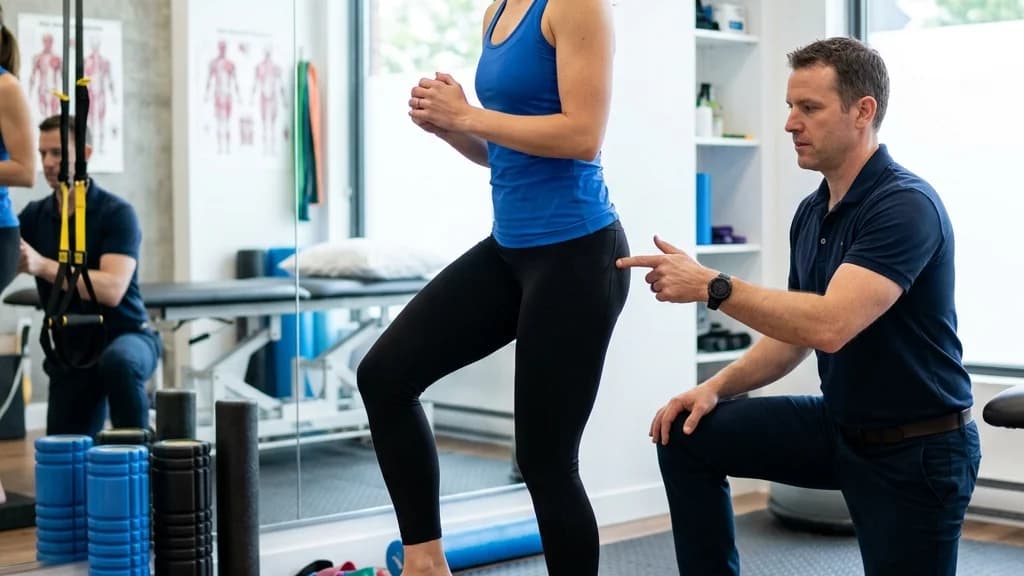
Featured image: A physical therapist in a clinical gym setting guiding a patient through a single-leg stability exercise on a foam pad, pointing to the active gluteus medius muscle. Professional clinical equipment and rehab bands are visible. Created for AyurPhysio educational resources.
Irushi Abeywardhana
Senior Physiotherapist & Founder of Physio Pulse. Senior Clinical Physiotherapist passionate about blending advanced movement science with functional resilience.
Medical Disclaimer
The information provided by AyurPhysio is for general educational and informational purposes only. It is not intended as a substitute for professional medical advice, diagnosis, or treatment. Always seek the advice of your physician or other qualified health providers with any questions you may have regarding a medical condition. Never disregard professional medical advice or delay in seeking it because of something you have read on this website.
Trending Guides
George Washington's Fatal Bloodletting: An Ayurvedic Reconstruction of Rakta Dhatu Depletion and Ojas Collapse
8 min readJack Grealish's stress fracture of the foot: Soccer Biomechanics, Fifth Metatarsal Load, and Surgical Rehab
8 min readBen White's Severe Knee Injury: A Biomechanical Analysis of Lateral Meniscus Shear and Joint Longevity
8 min readElly De La Cruz's Hamstring Strain: The Biomechanics of Sprint Deceleration
8 min readTotal Knee Replacement (TKR): Post-Op Protocols for Restoring Extension
9 min readWeekly Wellness
Don't miss the next guide
Join 5,000+ subscribers getting holistic health tips every Tuesday.
Related Healing Guides
View All Guides →
Total Knee Replacement (TKR): Post-Op Protocols for Restoring Extension
Fall Prevention in Seniors: Rebuilding Ankle Stability and Proprioception