Parkinson's Disease: Physical Therapy Exercises to Improve Gait, Balance, and Hand Tremors
"Exercise is not an adjunct to Parkinson's management. It is the most powerful disease-modifying intervention we currently possess. Levodopa replaces missing dopamine. Exercise teaches the remaining brain to use what it has more efficiently — and that is an incomparably more durable therapeutic strategy."
The fear of Parkinson's disease is not just the tremor that makes the cup shake — it is the gradual, relentless theft of independence. The shuffling steps that grow shorter each month. The freezing episodes at doorways, as if an invisible force has glued your feet to the floor. The posture that slowly curls you forward, as though gravity has decided to increase its demands specifically for you.
But here is what the clinical evidence — and increasingly, neuroscience — tells us with growing conviction: movement is medicine for the Parkinsonian brain in a way that no pill can replicate. Structured physical therapy does not slow the disease from the outside. It reshapes the brain from within, stimulating neuroplasticity in pathways that the disease has begun to compromise.
What Parkinson's Does to Movement: The Clinical Picture
Parkinson's disease is caused by the degeneration of dopaminergic neurons in the substantia nigra — a small region of the brainstem responsible for initiating and modulating smooth, coordinated movement. As dopamine levels fall by more than 60–80% (the threshold at which symptoms become clinically apparent), the motor system loses its fluid, automatic quality.
The result is a characteristic triad of motor dysfunction: resting tremor (the pill-rolling hand tremor), rigidity (lead-pipe or cogwheel resistance to passive movement), and bradykinesia (pathological slowness of movement initiation). These combine to produce the hallmark Parkinsonian gait — small steps, reduced arm swing, stooped posture, and the terrifying freezing of gait (FOG) phenomenon that causes sudden involuntary stops mid-stride.
"The single most dangerous misconception in Parkinson's rehabilitation is advising patients to 'rest more' as the disease progresses. Inactivity in Parkinson's is not protective — it is catastrophic. Sedentary Parkinson's patients lose functional capacity at 3–4 times the rate of age-matched active patients. Every week of bed rest in a Parkinson's patient erodes the neuroplastic gains accumulated over months of therapy. We must keep them moving — safely, strategically, and progressively."
Evidence-Based Exercise Protocols for Parkinson's Disease
- High-intensity treadmill training (at 80% maximum heart rate) reduces motor symptom severity scores (UPDRS-III) by an average of 7.5 points — comparable to a medication dose increase.
- LSVT BIG therapy produces an average 38% improvement in walking speed and step length after just 16 sessions over 4 weeks.
- Patients who exercise 3+ hours per week have a 30% lower fall rate compared to non-exercising peers with equivalent disease severity.
- Rhythmic auditory stimulation during walking increases cadence and stride length by up to 25% in patients experiencing freezing of gait.
- 1LSVT BIG Therapy — Recalibrating Movement AmplitudeThe Lee Silverman Voice Treatment BIG protocol is the most evidence-supported physiotherapy intervention for Parkinson's. Patients perform large-amplitude, high-effort movements — exaggerated arm swings, big steps, large trunk rotations — to recalibrate the motor cortex's internal model of "normal" movement size. The Parkinsonian brain systematically underestimates how large its movements are, producing the characteristic shuffle and hunch.
- 2High-Intensity Treadmill TrainingA 2019 multicenter clinical trial (SPARX3) demonstrated that treadmill training at 80–85% maximum heart rate produced significantly superior gait outcomes compared to moderate-intensity walking. Work at high intensity for 30 minutes, 3x per week, using handrail support only for safety — not for weight-bearing.
- 3Rhythmic Auditory Stimulation (RAS) for Freezing of GaitEntraining a metronome beat (or music with a clear beat at 110–120 BPM) during walking bypasses the damaged basal ganglia gating mechanism by providing an external temporal cue. Patients using RAS demonstrate consistently longer, faster, more regular strides — often eliminating FOG episodes entirely in the short term.
- 4Balance and Tai ChiA landmark 2012 NEJM randomized trial found that Tai Chi training for 24 weeks reduced falls by 47% and improved postural stability significantly more than resistance training or stretching alone. Tai Chi's slow, deliberate weight-shifting trains the precise balance pathways most compromised in Parkinson's.
- 5Hand Dexterity ExercisesFine motor drills — peg boards, writing exercises, coin manipulation, and therapy putty squeezing — must be performed daily. Research confirms that hand dexterity exercises performed for just 20 minutes daily maintain functional independence for activities of daily living significantly longer than patients who discontinue hand-specific training.
The Patient: Mr. Rajan, a 68-year-old retired engineer diagnosed with Parkinson's disease for 4 years, presented with severe freezing of gait, hunched posture, and had fallen three times in the preceding month.
The Mistake: His family had reduced his activity due to fall fear, leading to rapid deconditioning over 6 months.
The Solution: AyurPhysio enrolled him in a 16-session LSVT BIG program with added metronome-guided treadmill training 3x per week and daily 15-minute hand dexterity drills.
The Outcome: Zero falls in 8 months following the program. Walking speed increased by 28%. He independently dresses and writes legibly for the first time in two years.
The Ayurvedic Parallel: Vata and the Shrunken Flame
In Ayurvedic clinical theory, Parkinson's disease maps closely to Kampavata — a condition of excess Vata drying and destabilizing the nervous channels (majja vaha srotas). The tremor, rigidity, and movement arrest are classic signs of Vata's wind element spinning out of control in the nervous system without the anchoring oil of Sneha (lubrication). Daily Abhyanga (oil massage with Ksheerabala or Mahanarayan taila) combined with Nasya therapy has been used as an adjunct in Indian Ayurvedic hospitals for decades, with small clinical trials showing improvements in UPDRS tremor subscores when used alongside physiotherapy.
For the neurological rehabilitation foundation underpinning Parkinson's exercises, our deep dive into neuroplasticity and stroke rehabilitation reveals the same brain-reshaping principles. For fall prevention science in aging populations, our guide on protecting joint mobility and balance in your 60s is an essential companion read. And our Ayurvedic guide to managing Vata imbalance in the nervous system provides the constitutional framework for adjunct care.
Parkinson's is progressive — but so is your brain's capacity to adapt, compensate, and rewire when given the right stimulus. The question is not whether exercise helps in Parkinson's disease. The science has settled that. The question is: is your current program specific enough, intense enough, and consistent enough to make a real difference in daily function?
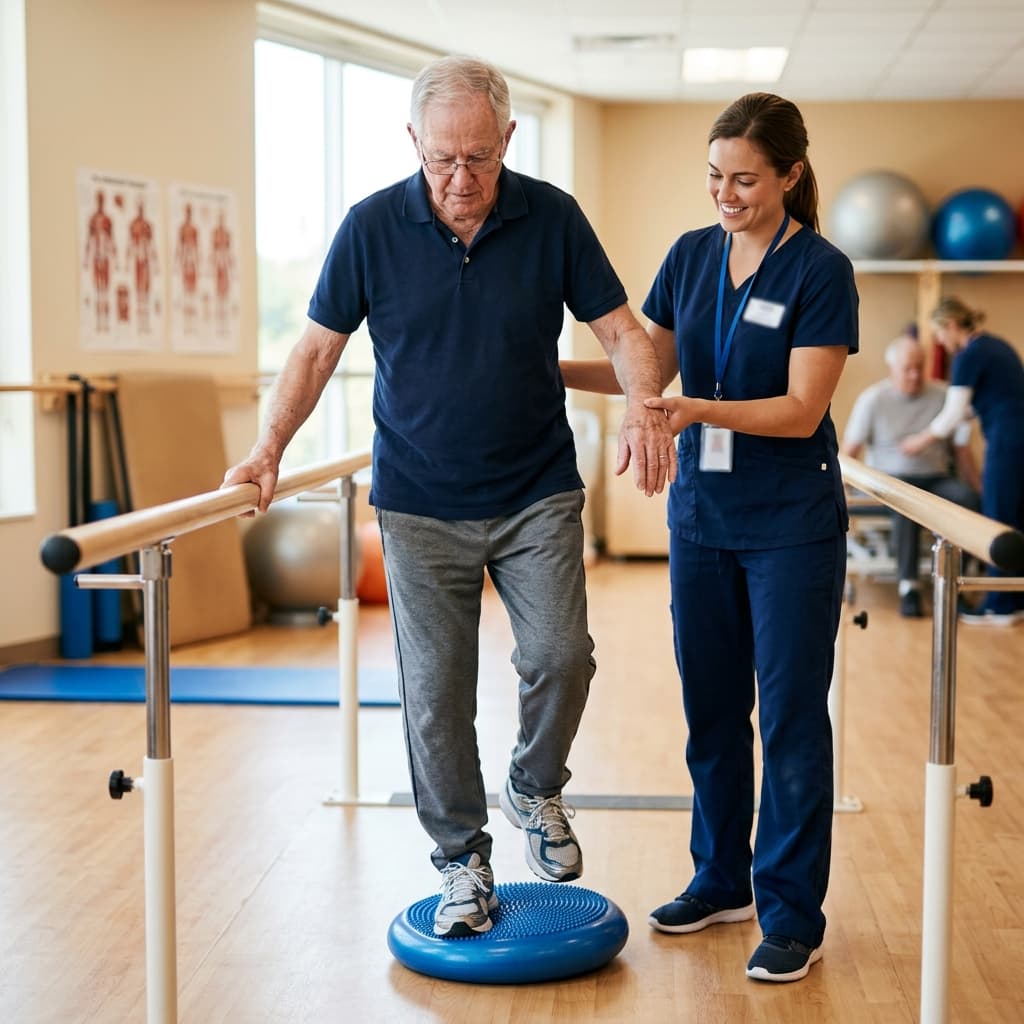
Featured image: Physiotherapist guiding elderly Parkinson's patient through balance board gait training in clinical rehab setting. Created for AyurPhysio editorial use.
Irushi Abeywardhana
Senior Physiotherapist & Founder of Physio Pulse. Senior Clinical Physiotherapist passionate about blending advanced movement science with functional resilience.
Medical Disclaimer
The information provided by AyurPhysio is for general educational and informational purposes only. It is not intended as a substitute for professional medical advice, diagnosis, or treatment. Always seek the advice of your physician or other qualified health providers with any questions you may have regarding a medical condition. Never disregard professional medical advice or delay in seeking it because of something you have read on this website.
Related Healing Guides
View All Guides →
Spinal Stenosis: Flexion-Based Rehab Protocols for Pain-Free Walking
Pelvic Organ Prolapse: Pelvic Floor Stabilization and Safe Lift Mechanics