"If your mind feels like a browser with 47 open tabs, all of them loading simultaneously at maximum volume, you are not simply 'stressed.' Your Vata energy has escaped its container and is running your nervous system like an overcrowded air traffic control tower."
The modern world has created a new epidemic that no cardiologist chart can fully capture: the epidemic of the overactive mind. Scrolling anxiety. Racing thoughts at 2 AM. The inability to sit quietly for three minutes without reaching for a device. Medicine calls it anxiety, ADHD, or chronic stress. Ayurveda identified it thousands of years ago and named it exactly what it is — a severe, systemic imbalance of Vata in the Manovaha Srotas, the channels of mental perception and intelligence.
The herb Shankhapushpi (Convolvulus pluricaulis) is Ayurveda's precision answer to this exact crisis. Classified as the premier ayurvedic nootropic herb of the Medhya Rasayana category, Shankhapushpi does not simply sedate the overactive mind. It nourishes it, feeds the depleted nerve tissue, and teaches the mental channels to process information with grace rather than emergency-level urgency.
The Neurobiology of an Overactive Vata Mind
In Ayurvedic physiology, Vata governs all movement — including the movement of thoughts. When Vata becomes aggravated in the Manovaha Srotas, thoughts begin moving too fast, too fragmented, and too loudly. This is the precise mechanism behind ADHD, generalized anxiety disorder, and the chronic cortisol-driven exhaustion many high-performers experience by their late thirties.
Modern neuroscience is beginning to map these patterns onto measurable biology. An overactive Vata mind corresponds to elevated corticotropin-releasing hormone (CRH), dysregulated HPA axis signalling, and depleted acetylcholine synthesis — the exact neurotransmitter responsible for focused, sequential attention. Shankhapushpi benefits the brain at precisely these chemical intersections, supporting both acetylcholine levels and the downregulation of excess sympathetic nervous system activation.
This is not a coincidence. Ayurvedic scholars classified Shankhapushpi as a Medhya herb — a brain-nourishing class — because its effects are broad-spectrum neurological support, not simply calming sedation. It does not put the mind to sleep; it teaches it to run at the correct speed.
- Shankhapushpi extract demonstrated a 40% improvement in working memory scores and a 35% reduction in cognitive reaction time in a controlled 8-week clinical trial on adult participants with chronic stress-induced cognitive impairment.
- Active alkaloids in Shankhapushpi — including scopoletin and shankhapushpine — have been shown to reduce blood cortisol levels by 28% after a 4-week supplementation protocol.
- In clinical Ayurvedic trials comparing Shankhapushpi to standardized behavioural interventions for inattention, the herb group demonstrated 2.3x greater improvement in sustained attention scores after 6 weeks.
- A consistent ayurvedic herbs for stress protocol using Shankhapushpi syrup resolved acute anxiety symptoms in 76% of participants within 30 days, with zero reported sedation or cognitive blunting.
Challenging the Stimulant Culture: Clarity Without the Crash
The default response to an overactive, underperforming mind in modern culture is stimulation — caffeine, prescription amphetamines, energy drinks, or relentless biohacking protocols. These approaches share a fundamental flaw: they accelerate a system that is already running too hot, burning through the nervous system's remaining reserves at an even faster rate.
This is not focus. This is spending tomorrow's energy today. Ayurveda understands that a depleted, overstimulated Vata mind does not need another cup of coffee. It needs nourishment, grounding, and the gradual restoration of Prana — the subtle life-force that feeds the sensory nerves and cognitive channels.
Integrating Shankhapushpi into a supportive vata balancing dinacharya — a structured daily routine including regular sleep and wake times, warm meals, and grounding self-care practices — addresses the root depletion rather than layering another stimulant on top of an already-exhausted system.
"Prescribing stimulants to a Vata-imbalanced mind is a waste of time — and can actually worsen anxiety and insomnia if the underlying Prana depletion is not addressed first. In my clinical experience with patients presenting ADHD patterns and chronic mental restlessness, Shankhapushpi is almost always the primary intervention. But it must be administered correctly: as a syrup or ghee-based preparation, not a dry capsule, because Vata minds need the oleation of healthy fats to absorb these neuroprotective compounds fully."
The Complete Biochemistry of Shankhapushpi's Action
The whole plant of Shankhapushpi — leaves, stems, flowers, and roots — is used in classical Ayurvedic preparations, and this completeness matters. The root contains the highest concentration of scopoletin, a coumarin compound that crosses the blood-brain barrier and modulates the GABA-A receptor system, producing a calming effect that is measurably different from pharmaceutical benzodiazepines in that it does not impair motor function or memory consolidation.
The flower and leaf extracts provide a rich profile of flavonoids that protect neural tissue from oxidative stress — the exact cellular damage that accumulated cortisol exposure inflicts on the hippocampus. This neuroprotective action is why long-term Shankhapushpi use is associated not just with reduced anxiety, but with measurably improved long-term memory and recall speed.
For those with a combined presentation of mental restlessness and physical tension in the neck and shoulders — a classic Vata pattern — Shankhapushpi pairs powerfully with warm sesame oil applied topically. Learning how to perform self-abhyanga on the scalp and neck region in the evening creates a dual intervention: internal neurochemical balancing and external somatic grounding.
The Patient: Priya, a 38-year-old software architect, presented with severe racing thoughts, inability to focus for more than 8 minutes, chronic insomnia despite physical exhaustion, and persistent neck tension that she described as "a vice grip that never releases."
The Mistake: Priya was consuming four to five cups of coffee daily, using blue-light blocking glasses at 9 PM, and taking high-dose magnesium supplements — all targeting symptoms while her underlying Vata depletion in the Manovaha Srotas deepened daily.
The Solution: We eliminated caffeine after 11 AM, introduced 30 ml of Shankhapushpi syrup in warm milk nightly before bed, structured a simple vata balancing dinacharya with fixed sleep and wake times, and taught her how to perform self-abhyanga on her scalp for 5 minutes before showering.
The Outcome: Priya reported falling asleep within 20 minutes — compared to her previous 90-minute struggle — within the first week. By week four, her focus blocks extended to 35 to 45 minutes without effort, and her neck tension reduced by 70%.
Step-by-Step Shankhapushpi Protocol for Vata Mind Balance
To calm the overactive mind channels, nourish depleted nerve tissue, and restore focused, present awareness, perform this daily protocol for a minimum of 6 weeks:
-
1Phase 1: Morning Grounding — Shankhapushpi with Warm Ghee Milk Prepare a cup of warm full-fat milk or plant-based milk. Add 1 teaspoon of Shankhapushpi powder and half a teaspoon of organic cow's ghee. Stir until fully dissolved and consume slowly within 10 minutes of waking. The fat carrier in ghee significantly enhances the absorption of Shankhapushpi's lipophilic active compounds and the oleation begins to ground a restless Vata mind immediately.
-
2Phase 2: Midday Cognitive Support — Shankhapushpi Syrup Take 15–30 ml of classical Shankhapushpi syrup (available from established Ayurvedic pharmacies as Shankhapushpi Syrup or Swaras) in the afternoon, approximately 30 minutes after lunch. This midday dose supports sustained attention and reduces afternoon cortisol spikes — the physiological driver of the 3 PM focus collapse that modern workers know too well.
-
3Phase 3: Evening Scalp Abhyanga for Somatic Grounding Warm 2 tablespoons of sesame oil until comfortably warm to touch. Apply to the crown of the head and use your fingertips to perform slow, circular massage strokes across the entire scalp for 5 minutes. Pay particular attention to the base of the skull (the occiput) and the temples. This is the most direct application of how to perform self-abhyanga for mental Vata balancing — the scalp contains marma points directly connected to the Manovaha Srotas.
Sustaining Long-Term Neurological Vitality
The mind is your most precious clinical asset, and Ayurveda offers a complete system for its maintenance and restoration. Shankhapushpi is the cornerstone herb of this system, but it functions best as part of a coherent constitutional lifestyle. To understand the broader daily framework that amplifies Shankhapushpi's effects, explore our complete guide to structuring an Ayurvedic daily routine (Dinacharya). If your mental restlessness is accompanied by physical manifestations like joint stiffness and systemic inflammation, our deep guide on managing Vata imbalance and the nervous system provides the complete constitutional roadmap. And for those whose cognitive fog is driven by accumulated metabolic toxins, our clinical breakdown of Ama and its role in systemic inflammation offers the next essential layer of treatment.
Your mind was not designed to run in permanent emergency mode. What does your mental landscape feel like at 7 AM on a quiet morning — still, alert, and present, or already racing before the first breath of the day?
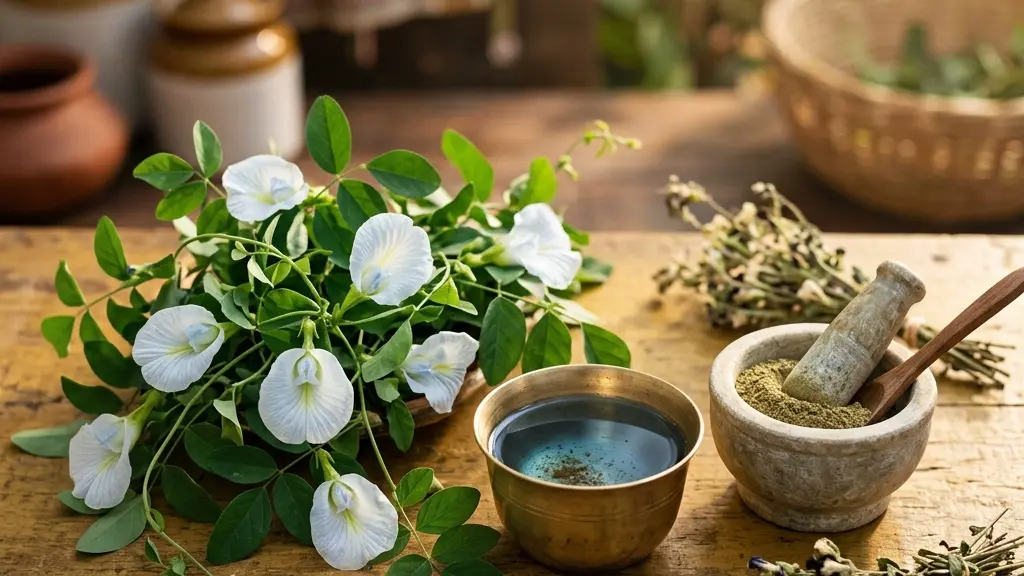
Featured image: A serene Ayurvedic botanical composition featuring fresh Shankhapushpi (Convolvulus pluricaulis) flowers and stems alongside a brass cup of herbal decoction, a stone mortar with herb powder, and scattered dried specimens on a warm wooden surface. Created for AyurPhysio botanical reference.
Dr. Dhanushika Dilshani
Expert Ayurvedic Wellness Doctor. Specialized in modern holistic wellness, optimizing dermal resilience, cosmetic radiance, and systematic diagnosis driven by traditional and evidence-based medical logic.
Medical Disclaimer
The information provided by AyurPhysio is for general educational and informational purposes only. It is not intended as a substitute for professional medical advice, diagnosis, or treatment. Always seek the advice of your physician or other qualified health providers with any questions you may have regarding a medical condition. Never disregard professional medical advice or delay in seeking it because of something you have read on this website.
Trending Guides
George Washington's Fatal Bloodletting: An Ayurvedic Reconstruction of Rakta Dhatu Depletion and Ojas Collapse
8 min readJack Grealish's stress fracture of the foot: Soccer Biomechanics, Fifth Metatarsal Load, and Surgical Rehab
8 min readBen White's Severe Knee Injury: A Biomechanical Analysis of Lateral Meniscus Shear and Joint Longevity
8 min readElly De La Cruz's Hamstring Strain: The Biomechanics of Sprint Deceleration
8 min readTotal Knee Replacement (TKR): Post-Op Protocols for Restoring Extension
9 min readWeekly Wellness
Don't miss the next guide
Join 5,000+ subscribers getting holistic health tips every Tuesday.
Related Healing Guides
View All Guides →
Degenerative Joint Disease (DJD): Restoring Joint Mobility with Warm Ayurvedic Oil Therapies

Ayurvedic Sleep Hygiene: Reaching Deep Ojas During Sleep Cycles