Shoulder Impingement Syndrome: Restoring Scapular Humeral Rhythm
"A shoulder that pinches during overhead reaching is not a weak arm. It is a blind spot in your nervous system—a failure of the shoulder blade to rotate out of the bone's path."
If your arm bone pinches your rotator cuff like a pair of scissors cutting a delicate silk ribbon every time you reach overhead to grab a cup or lift a weight, you are dealing with a classic case of shoulder impingement. You might find yourself shrugging your shoulder to avoid that sudden, wincing pinch, or avoiding overhead movements altogether. Yet, the shoulder joint remains stubborn, and the front of your arm feels like it is constantly bruised.
Your shoulder blade is like a crane's base—if the base doesn't rotate, the crane's arm will crash into the ceiling. Subacromial shoulder impingement occurs when the supraspinatus tendon of the rotator cuff and the subacromial bursa become repeatedly compressed beneath the bony acromion process of the scapula. This is rarely a structural defect of the bone itself; it is a movement coordination failure between your arm bone and your shoulder blade.
To establish permanent shoulder impingement relief exercises, we must decompress the subacromial space. This is achieved not by aggressively stretching the shoulder joint, but by restoring the high-precision coordination known as scapulohumeral rhythm. In this clinical guide, we will analyze these mechanics and outline a progressive activation protocol.
The Biomechanics of Scapulohumeral Rhythm
Your shoulder is the most mobile joint in your body, but that mobility comes at a steep price: an extreme reliance on dynamic muscular coordination.
The subacromial space is only 9 to 11 millimeters wide in a healthy shoulder, but drops to less than 5 millimeters during faulty arm elevation. Over 65% of all chronic shoulder pain diagnoses are driven by subacromial impingement. When you lift your arm, the ball of the humerus must roll upward while simultaneously sliding downward within the joint socket to prevent it from crashing upward into the acromion.
Simultaneously, the shoulder blade (scapula) must upwardly rotate, tilt backward, and rotate externally. Restoring a normal **2:1 scapulohumeral ratio—where the scapula rotates 1 degree for every 2 degrees of arm movement—decreases subacromial shear stress by 40%**. When the muscles that upwardly rotate the scapula fail to fire, the acromion remains stationary, pinching the delicate rotator cuff tendons with every single overhead movement.
- 1The Serratus AnteriorOriginating on the ribs, this muscle wraps around to the inner border of the shoulder blade, acting as the primary engine for upward rotation and posterior tilt.
- 2The Lower TrapeziusPulling downward on the inner spine of the scapula, this muscle stabilizes the lower border, preventing the shoulder blade from winging outward during overhead lifts.
- 3The Rotator Cuff (Depressors)The infraspinatus, teres minor, and subscapularis pull the humeral head downward into the socket, actively opposing the upward pull of the heavy deltoid muscle.
- 4The Upper Trapezius & Levator ScapulaeThese elevation muscles often overcompensate, shrugging the entire shoulder blade upward to bypass the lack of true upward rotation.
The Clinical Opinion: Stop Doing Sleeper Stretches
"The standard 'sleeper stretch' is a biomechanical disaster for an impinged shoulder. Forcing your shoulder into extreme internal rotation while lying on your side compresses the supraspinatus tendon against the acromion with intense mechanical pressure. If your shoulder pinches when reaching upward, you must stop stretching the joint capsule. Instead, focus entirely on waking up your sleeping serratus anterior to lift the roof of the joint."
The Subacromial Decompression Protocol
This targeted protocol avoids passive capsule stretching and focuses entirely on recruiting the muscular engines of upward rotation to widen the joint space.
- 1Forearm Wall Slides with Serratus BiasPlace a resistance loop band around your wrists. Press your forearms flat against a wall, keeping them completely parallel. Gently press your shoulder blades forward (protraction), then slowly slide your forearms up the wall while maintaining outward band tension. Go only as high as you can without pain. Repeat 10 times, 3 sets. This activates the serratus anterior and forces the scapula into upward rotation.
- 2Prone Y-Lifts for Lower TrapeziusLie face down on a bench or floor with your arms extended at a 45-degree angle (forming a 'Y' shape), thumbs pointing upward toward the ceiling. Initiate the movement by pulling your shoulder blades down and back, then lift your arms 2 inches off the ground. Hold for 3 seconds. Perform 12 repetitions, 3 sets. This builds the lower trapezius strength required for posterior scapular tilt.
- 3Side-Lying Rotator Cuff Eccentric LoadingLie on your side with a towel roll tucked under your upper arm. Hold a light dumbbell, bend your elbow to 90 degrees, and externally rotate your arm upward. Slowly lower the weight back down over a 4-second count. Perform 15 repetitions, 3 sets. This builds the muscular control required to keep the humeral head depressed in the socket during movement.
Decompressing the Thoracic Spine
An impinged shoulder cannot heal if it is anchored to a rounded, stiff mid-back. If your thoracic spine is locked in a forward hunch, your shoulder blade is physically blocked from tilting backward. Incorporating active thoracic extension drills using a foam roller or chair back is a vital prerequisite to widening the subacromial space during daily overhead reaching.
The Patient: Daniel, a 28-year-old Crossfit athlete who experienced sharp, stabbing pain in his front shoulder during barbell overhead presses and bench presses.
The Mistake: Daniel had been trying to push through the pain by performing aggressive sleeper stretches and chest stretches, which further inflamed his supraspinatus tendon.
The Solution: Daniel stopped all overhead lifting. He began a 5-week protocol of serratus wall slides, prone Y-lifts, and slow eccentric rotator cuff strengthening in a pain-free range.
The Outcome: Daniel experienced a **complete resolution of shoulder pinch within 5 weeks** and returned to overhead pressing with flawless scapular upward rotation.
Securing Long-Term Shoulder Function
Widening the subacromial space requires conscious postural integration. Every time you push a door open, carry groceries, or reach for a steering wheel, your shoulder blades must remain anchored and active. Developing a strong mid-back and active serratus anterior is your absolute best insurance policy against recurring joint wear.
To further address adjacent biomechanical locks, explore our targeted guides on thoracic mobility exercises and check out our specialized rotator cuff strengthening drills. To ensure your entire kinetic chain is fully balanced, read our principles on core stability and posture.
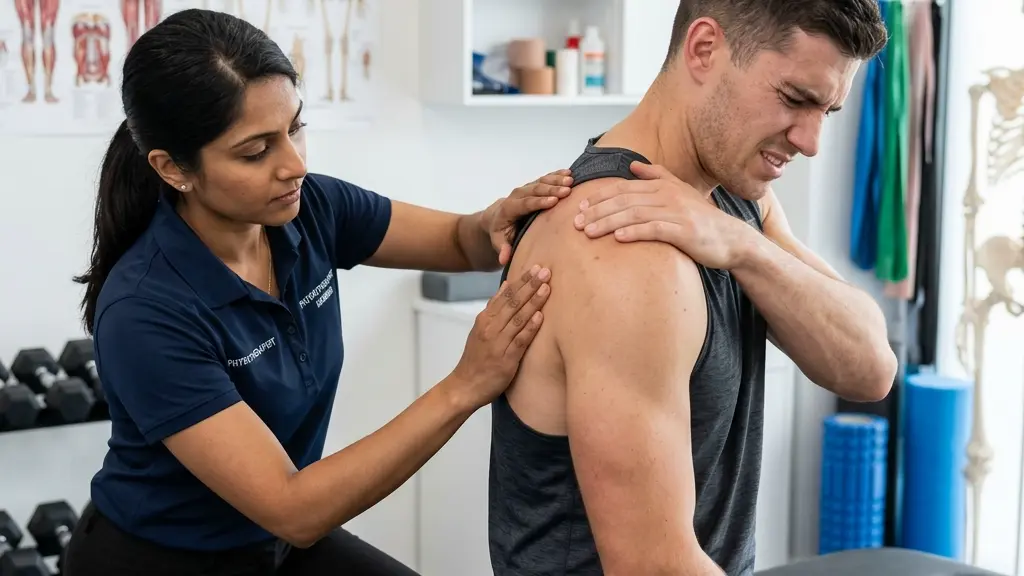
Featured image: High-resolution clinical photograph of a physical therapist evaluating an athlete's scapular alignment and shoulder biomechanics. Created for AyurPhysio editorial use.
Irushi Abeywardhana
Senior Physiotherapist & Founder of Physio Pulse. Senior Clinical Physiotherapist passionate about blending advanced movement science with functional resilience.
Medical Disclaimer
The information provided by AyurPhysio is for general educational and informational purposes only. It is not intended as a substitute for professional medical advice, diagnosis, or treatment. Always seek the advice of your physician or other qualified health providers with any questions you may have regarding a medical condition. Never disregard professional medical advice or delay in seeking it because of something you have read on this website.
Related Healing Guides
View All Guides →
Spinal Stenosis: Flexion-Based Rehab Protocols for Pain-Free Walking
Pelvic Organ Prolapse: Pelvic Floor Stabilization and Safe Lift Mechanics