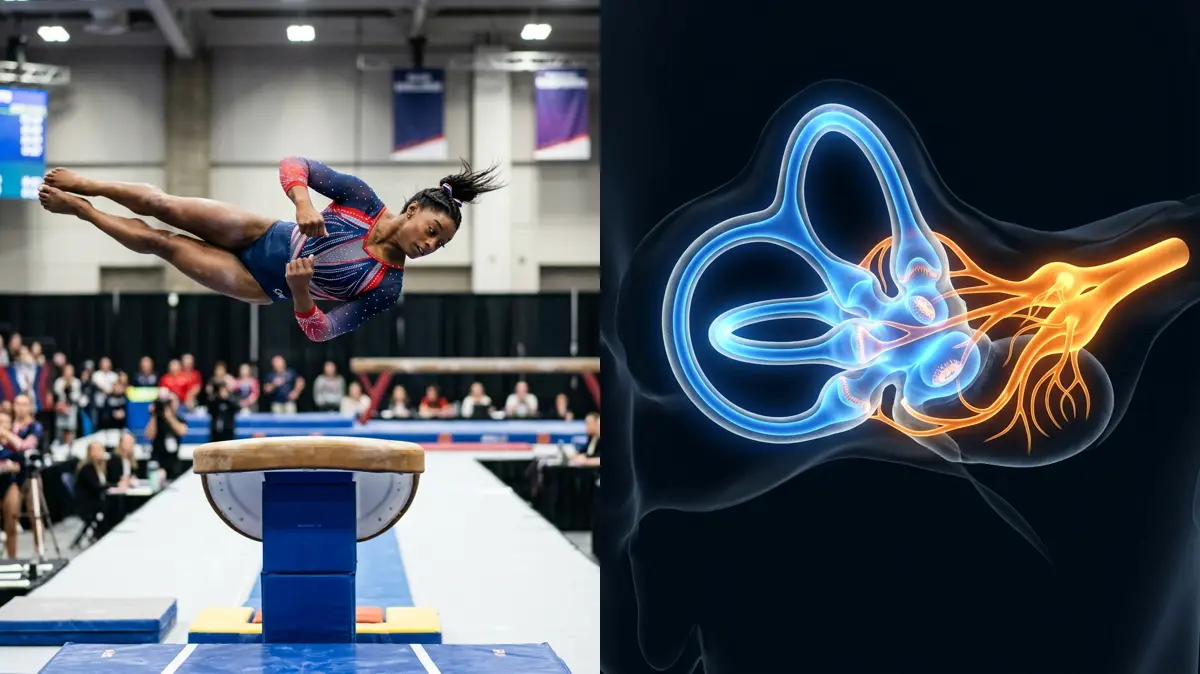
"When a gymnast is rotating through multiple axes at fifteen feet in the air, a microscopic delay in inner ear sensory signaling turns the body from a precision instrument into an unguided projectile."
At the Tokyo Olympics, the sporting world watched in disbelief as gymnastics legend Simone Biles withdrew from multiple events. The cause was not a muscular tear or a broken bone, but a mysterious mental block known in gymnastics as the twisties. Mid-flight, Biles lost her spatial orientation, describing the sensation of her brain and body completely decoupling in mid-air. What was dismissed by some as performance anxiety was, in fact, a profound neuro-biomechanical crisis.
The phenomenon of simone biles twisties is a real-world manifestation of acute vestibular mismatch. In gymnasts, the brain must synthesize visual cues, joint feedback, and gravity signals from the inner ear within milliseconds. When these streams disagree, spatial awareness collapses. It is the neurological equivalent of trying to pilot a drone whose GPS is feeding coordinates from a different time zone. Passive rest does not fix this; reclaiming control requires active sensory retraining.
Rather than letting the nervous system remain disoriented, sports physical therapists deploy specific vestibular exercises. These drills force the brain to reconcile conflicting inputs, strengthening neural pathways and restoring coordination. Let us dive into the complex biomechanics of spatial orientation and look at how athletes rebuild their internal coordinates.
The Tri-Planar Equilibrium: Inside the Vestibular Apparatus
To keep the body balanced during complex movement, the nervous system relies on three sensory systems: vision, proprioception (joint receptors), and the vestibular system (the inner ear). The vestibular apparatus consists of three fluid-filled semicircular canals that detect rotational acceleration and two otolith organs (the utricle and saccule) that register linear movement. These organs transmit acceleration coordinates to the brain via the vestibulocochlear nerve.
During flips and twists, an athlete is spinning around multiple axes at high speeds. The fluid inside the semicircular canals moves, bending microscopic hair cells that trigger electrical impulses. Under ordinary circumstances, the brain cross-references these inner ear signals with visual landmarks and muscular feedback. This integration is what constructs proprioception in gymnastics, keeping the athlete aware of their position relative to the floor.
A sensory mismatch occurs when one system lags. If high stress or physiological fatigue alters the fluid dynamics of the inner ear, or if visual landmarks are blurred, the brain receives contradictory data. Reconciling these inputs is like calibrating a smartphone's internal gyroscope on a shaky subway ride. If the calibration fails, the motor cortex is unable to plan a safe landing, leading to sudden, involuntary motor lockups.
- Vestibular mismatch occurs when the brain is forced to process conflicting sensory signals moving at speeds up to 100 milliseconds slower than visual inputs, triggering motor inhibition.
- Elite gymnasts experience angular velocities exceeding 720 degrees per second, where even a 0.5-degree deviation in head position compromises landing safety.
- Over 90% of sensory integration deficits in athletes can be successfully resolved with targeted vestibular rehabilitation protocols.
- Integrating balance-related training reduces non-contact sports injuries by up to 45% in high-impact, multi-axial disciplines.
Why Mental Grinding Fails a Mismatched Brain
When an athlete experiences disorientation, the instinct is often to push through, repeating the skill in the hope that muscle memory will override the block. This is a dangerous mistake. Attempting complex air maneuvers while experiencing a sensory mismatch forces the brain to associate those skills with extreme panic, reinforcing the neural block.
My clear, clinician-led perspective is that trying to mentally grind through the twisties is both counterproductive and physically hazardous. The nervous system is shutting down motor patterns as a safety mechanism because it cannot confirm where the ground is. Reconditioning must start with basic, low-impact sensory-reweighting drills on flat ground. If you try to force air spins before recalibrating your inner ear, you are teaching your brain to fail under load.
Re-education begins by stripping away the complex moves and training the vestibulo-ocular reflex (VOR). VOR is the mechanism that stabilizes images on the retina during head movement. By performing eye-tracking drills while moving the head, we train the brain to keep the eyes fixed on a target, laying the foundation for complex aerial control.
"In elite gymnastics, spatial navigation is not just a mental trick — it is a precise calculation executed by the brainstem. When Simone Biles experienced the twisties, her inner ear was telling her she was rotating, while her eyes were searching for the ceiling, and her joints were feeling gravity in a different vector. To resolve this mismatch in my clinic, we do not throw athletes back onto the trampoline. We start with closed-eyes joint positioning drills and vestibular tracking exercises. We teach the brain to trust the inner ear when the eyes are moving too fast, rebuilding spatial coordinates from the ground up."
Rebuilding Coordination: Vestibular Rehabilitation Therapy
Restoring spatial awareness after disorientation requires structured vestibular rehabilitation. The primary objective is to train the brain to prioritize vestibular and proprioceptive inputs over visual input, particularly when visual cues are moving too fast to process. This sensory-reweighting process is crucial for dynamic balance.
Rehab starts with gaze stabilization drills. The patient keeps their eyes focused on a target while turning their head side to side and up and down. This exercises the brain's ability to maintain focus despite movement. Gradually, we progress to balance training on unstable surfaces, using soft foam pads and balance boards to force the joint receptors to work harder.
Finally, we introduce head-turning movements during walking and jumping. This simulates the rotational forces of gymnastics, training the vestibular system to react to sudden accelerations. By pairing these exercises with proper cervical spine mobility, we ensure that sensory signals travel to the brain without restriction.
Step-by-Step Vestibular Recalibration Protocol
Perform this balance sequence daily in a safe environment, holding onto a stable support if you feel lightheaded. Stop immediately if you experience dizziness or nausea:
-
1Phase 1: Gaze Stabilization (VOR x1) (3 sets of 30 seconds) Hold a target card (with a small letter 'X' printed on it) at arm's length at eye level. Keeping your eyes focused on the 'X', slowly shake your head left and right, and then up and down. The target must remain in sharp focus. This is a foundational exercise in vestibular system rehab to stabilize visual tracking during movement.
-
2Phase 2: Sensory-Reweighted Balance (3 sets of 45 seconds) Stand tall with your feet together on a soft cushion or balance board. Fold your arms across your chest and close your eyes. Try to maintain your balance without moving your feet. Removing visual cues forces the brain to rely entirely on inner ear balance exercises and joint proprioceptors to maintain alignment.
-
3Phase 3: Dynamic Rotation Drills (2 sets of 10 repetitions) Walk slowly in a straight line. Every two steps, turn your head 90 degrees to the left, then back to center, then 90 degrees to the right. Once this is comfortable, progress to doing this while jogging or performing light hopping exercises. This trains the brain to process rotational changes during vertical acceleration.
Sustaining Spatial Coordination
Maintaining balance requires continuous training of your joints and nervous system. If you want to explore the tools used in clinic, read our detailed review of the top 5 balance boards for proprioceptive training. If you are recovering from a lower-extremity injury, learn about restoring balance in our guide on ankle sprains and proprioception. You can also view our sports-specific balance analysis in the breakdown of Stephen Curry's ankle rehab protocol.
Your balance is a dynamic conversation between your eyes, your inner ear, and your joints. Feed your brain clear coordinates, train your stabilizers, and stay grounded.
Are you actively training your inner ear to navigate complex movement, or are you waiting for your spatial awareness to fail mid-flight?
Dr. Dhanushika Dilshani
Expert Ayurvedic Wellness Doctor. Specialized in modern holistic wellness, optimizing dermal resilience, cosmetic radiance, and systematic diagnosis driven by traditional and evidence-based medical logic.
Medical Disclaimer
The information provided by AyurPhysio is for general educational and informational purposes only. It is not intended as a substitute for professional medical advice, diagnosis, or treatment. Always seek the advice of your physician or other qualified health providers with any questions you may have regarding a medical condition. Never disregard professional medical advice or delay in seeking it because of something you have read on this website.
Trending Guides
George Washington's Fatal Bloodletting: An Ayurvedic Reconstruction of Rakta Dhatu Depletion and Ojas Collapse
8 min readJack Grealish's stress fracture of the foot: Soccer Biomechanics, Fifth Metatarsal Load, and Surgical Rehab
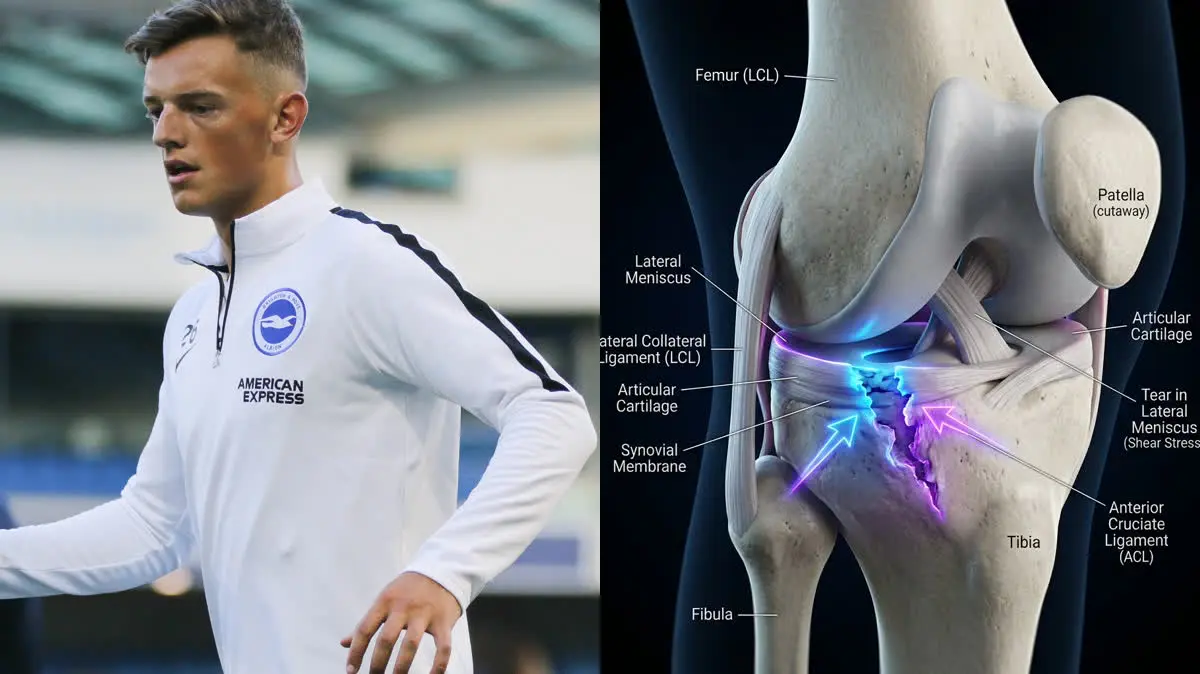
8 min readBen White's Severe Knee Injury: A Biomechanical Analysis of Lateral Meniscus Shear and Joint Longevity
8 min readElly De La Cruz's Hamstring Strain: The Biomechanics of Sprint Deceleration
8 min readTotal Knee Replacement (TKR): Post-Op Protocols for Restoring Extension
9 min readWeekly Wellness
Don't miss the next guide
Join 5,000+ subscribers getting holistic health tips every Tuesday.
Related Healing Guides
View All Guides →
George Washington's Fatal Bloodletting: An Ayurvedic Reconstruction of Rakta Dhatu Depletion and Ojas Collapse
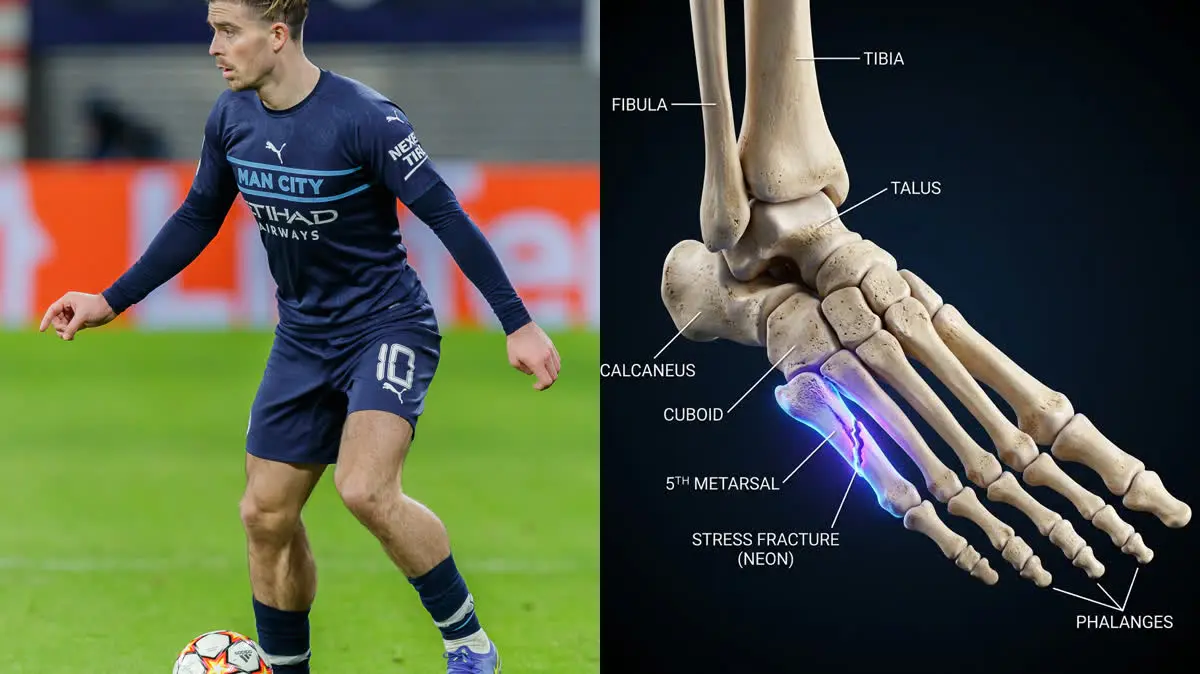
Jack Grealish's stress fracture of the foot: Soccer Biomechanics, Fifth Metatarsal Load, and Surgical Rehab