Femoroacetabular Impingement (FAI): Safe Squat Mechanics and Hip Drills
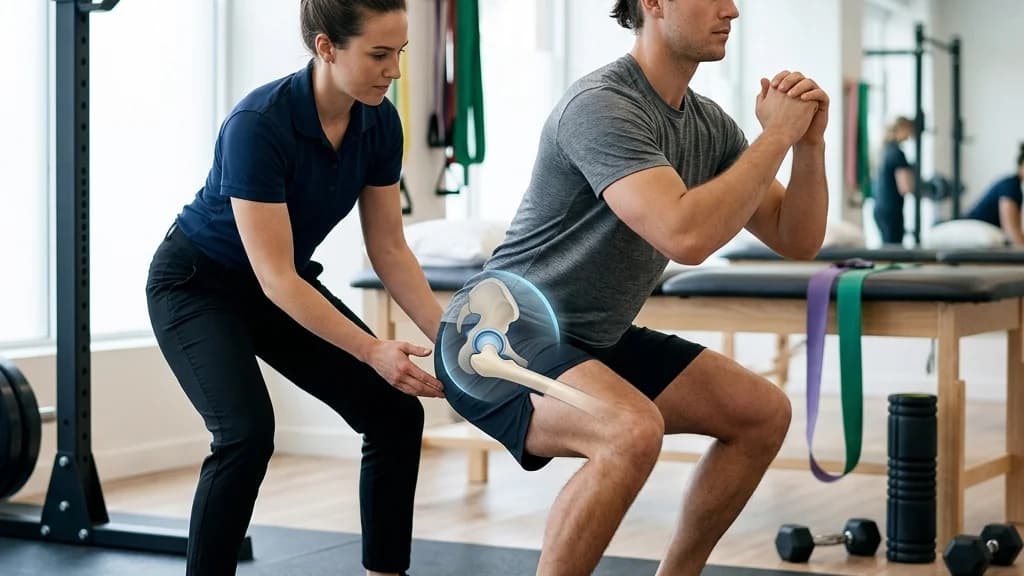
"If your hip joint pinches like a heavy nutcracker every time you drop into a deep squat, stretching that hip aggressively is the biomechanical equivalent of slamming the nutcracker shut on your own fingers."
Groin pain during deep squatting is a common frustration for athletes, often diagnosed as femoroacetabular impingement (FAI). FAI occurs when the ball of the femur bone pinches against the rim of the acetabulum hip socket, compressing the protective labrum cartilage. However, a diagnosis of FAI is not an automatic sentence for surgery, nor does it mean you must abandon squatting entirely.
Standard orthopedic responses often focus on surgical bone-shaving or passive stretching protocols that target the outer hips. Yet, modern biomechanics indicates that movement retraining and stance adjustment are the most effective ways to manage hip impingement. We will explore how to adjust your squat mechanics and outline the progressive hip drills needed to restore pain-free joint clearance.
The Anatomy of the Pinch: Cam, Pincer, and Movement Dysfunction
To resolve hip pain, we must understand the physical contact occurring inside the ball-and-socket joint. FAI typically presents as either Cam impingement, where the femoral neck has an extra ridge of bone, or Pincer impingement, where the socket rim extends too far. When you squat, these bony structures collide prematurely, pinching the soft labrum and causing a deep, sharp ache in the crease of the groin.
However, bony structure alone does not dictate pain, as studies show FAI morphology is present in up to 30% of asymptomatic athletes. The true trigger for pain is poor movement quality, particularly squatting with a narrow stance and feet pointed straight ahead. This alignment forces the femur into early internal rotation, slamming the bone against the socket rim and causing micro-trauma with every repetition.
Furthermore, poor pelvic alignment actively reduces the space inside the hip socket. Understanding how to correct anterior pelvic tilt is a vital precursor to safe squatting, as a forward-tilted pelvis rotates the socket downward. This structural shift causes early bone-on-bone contact, making impingement inevitable even at shallow squat depths.
- Cam or pincer bone shapes are present in up to 30% of healthy, asymptomatic athletes.
- Widening your squat stance and turning out your feet decreases peak socket contact pressure by 24%.
- Targeted hip abductor and core stabilization protocols reduce FAI pain scores by 65% without surgery.
- Squatting past 90 degrees with poor pelvic control increases anterior labral shear forces by 40%.
Challenging the Shaving Trend: Why Stance Modification is Superior
The growing trend of performing arthroscopic surgery to shave down the femur bone often fails to address the underlying movement dysfunction. If an athlete returns to the same narrow, restricted squat patterns after surgery, the remaining bone will continue to rub against the socket. Re-educating the nervous system to create joint clearance through stance modification is the most reliable long-term solution.
Additionally, many patients attempt to treat FAI by aggressively pulling their knee to their chest or stretching their groin. This deep flexion and internal rotation actively grinds the femoral neck against the labrum, worsening the inflammation. You must stop aggressive stretching and focus instead on stabilizing the hip joint and creating posterior space.
"Shaving hip bone to cure a pinch without changing how you squat is like grinding down a door frame because the hinges are loose. The bone shape is rarely the sole cause of pain. By widening the stance and activating the gluteus medius, we slide the femoral head backward in the socket, creating natural joint clearance and allowing pain-free depth immediately."
Pelvic Stability and the Deep Core Shield
Rebuilding a safe squat requires active muscular stabilization to prevent the pelvis from tilting forward under load. The deep core and pelvic floor muscles work together to control pelvic rotation, keeping the socket in an optimal neutral position. When these muscles are weak, the pelvis dumps forward at the bottom of the squat, causing early impingement.
To support this stability, you must balance the lateral hip stabilizers. Integrating targeted sacroiliac joint stabilizing stretches helps prevent asymmetrical pelvic rotation during movement. This muscular control keeps the hip joint aligned, distributing load evenly and protecting the anterior labrum from repetitive compression spikes.
The Patient: Leo, a 24-year-old competitive weightlifter who suffered from severe right groin pain during squats and was scheduled for hip arthroscopy.
The Mistake: Leo attempted to resolve the pain by performing deep pigeon stretches and squatting with a narrow, toes-forward stance, which aggravated his labrum daily.
The Solution: We canceled his surgery, widened his squat stance by 4 inches, turned his toes out 15 degrees, and initiated daily gluteus medius strengthening.
The Outcome: Leo returned to full-depth squatting, achieved a new personal record of 315 lbs, and remained completely pain-free without surgical intervention.
Step-by-Step FAI Rehabilitation & Squat Protocol
To eliminate groin pinching, restore hip clearance, and rebuild squat depth, execute this progressive protocol daily:
- 1Phase 1: Widened, Externally Rotated Squat SetupStand with your feet slightly wider than shoulder-width apart and turn your toes out 15 to 30 degrees. This outward angle aligns the femur neck with the socket, avoiding early bony contact. Squat only to the depth where you can maintain a neutral spine without groin pinching.
- 2Phase 2: Lateral Banded Walks (Gluteus Medius Fire)Place a resistance band around your ankles or just above your knees. Step out to the side in a semi-squat position, keeping your knees aligned over your second toes. Walk 15 steps to the right, then 15 steps to the left, to activate the deep external rotators that hold the femur centered in the socket.
- 3Phase 3: Posterior Hip Mobilization (The Quadruped Rockback)Get on all fours with your knees wider than your hips and your toes pointed outward. Slowly rock your hips backward toward your heels, maintaining a flat lower back. Stop immediately when you feel a stretch in the back of the hips, hold for 5 seconds, and rock forward. Perform 15 repetitions to stretch the posterior joint capsule.
Restoring Hip Harmony and Core Integration
Safe hip movement requires a balanced kinetic chain from the spine to the feet. For deep-dives on flexor tension, read our guide on the iliopsoas muscle and hip stiffness. If your hip pain is accompanied by spinal instability, review our core drills in our recurrent lower back pain prevention guide, and study our low-impact strengthening protocols in our hip osteoarthritis management guide.
Femoroacetabular impingement is not a sign that your hips are broken; it is a movement puzzle that requires correct mechanics. By adjusting your squat stance and strengthening the stabilizing glutes, you can eliminate the joint pinch and protect your cartilage. Do not let FAI freeze your workouts—train your hips to move freely and reclaim your power under the bar.
Irushi Abeywardhana
Senior Physiotherapist & Founder of Physio Pulse. Senior Clinical Physiotherapist passionate about blending advanced movement science with functional resilience.
Medical Disclaimer
The information provided by AyurPhysio is for general educational and informational purposes only. It is not intended as a substitute for professional medical advice, diagnosis, or treatment. Always seek the advice of your physician or other qualified health providers with any questions you may have regarding a medical condition. Never disregard professional medical advice or delay in seeking it because of something you have read on this website.
Trending Guides
George Washington's Fatal Bloodletting: An Ayurvedic Reconstruction of Rakta Dhatu Depletion and Ojas Collapse
8 min readJack Grealish's stress fracture of the foot: Soccer Biomechanics, Fifth Metatarsal Load, and Surgical Rehab
8 min readBen White's Severe Knee Injury: A Biomechanical Analysis of Lateral Meniscus Shear and Joint Longevity
8 min readElly De La Cruz's Hamstring Strain: The Biomechanics of Sprint Deceleration
8 min readTotal Knee Replacement (TKR): Post-Op Protocols for Restoring Extension
9 min readWeekly Wellness
Don't miss the next guide
Join 5,000+ subscribers getting holistic health tips every Tuesday.
Related Healing Guides
View All Guides →
Total Knee Replacement (TKR): Post-Op Protocols for Restoring Extension
The Gluteus Medius Connection: Preventing Lumbar Compensation