Post-Pregnancy Hip Instability: Reconditioning the Pelvic Ring and Glutes
“A stable pelvis acts like the solid foundation of a house; when pregnancy loosens the mortar, the surrounding structures must work twice as hard to prevent the walls from cracking.”
Does walking feel like your hips are made of mismatched puzzle pieces that slip and slide with every step you take? If lifting your baby from the crib triggers a deep, dull ache in your lower back or pelvis, you are not dealing with standard postpartum fatigue. You are experiencing the mechanical instability of the pelvic ring, a common result of ligament laxity after pregnancy.
Many new mothers are told to immediately perform aggressive stretching or core exercises to snap their bodies back into shape. However, stretching a hyper-mobile pelvis without stabilizing the surrounding joints first is a recipe for chronic pain. We recommend a clinical physical therapy protocol that focuses on closing the pelvic ring and rebuilding the glutes.
The Anatomy of Pelvic Laxity
During pregnancy, the hormone relaxin softens the pelvic ligaments to allow joint expansion for childbirth. Studies show this ligamentous laxity causes a 32% increase in pelvic shear forces during normal walking. This instability forces the surrounding muscles to tighten as a protective mechanism, causing a false sensation of hip stiffness.
To visualize this, think of your pelvis as a suspension bridge where the main cables have become loose and saggy. The gluteal muscles and the pelvic floor are the supporting cables that must be tensioned to keep the bridge stable. Attempting to stretch away postpartum hip tightness is like pulling on the saggy bridge cables—it only increases joint laxity.
Understanding pelvic biomechanics requires analyzing two concepts: form closure and force closure. Form closure refers to the stable, interlocking shape of the pelvic bones themselves. Force closure is the compression generated by muscles and fascia acting across the joints to hold them together under load.
While pregnancy temporarily compromises form closure by loosening the ligaments, we can compensate by maximizing force closure. Rebuilding the strength of the glutes and pelvic floor muscles creates an active clamp across the joints. This muscular compression prevents abnormal joint shearing and eliminates the chronic ache.
The standard advice to stretch out tight hips after pregnancy is a dangerous myth that worsens pelvic instability. What feels like muscle tightness is actually your nervous system clamping down to hold your loose joints together. Stretching these muscles removes the only stability you have left, which will worsen your sacroiliac joint pain.
Reconditioning the Pelvic Ring
Reconditioning the pelvis requires a progressive transition from basic alignment to active stabilization. These exercises should be performed daily within a pain-free range of motion. Focus on quality of muscle activation rather than the number of repetitions.
-
1Isometric Adductor Squeezes Lie on your back with knees bent, place a soft ball between your knees, and gently squeeze for 5 seconds to activate the pelvic floor.
-
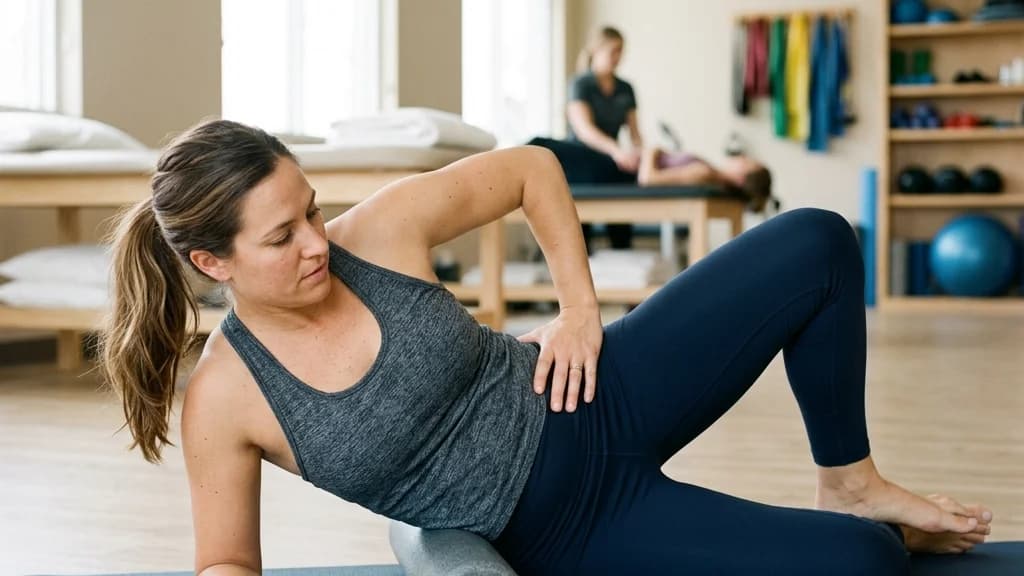
2Side-Lying Clamshells Lie on your side with hips bent at 45 degrees, keep your heels together, and raise your top knee slowly to isolate the gluteus medius.
-
3Band-Resisted Glute Bridges Place a resistance loop around your knees, press your feet down, and lift your hips while pressing outward against the band.
The Patient: Amanda, a 31-year-old school teacher and mother of a 3-month-old, suffered from severe pain in her lower back and pubic bone that made walking difficult.
The Mistake: She attempted to relieve her hip stiffness by doing deep pigeon stretches and hamstring stretches, which severely aggravated her unstable sacroiliac joints.
The Solution: We stopped all static stretches, introduced a rigid pelvic support belt, and initiated a 5-week protocol of glute medius strengthening and pelvic floor stabilization.
The Outcome: Amanda reported a 90% reduction in pelvic pain, returned to walking 3 miles daily, and could lift her baby without discomfort.
Targeted Stabilizing Stretches and Core Integration
To begin your active recovery, we recommend incorporating specific sacroiliac joint stabilizing stretches into your daily routine. Unlike standard deep stretches, these exercises use isometric contractions to align and lock the pelvis. Performing these movements on a firm surface ensures optimal joint alignment during muscle activation.
If your pelvic pain is concentrated on one side of your lower back, you may be dealing with localized sacroiliac joint dysfunction. We recommend reviewing our complete protocol on stabilizing the pelvic ring for detailed anatomical insights. Understanding these mechanics helps you avoid movements that shear the joint.
While stabilizing the pelvic ring is crucial, you must also address abdominal wall separation. You can learn how to safely rebuild this support in our guide to postpartum diastasis recti recovery. Restoring this front wall reduces the mechanical loads placed on your posterior pelvic joints.
Postural Alignment and Anterior Pelvic Tilt
Many postpartum women experience an exaggerated arch in their lower back, which increases hip stress. Learning how to correct anterior pelvic tilt through hip flexor releases and deep core activation is essential. This correction re-centers your center of gravity and unloads the strained sacroiliac joints.
This postural correction also restores the mechanical efficiency of your gluteal muscles during daily movement. When your pelvis is tilted too far forward, the glutes are placed in a disadvantaged position and cannot fire properly. Aligning the pelvis allows these vital muscles to provide continuous stabilization while you walk.
A Gradual Journey Back to Strength
Rebuilding your hip and pelvic stability after pregnancy is a gradual process that requires patience and consistency. By shifting your focus from passive stretching to active stabilization, you give your loose ligaments the support they need to heal. Are you ready to reclaim your strength and move without fear today?
Featured image attribution: Clean clinical photography. A postpartum woman in athletic wear lying on a blue exercise mat, holding her pelvis for alignment while performing side-lying stability exercises. The background features a brightly lit, clean physical therapy room with therapeutic equipment. Created for AyurPhysio clinical reference.
Irushi Abeywardhana
Senior Physiotherapist & Founder of Physio Pulse. Senior Clinical Physiotherapist passionate about blending advanced movement science with functional resilience.
Medical Disclaimer
The information provided by AyurPhysio is for general educational and informational purposes only. It is not intended as a substitute for professional medical advice, diagnosis, or treatment. Always seek the advice of your physician or other qualified health providers with any questions you may have regarding a medical condition. Never disregard professional medical advice or delay in seeking it because of something you have read on this website.
Trending Guides
George Washington's Fatal Bloodletting: An Ayurvedic Reconstruction of Rakta Dhatu Depletion and Ojas Collapse
8 min readJack Grealish's stress fracture of the foot: Soccer Biomechanics, Fifth Metatarsal Load, and Surgical Rehab
8 min readBen White's Severe Knee Injury: A Biomechanical Analysis of Lateral Meniscus Shear and Joint Longevity
8 min readElly De La Cruz's Hamstring Strain: The Biomechanics of Sprint Deceleration
8 min readTotal Knee Replacement (TKR): Post-Op Protocols for Restoring Extension
9 min readWeekly Wellness
Don't miss the next guide
Join 5,000+ subscribers getting holistic health tips every Tuesday.
Related Healing Guides
View All Guides →
Total Knee Replacement (TKR): Post-Op Protocols for Restoring Extension
The Gluteus Medius Connection: Preventing Lumbar Compensation