Scoliosis in Adults: Exercises to Manage Pain and Correct Muscle Imbalances
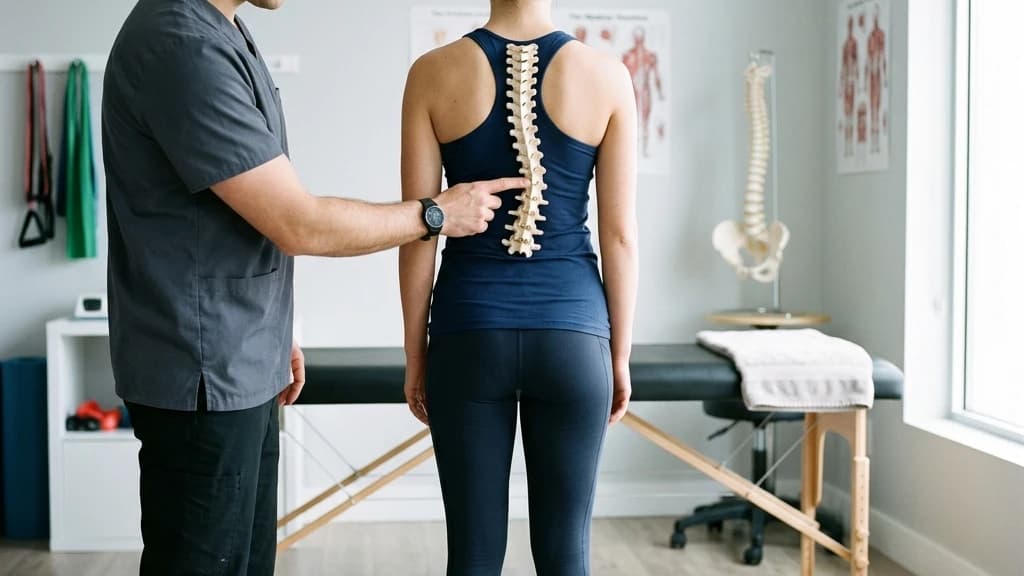
"If your spine has an S-curve, performing generic, symmetric back exercises is like driving a car with a bent steering column and expecting it to travel in a straight line without pulling to one side."
When most people think of scoliosis, they picture middle school screenings and rigid braces worn under loose t-shirts. However, scoliosis in adults is a highly prevalent, underdiagnosed condition that leads to severe pain, muscle fatigue, and progressive spinal imbalances. Unlike adolescent scoliosis, which is primarily developmental, adult scoliosis is frequently driven by degenerative changes in the spinal discs and joints.
As these structures wear down unevenly, the spine begins to tilt, twist, and curve to one side. This asymmetric load distribution forces the muscles on one side of your back to work double-time to keep you upright, leading to chronic spasms, while the opposite side becomes weak and slacked.
Managing this asymmetrical condition requires more than just generic core stretches. To achieve permanent relief, you must implement targeted scoliosis exercises for pain relief that actively restore balance to your musculature.
The Asymmetric Spine: Cobb Angles and Localized Pressures
To understand why adult scoliosis is so painful, we must examine the physics of the curved spine. When the spine loses its straight vertical alignment, gravity ceases to distribute load evenly across your joints.
Adult scoliosis affects up to 60% of seniors over the age of 60, largely due to age-related degenerative changes. Left unconditioned, degenerative Cobb angles can progress at a rate of 0.5 to 2 degrees per year.
An asymmetrical spinal curve creates localized imbalances that affect adjacent tissues:
- Concave Compression: The inner curve (concavity) experiences a load spike, increasing local disc pressure by up to 300%.
- Convex Distraction: The outer curve (convexity) causes long-term stretching and elongation of paraspinal muscles, leaving them weak and chronically fatigued.
- Rotational Force: As the vertebrae curve, they also rotate, pulling the rib cage out of alignment and creating a visual "rib hump" on one side.
This combination of compression and elongation is why patients complain of a constant, dull ache on one side of the spine. Relying on passive treatments like heat pads or rigid braces fails to address the underlying muscular imbalance.
Why Symmetrical Planks and Sit-Ups Are Worsening Your Curve
When patients discover they have a curved spine, their natural instinct is to start standard core routines. They perform symmetrical front planks, double-leg raises, or traditional sit-ups in an effort to "strengthen the back."
My bold, decisive clinical opinion is that generic, symmetric core strengthening is counter-productive for adult scoliosis—it reinforces existing muscle compensations, making the strong side stronger while the weak side remains inactive. Because your body naturally paths toward the curve, symmetric movements let the dominant muscles do all the work. To successfully correct spinal imbalances, you must use unilateral, asymmetrical exercises that specifically target and contract the elongated muscles on the convex side.
By replacing symmetric planks with targeted, side-specific movements, you force the weak, dormant muscles to fire. This dynamic correction is key to achieving long-term stability and finding out how to manage scoliosis pain without drugs.
The Patient: Margaret, a 64-year-old retired nurse, presented with a 24-degree lumbar curve and severe, localized lower back pain that made standing for over 20 minutes a painful chore.
The Mistake: Margaret was attending standard Pilates classes and doing symmetric back extensions, which left her in severe pain for two days afterward.
The Solution: We mapped her curve, identified her weak convex side, and prescribed unilateral side planks and asymmetrical breathing to expand the compressed concave joints.
The Outcome: Within 5 weeks, Margaret's standing pain was reduced by 80%, and she was able to walk for over an hour without any muscular fatigue.
Three Clinical Asymmetric Exercises for Adult Scoliosis
To decompress your concave joints, strengthen your weak convex muscles, and stabilize your spine, perform these three adult scoliosis rehab exercises daily:
-
1The Convex-Side Modified Side Plank Determine which side of your waist is compressed (the concavity) and which side is elongated (the convexity). Lie on your side so your convex side is facing down toward the floor. Prop yourself up on your elbow and knees, lifting your hips to create a straight line from head to knees. Hold this position for 20 to 30 seconds. Performing this side plank exclusively on the convex side strengthens the weak, overstretched lateral muscles, pulling your spine back toward the center.
-
2The Asymmetrical Birddog (Unilateral Extension) Get on all fours. To correct your lumbar curve, you will extend only the arm on the concave side and the leg on the convex side. Slowly reach your selected arm forward and the opposite leg backward, holding for 3 seconds before returning. Perform 3 sets of 10 repetitions. This targeted diagonal contraction strengthens the specific multifidus fibers needed to de-rotate the twisted vertebrae.
-
3Concave-Expansion Breathing (Schroth Method Variant) Sit tall in a chair. Place one hand on the compressed side of your ribs (the concavity). Take a slow, deep breath in, actively directing the air to expand the compressed ribs into your hand. Hold for 2 seconds, then exhale slowly. Perform 15 repetitions. This utilize lung volume to internally stretch the tight intercostal muscles, opening up the compressed side of your curve. If you also feel neck tension, complement this with a gentle myofascial release.
Locking in Spinal Stability
As you build strength on your weak side, your nervous system will begin to recognize this new, more centered alignment as its default state. Maintain good sitting posture throughout the day, and avoid slumping to your compressed side.
By replacing passive stretches with targeted, asymmetric movements, you give your spine the dynamic support it needs to fight gravity and prevent further curve progression. Take control of your alignment, focus on balance, and walk with confidence.
Irushi Abeywardhana
Senior Physiotherapist & Founder of Physio Pulse. Senior Clinical Physiotherapist passionate about blending advanced movement science with functional resilience.
Medical Disclaimer
The information provided by AyurPhysio is for general educational and informational purposes only. It is not intended as a substitute for professional medical advice, diagnosis, or treatment. Always seek the advice of your physician or other qualified health providers with any questions you may have regarding a medical condition. Never disregard professional medical advice or delay in seeking it because of something you have read on this website.
Trending Guides
George Washington's Fatal Bloodletting: An Ayurvedic Reconstruction of Rakta Dhatu Depletion and Ojas Collapse
8 min readJack Grealish's stress fracture of the foot: Soccer Biomechanics, Fifth Metatarsal Load, and Surgical Rehab
8 min readBen White's Severe Knee Injury: A Biomechanical Analysis of Lateral Meniscus Shear and Joint Longevity
8 min readElly De La Cruz's Hamstring Strain: The Biomechanics of Sprint Deceleration
8 min readTotal Knee Replacement (TKR): Post-Op Protocols for Restoring Extension
9 min readWeekly Wellness
Don't miss the next guide
Join 5,000+ subscribers getting holistic health tips every Tuesday.
Related Healing Guides
View All Guides →
Total Knee Replacement (TKR): Post-Op Protocols for Restoring Extension
The Gluteus Medius Connection: Preventing Lumbar Compensation