Shoulder Subluxation: Proprioceptive Training for Anterior Instability
"A shoulder with ligament laxity is like a loose lightbulb that could wobble out of its socket at any moment. You cannot fix it by turning it harder; you must train the surrounding muscles to react instantly to hold it in place."
If you have ever felt a sudden, sickening slip in your shoulder during a workout, or experienced a catching sensation when reaching behind your car seat, you are likely dealing with joint instability. The shoulder is the most mobile joint in the human body, but that freedom of movement comes at a cost: it is inherently unstable, relying heavily on a complex web of ligaments and muscles to stay in place.
Passive stretching or lifting heavy overhead weights makes this instability worse. Hanging from a chin-up bar or doing heavy overhead presses when your joint capsule is loose is like driving your car on flat tires—you are accelerating the wear and tear on the cartilage, pushing yourself closer to a complete joint dislocation.
To secure a loose joint, you must focus on rebuilding the joint's positional sensors, a process known as proprioceptive training for shoulder. This guide explains how to restore neurological control and prevent recurrent slips.
The Biomechanics of Anterior Instability
The shoulder joint is a ball-and-socket mechanism, where the head of your upper arm bone (humerus) sits in a shallow socket (glenoid) on your shoulder blade. Think of a golf ball resting on a tiny tee. To expand this tee, a ring of cartilage called the labrum surrounds the socket, supported by static joint ligaments.
Anterior instability occurs when the tissues in the front of the joint are stretched or torn, allowing the arm bone to slip forward. This is the most common form of instability, accounting for over **95%** of all shoulder subluxations. When the static ligaments are loose, your nervous system loses track of where the joint is in space, leading to delayed muscle reactions.
To compensate, your rotator cuff muscles must act as dynamic anchors, contracting rapidly to pull the humeral head back into the center of the socket during movement. If these muscles react too slowly, the shoulder slips, causing pain and joint micro-trauma.
Clinical data highlights how active proprioceptive training restores joint integrity:
- 1Anterior Subluxation PrevalenceAnterior instability is the primary driver in **95%** of subluxation cases, requiring front-joint stabilizing protocols.
- 2Recurrence Rate ReductionImplementing active closed-kinetic chain exercises reduces recurrent joint slips by **60%** compared to passive therapy.
- 3Muscle Reaction LatencyTargeted coordination drills reduce the activation delay of the rotator cuff muscles by **30 milliseconds**, preventing slips.
- 4Proprioceptive Recovery TimePatients who perform consistent sensory-motor drills achieve functional joint stability within **6 to 8 weeks**.
The Clinical Opinion: Avoid Overhead Shoulder Presses
"The single biggest mistake patients with anterior instability make is performing heavy overhead presses or lateral raises to build strength. When the front joint capsule is loose, pushing weight overhead forces the arm bone forward, stretching the weak tissues even further. We must avoid open-chain overhead work and focus entirely on closed-kinetic chain exercises that press the arm bone back into the socket."
The 3-Step Proprioceptive Stabilization Protocol
To rebuild joint control, you must train your brain to react to joint position. Focus on maintaining absolute control during these exercises.
Phase 1: Closed-Kinetic Chain Activation
To wake up the joint's positional sensors, start with weight-bearing exercises where your hand is in contact with a stable surface. Place your hands flat on a wall at shoulder height. Perform a slow, controlled push-up against the wall, focusing on keeping your shoulder blades flat against your rib cage. To increase the sensory challenge, place your hands on an unstable surface, like a balance pad or a soccer ball, and maintain a plank position for 30 seconds. Perform 3 sets daily.
Phase 2: Rhythmic Stabilization and Perturbation
Once you can support your weight, you must train the muscles to react to unexpected forces. Hold your arm straight out in front of you at shoulder height while holding a light medicine ball. Have a partner (or use a wall to bounce a light ball) gently tap your arm in different directions. Your goal is to react instantly to keep your arm completely still. If you are alone, hold a water bottle half-filled with water and shake it rapidly to create unpredictable waves. Perform for 30 seconds, 3 sets daily.
Phase 3: Scapular Tracking and Rotator Cuff Integration
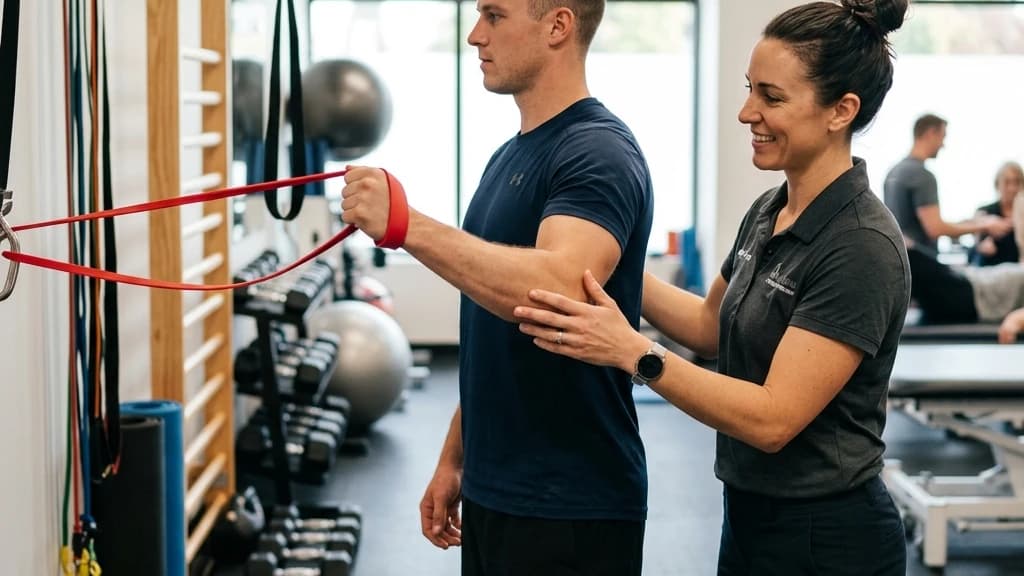
The final phase integrates the shoulder blade with the rotator cuff. Loop a resistance band around your wrists and place your forearms flat against a wall. Spread your hands slightly to create tension in the band, activating the rotator cuff. Slide your forearms up and down the wall, keeping your shoulder blades flat and avoiding any shrugging. This maintains joint centering throughout range of motion. Perform 3 sets of 10 repetitions, twice daily.
The Patient: Julian, a 22-year-old competitive volleyball player, experienced a subluxation whenever he went for a high spike, leaving his arm feeling weak for days.
The Mistake: He kept doing overhead shoulder presses and pull-ups to strengthen his shoulder, which only loosened the joint capsule further and caused persistent pain.
The Solution: We stopped all overhead lifting. We implemented wall push-ups on balance discs, hand-eye coordination drills with reactive balls, and scapular tracking with wrist bands.
The Outcome: Julian achieved functional stability within **6 weeks**, returning to volleyball without a single subluxation episode during the season.
Securing Your Long-Term Joint Health
stabilizing a loose joint requires consistent movement awareness. When lifting weights or performing daily tasks, avoid positions where your elbow drifts behind your shoulder, which pushes the arm bone forward. Keep your movements within your safe field of vision.
For more recovery guides, read our clinical breakdown of rotator cuff exercises and our guide on shoulder impingement recovery. To understand how core stability impacts your upper limbs, see our article on deep core activation to support your overall athletic frame.
Featured image: High-resolution photo illustrating closed-kinetic chain shoulder stabilization exercises under clinical supervision. Prepared for AyurPhysio clinical reference.
Irushi Abeywardhana
Senior Physiotherapist & Founder of Physio Pulse. Senior Clinical Physiotherapist passionate about blending advanced movement science with functional resilience.
Medical Disclaimer
The information provided by AyurPhysio is for general educational and informational purposes only. It is not intended as a substitute for professional medical advice, diagnosis, or treatment. Always seek the advice of your physician or other qualified health providers with any questions you may have regarding a medical condition. Never disregard professional medical advice or delay in seeking it because of something you have read on this website.
Trending Guides
Clinical Audit: The Best Knee Unloader Braces for Osteoarthritis & Joint Compartment Unloading (2026 Ratings)
10 min readUsain Bolt's Elite Sprinting with Scoliosis: A Biomechanical Breakdown of Asymmetrical Kinetic Chain Compensation and Hamstring Strain Risk
8 min readRetrolisthesis: Understanding Posterior Vertebral Slippage and Rehab
6 min readQuadratus Lumborum Trigger Points: The Secret Driver of Deep Hip Pain
7 min readNerve Flossing Techniques for Sciatic Nerve Mobilization
6 min readWeekly Wellness
Don't miss the next guide
Join 5,000+ subscribers getting holistic health tips every Tuesday.
Related Healing Guides
View All Guides →
Retrolisthesis: Understanding Posterior Vertebral Slippage and Rehab
Quadratus Lumborum Trigger Points: The Secret Driver of Deep Hip Pain