Turf Toe: Rehabilitation and Mobility Exercises for the Great Toe
"When you push off the ground to sprint, the joint at the base of your big toe bears a load equal to eight times your body weight. If that joint is sprained, trying to run is like driving a high-performance sports car with a cracked front axle."
For athletes and weekend warriors alike, foot injuries are incredibly disruptive. A sprain of the first metatarsophalangeal (MTP) joint, commonly known as turf toe, can immediately halt your ability to run, jump, or change directions. The big toe may seem minor, but it is the final lever through which your body transfers force into the ground.
Standard rest and soft shoes often delay your recovery. Allowing the big toe joint to heal in a shortened, stiff position causes the surrounding tissue to scar down, leading to permanent mobility deficits. To restore peak athletic performance, you must apply structured load and execute progressive mobility drills.
To ensure a safe return to sport, you must navigate a systematic turf toe rehabilitation program that restores great toe mobility exercises while protecting the healing ligaments. This article details the clinical progression stages to rebuild your foot's foundation.
The Biomechanics of the Big Toe Lever
The first MTP joint is located where the long metatarsal bone of the foot meets the proximal phalanx of the big toe. Beneath this joint sit two tiny, pea-shaped bones called sesamoids, which act as pulleys for the tendons that pull the toe downward. Together with the surrounding joint capsule and collateral ligaments, they form the plantar complex.
Turf toe occurs when the big toe is forcibly hyperextended, usually when the heel is raised and the toe is pinned to the ground while another player falls on the back of the leg. This hyperextension sprains or tears the plantar complex, destabilizing the entire inner arch of the foot.
Clinical sports data indicates that Grade I sprains account for 50% to 60% of turf toe cases, representing micro-tearing without joint instability. Grade II sprains involve partial tears, requiring temporary joint immobilization, while Grade III sprains involve complete rupture of the plantar complex, requiring a minimum of 6 weeks of non-weight-bearing protection.
Athletic research shows how loads and mobility deficits affect first MTP joint rehabilitation:
- 1Push-off Peak ForceSprinting places a mechanical load of up to 8 times your body weight on the first MTP joint during the toe-off phase.
- 2Required Extension RangeNormal walking requires 60 degrees of big toe extension, while athletic sprinting demands up to 90 degrees of mobility.
- 3Scar Tissue RestrictionImmobilization without early controlled mobilization reduces extension range by 40%, leading to chronic push-off compensation.
- 4Re-injury Risk FactorAthletes returning to sport with less than a 90% LSI in toe-off power have a 3 times higher rate of recurrent sprains.
The Clinical Opinion: Avoid Soft, Flexible Athletic Shoes
"The biggest mistake injured athletes make is wearing soft, highly flexible running shoes during their recovery. A flexible sole allows the big toe joint to bend repeatedly during walking, which continuously micro-tears the healing plantar complex. You must wear stiff-soled shoes or place a rigid carbon-fiber plate insert under your orthotic to completely block MTP extension during early rehabilitation."
The 3-Phase Metatarsophalangeal Joint Rehab Protocol
To safely restore the big toe lever, you must progress from joint protection to active mobility and finally to dynamic, high-impact loading.
Phase 1: Controlled Mobility and Joint Distraction
To prevent the joint capsule from scarring down, perform passive distraction. Sit comfortably and hold the base of your big toe with one hand. Gently pull the toe straight out away from your foot to create a small gap in the joint (distraction). While maintaining this light pull, gently wiggle the toe up and down within a pain-free range. Perform 20 wiggles, twice daily.
Phase 2: Intrinsic Foot Strengthening and Taping
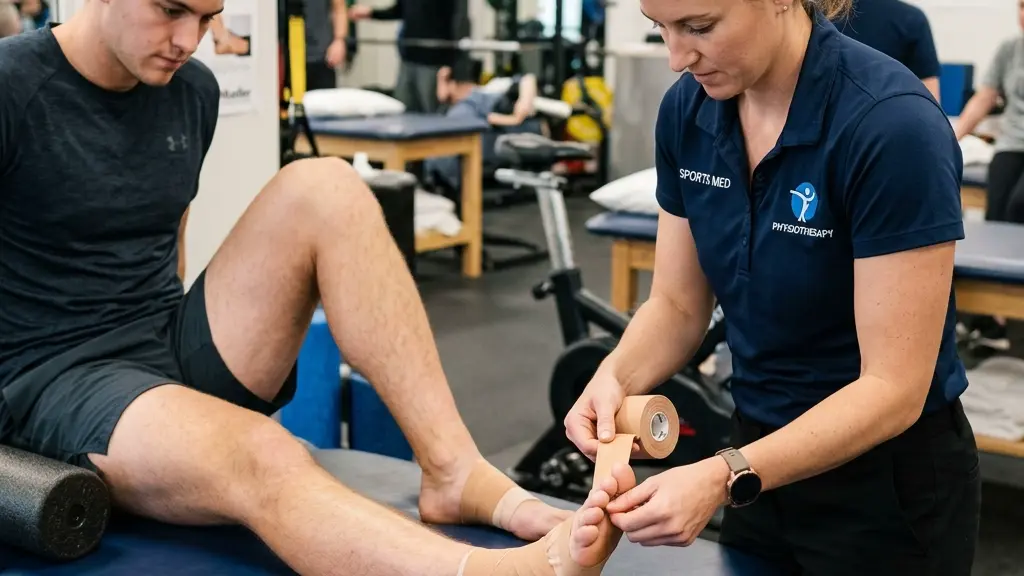
To stabilize the joint, strengthen the local stabilizing muscles. Place a towel flat on the floor and use your toes to scrunch the towel toward you, keeping your heel on the ground. To protect the joint during daily walking, apply turf toe taping techniques using athletic tape to create an "X" pattern on the bottom of the toe, preventing it from bending upward. Perform 3 sets of 15 towel scrunches daily.
Phase 3: Progressive Calf-Raise Loading
Once passive mobility is restored, you must rebuild push-off strength. Stand facing a wall for balance. Slowly raise up onto the balls of your feet, holding the top position for 2 seconds before lowering. Progress from double-leg raises to single-leg raises on a flat floor, and finally to raises on the edge of a step to slowly introduce extension load under control. Perform 3 sets of 12 repetitions daily.
The Patient: Tyler, a 22-year-old collegiate soccer player, sustained a Grade II turf toe sprain on artificial turf that prevented him from running or kicking.
The Mistake: He rested for two weeks and then tried to return to training in his flexible soccer cleats, which immediately caused sharp pain and swelling.
The Solution: We placed a carbon-fiber insert in his training shoes to block toe extension. We initiated passive joint distractions and progressive calf-raise loading, while taping his toe before all functional drills.
The Outcome: Tyler achieved 100% pain-free push-off power within 6 weeks and successfully returned to competitive soccer without recurring symptoms.
Securing Your Foot's Dynamic Arch
Rebuilding a strong foundation requires regular maintenance of the small muscles in the foot. Consider rolling the arch of your foot over a golf ball daily to release tension in the plantar fascia, which supports the big toe joint from behind.
For adjacent leg conditioning guides, read our clinical guide on shin splints treatment and our guide on plantar fasciitis recovery. To learn how general joint health impacts sports performance, see our article on ankle sprain rehabilitation to stabilize your lower kinetic chain.
Featured image: High-resolution clinical photograph displaying a sports therapist applying stabilizing athletic tape to the first MTP joint of an athlete. Prepared for AyurPhysio clinical reference.
Irushi Abeywardhana
Senior Physiotherapist & Founder of Physio Pulse. Senior Clinical Physiotherapist passionate about blending advanced movement science with functional resilience.
Medical Disclaimer
The information provided by AyurPhysio is for general educational and informational purposes only. It is not intended as a substitute for professional medical advice, diagnosis, or treatment. Always seek the advice of your physician or other qualified health providers with any questions you may have regarding a medical condition. Never disregard professional medical advice or delay in seeking it because of something you have read on this website.
Trending Guides
George Washington's Fatal Bloodletting: An Ayurvedic Reconstruction of Rakta Dhatu Depletion and Ojas Collapse
8 min readJack Grealish's stress fracture of the foot: Soccer Biomechanics, Fifth Metatarsal Load, and Surgical Rehab
8 min readBen White's Severe Knee Injury: A Biomechanical Analysis of Lateral Meniscus Shear and Joint Longevity
8 min readElly De La Cruz's Hamstring Strain: The Biomechanics of Sprint Deceleration
8 min readTotal Knee Replacement (TKR): Post-Op Protocols for Restoring Extension
9 min readWeekly Wellness
Don't miss the next guide
Join 5,000+ subscribers getting holistic health tips every Tuesday.
Related Healing Guides
View All Guides →
Total Knee Replacement (TKR): Post-Op Protocols for Restoring Extension
The Gluteus Medius Connection: Preventing Lumbar Compensation