Groin Strain: Strengthening the Adductors Safely
"Trying to heal an acute groin strain by aggressively stretching your inner thigh is like pulling hard on the torn seams of a sailboat's sail during a gale. You are not aligning the fibers; you are simply widening the tear."
Imagine sprinting down the field, preparing to cut past a defender, when a sudden, sharp pinch in your inner thigh causes you to collapse. You limp to the sidelines, clutching your groin, knowing that your athletic season has just ground to a painful halt.
When athletes experience groin discomfort, their immediate response is almost always identical. They rest on the couch for two weeks, apply ice packs, and perform daily butterfly stretches to relieve the tightness. Yet, the moment they return to running or kicking, that familiar, biting pain flares up again.
The classic error is treating a tendon or muscle tear with passive rest. In reality, the adductor muscles of the hip require targeted, progressive loading to stimulate tissue remodeling, restore elasticity, and prevent a chronic groin issue.
To break this cycle of recurrent injury, you must incorporate active groin strain rehabilitation protocols. In this guide, we will examine the biomechanics of the inner thigh, outline the clinical evidence, and show you how to perform the copenhagen adductor exercise safely to speed up your sports groin injury rehab.
The Biomechanics of Pelvic Power: The Adductor Complex
The adductor muscle group consists of five distinct muscles: adductor longus, adductor brevis, adductor magnus, gracilis, and pectineus. They originate on the pubic bone and insert along the femur, functioning as the primary stabilization system for the pelvic ring.
During sprinting, cutting, and jumping, these muscles manage immense rotational torque. They do not just pull the leg inward; they work together with the glutes and core to stabilize your hips with every stride.
If the adductor tendon is weakened or injured, this stabilizing system is compromised. The body is forced to compensate, placing excessive stress on the pubic joint and opposite hip, which highlights the importance of targeted adductor strengthening exercises in recovery.
Clinical sports medicine data indicates that adductor strains make up 10% to 15% of all soccer and rugby injuries, making them one of the most common causes of missed play.
Furthermore, clinical trials demonstrate that implementing the Copenhagen adductor exercise program reduces the risk of groin injuries by 41% in competitive athletes.
In terms of functional testing, athletes returning to sport with an adductor-to-abductor strength ratio of less than 90% have a 4x higher rate of re-injury, highlighting the need for objective strength evaluation before discharge.
Why Complete Rest and Stretching Delay Recovery
When your inner thigh feels tight and painful, pulling it into a deep stretch seems logical. You believe you are helping the tissues heal.
My strong clinical opinion is that complete rest and passive stretching are highly detrimental to an acute adductor strain. When you stretch a newly torn tendon or muscle fiber, you disrupt the fragile collagen bridges forming at the injury site.
To successfully recover, you must replace passive stretching with early, pain-free loading. Retraining the adductors through progressive resistance sends a mechanical signal to the cells to lay down strong, aligned collagen. If you want to know how to heal groin strain, the answer is loaded isometric and eccentric exercise, not rest.
If you are also suffering from hip stability issues or lower back tightness, understanding how SI joint stabilizing stretches stabilize the pelvis can ensure your pelvic ring is balanced.
The Patient: Marcus, a 24-year-old amateur soccer player, suffered from a persistent, sharp left groin strain that kept him off the pitch for three months.
The Mistake: Marcus rested for six weeks, wore compressive shorts, and performed butterfly stretches daily, but his groin pain returned the moment he tried to kick a soccer ball.
The Protocol: We started a structured rehab program of side-lying adductor lifts, progressing to wall isometric squeezes with a ball, and finally to loaded Copenhagen adductor bridges.
The Outcome: Within six weeks, his groin pain was eliminated. Strength testing showed his adductor-to-abductor ratio reached 95%, allowing him to return to competitive play and kick without pain.
The Three-Step Progressive Adductor Rehabilitation Protocol
To rebuild your inner thigh and protect your pelvic ring from future injury, perform this progressive routine 3 times per week:
-
1Isometric Ball Squeezes (Pain Management) Lie on your back with your knees bent. Place a soccer ball or medicine ball between your knees. Gently squeeze the ball with 50% of your maximum effort and hold for 45 seconds. Rest for 15 seconds, and repeat 5 times. This hold triggers a biological analgesic effect, reducing local pain.
-
2Side-Lying Adductor Lifts (Concentric Strength) Lie on your injured side, with your top leg crossed over and foot flat on the floor. Slowly raise your bottom leg toward the ceiling, keeping your knee straight. Hold for 2 seconds, then lower slowly. Complete 3 sets of 15 repetitions. This targets the adductor longus without placing shear forces on the pubic joint.
-
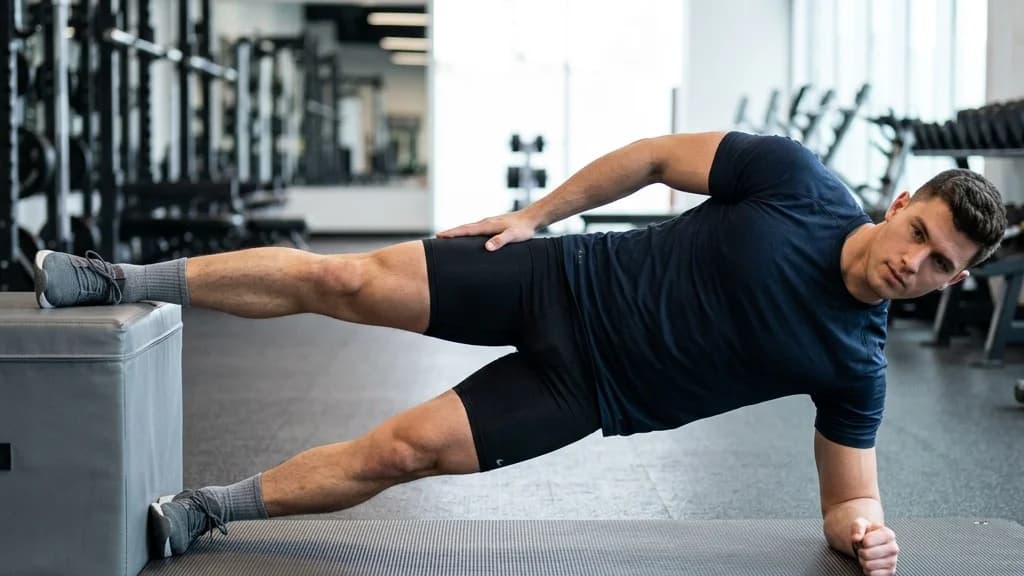
3The Copenhagen Adductor Bridge (Tendon Adaptation) Lie on your side. Place your top foot on a bench or chair, with your bottom leg underneath. Lift your hips off the floor, supporting your weight on your top foot and forearm. For the beginner version, place your knee on the bench instead of your foot. Hold for 30 seconds, repeating 3 times per side. This is the gold standard exercise for groin resilience.
Just like in hamstring strain rehabilitation for sprinters, tracking your weekly progression is essential for a safe return to sport.
Reclaim Your Lateral Power
Your groin is not fragile; it is designed to transmit high forces. By replacing passive rest and stretching with progressive, loaded adductor strengthening, you can rebuild the tendon matrix and protect your pelvis from future injury.
To learn how to protect the rest of your lower limb from injury, read our guide on restoring ankle stability after a sprain.
Are you ready to stop resting and start actively strengthening your pelvis today? Perform your first set of ball squeezes and take control of your recovery.
Irushi Abeywardhana
Senior Physiotherapist & Founder of Physio Pulse. Senior Clinical Physiotherapist passionate about blending advanced movement science with functional resilience.
Medical Disclaimer
The information provided by AyurPhysio is for general educational and informational purposes only. It is not intended as a substitute for professional medical advice, diagnosis, or treatment. Always seek the advice of your physician or other qualified health providers with any questions you may have regarding a medical condition. Never disregard professional medical advice or delay in seeking it because of something you have read on this website.
Trending Guides
George Washington's Fatal Bloodletting: An Ayurvedic Reconstruction of Rakta Dhatu Depletion and Ojas Collapse
8 min readJack Grealish's stress fracture of the foot: Soccer Biomechanics, Fifth Metatarsal Load, and Surgical Rehab
8 min readBen White's Severe Knee Injury: A Biomechanical Analysis of Lateral Meniscus Shear and Joint Longevity
8 min readElly De La Cruz's Hamstring Strain: The Biomechanics of Sprint Deceleration
8 min readTotal Knee Replacement (TKR): Post-Op Protocols for Restoring Extension
9 min readWeekly Wellness
Don't miss the next guide
Join 5,000+ subscribers getting holistic health tips every Tuesday.
Related Healing Guides
View All Guides →
Total Knee Replacement (TKR): Post-Op Protocols for Restoring Extension
The Gluteus Medius Connection: Preventing Lumbar Compensation