Lumbar Spinal Traction: Clinical Efficacy and Home Self-Traction Setup
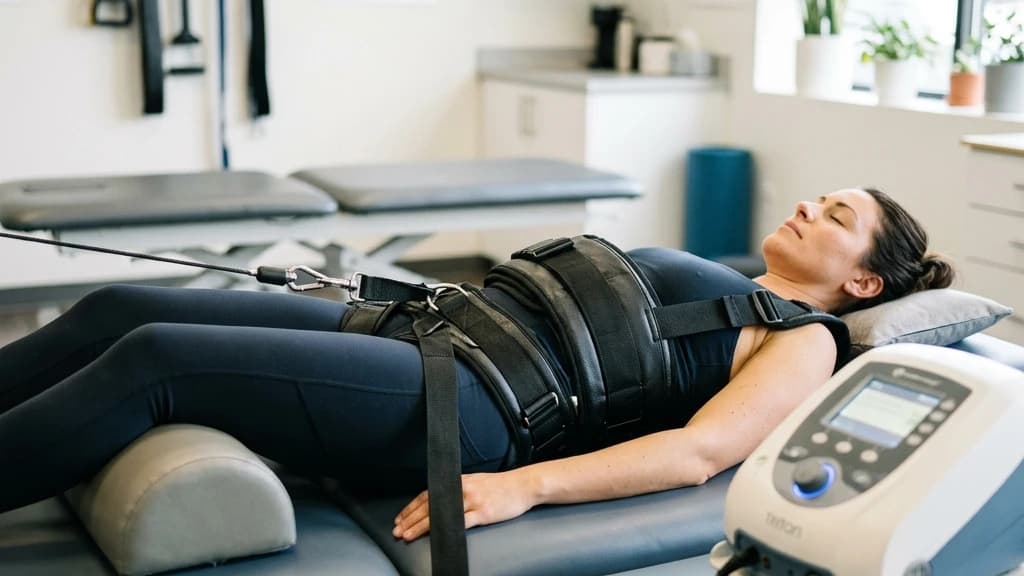
"Think of your spinal discs like jelly donuts. When gravity presses down on them all day, the jelly starts to ooze out of the sides, pinching the sensitive nerve roots nearby. Lumbar traction is the mechanical force that pulls the donuts back into shape."
If your lower back feels like a rusty, compressed accordion after sitting at your office desk for a long shift, you are not alone. Gravity is a relentless force, constantly compressing your vertebrae and reducing the fluid spacing within your spinal discs. Over years of poor posture, this constant loading can lead to herniations, nerve impingement, and chronic spasms.
In clinical practice, one of the most common physical therapy tools used to fight this compression is lumbar spinal traction. By applying a controlled pulling force to the pelvis, we can physically separate the vertebral segments and create an immediate reduction in pressure.
However, while clinical traction machines are highly effective, patients often ask if they can replicate these decompression benefits at home. Setting up a safe and effective home self-traction setup is entirely possible, provided you understand the biomechanics and follow clinical guidelines.
The Biomechanics of Decompression: Overcoming Friction
To understand how traction works, we must look at the mechanical forces required to distract the human spine. Your body is highly resistant to stretching, protected by thick ligaments, tight muscles, and the natural friction of your skin against the treatment table.
Sitting with poor posture spikes your lumbar disc pressure to 185% of normal baseline levels, while leaning forward over your keyboard pushes it to 220%. To reverse this, we must create a negative pressure environment inside the spinal disc.
Clinical biomechanical research has mapped the exact force requirements for effective lumbar traction:
- Friction Threshold: To physically distract the lumbar vertebrae, traction forces must exceed at least 50% of the patient's body weight to overcome body friction on the table.
- Intradiscal Decompression: Successful traction can reduce internal disc pressure to negative values, reaching between -100 and -150 mmHg.
- Nucleus Re-centering: This negative pressure acts like a vacuum, pulling a bulging or herniated nucleus pulposus back toward the center of the disc.
This mechanical vacuum effect provides immediate relief to compressed nerve roots. However, if the paraspinal muscles are not actively trained to support this new space, the disc will compress right back to its painful baseline within 15 minutes of standing up.
Why Passive Mechanical Traction is a Short-Lived Illusion
Many clinics offer expensive spinal decompression packages that place patients on computerized tables for 30 minutes of passive pulling. While these sessions feel wonderful and provide short-term relief, they often fail to deliver long-term results.
My strong, decisive clinical opinion is that relying purely on passive machine traction is a biological distraction—it does nothing to build muscular stability and leads to immediate relapse once you stand up. Your nervous system must be trained to control the newly distracted joint space. If you do not follow decompression with active stabilization, your body will revert to its defensive muscle guarding patterns.
To achieve permanent relief, you must combine passive traction with active core strengthening. Specifically, integrating traction with targeted deep core activation exercises ensures your muscles can support your spine against gravity.
The Patient: Robert, a 42-year-old software architect, presented with severe, shooting sciatic pain down his left leg, caused by a chronic L4-L5 disc herniation.
The Mistake: Robert had spent thousands of dollars on passive clinical traction tables, getting relief for about an hour before his leg pain flared up again on his drive home.
The Solution: We combined short, controlled home self-traction sessions with immediate, active transversus abdominis bracing and core stabilization routines.
The Outcome: Within 4 weeks, Robert's shooting leg pain was reduced by 90%, and he returned to full-time work without experiencing any post-sitting relapses.
A Safe Home Self-Traction Setup
If you want to experience the benefits of decompression at home without expensive machinery, you can perform these three safe spinal decompression exercises. These movements use gravity and body positioning to gently distract the lumbar spine.
-
1The 90-90 Chair Decompression Lie flat on your back on a supportive yoga mat. Place your lower legs on the seat of a sturdy chair so your hips and knees are bent at a 90-degree angle. Press your hands gently against the tops of your thighs, pushing your thigh bones away from your torso. This simple leverage unloads the lower back, reducing compression at L4-L5 and L5-S1 immediately. Hold for 2 to 3 minutes while taking slow, deep diaphragmatic breaths.
-
2The Countertop Suspension Stretch Stand facing a sturdy kitchen countertop or table. Place both hands firmly on the edge, keeping your arms straight. Slowly bend your knees and step your feet back slightly, allowing your torso to hang down between your arms. Let your body weight shift into your hands, letting your lower back sag toward the floor without touching it. This utilizes your lower body weight to create a gentle, vertical tractive pull on your lumbar spine. Repeat for 3 sets of 30-second holds.
-
3The Prone Press-Up with Hip Sag Lie on your stomach on the floor. Place your hands under your shoulders and slowly push your upper body up, keeping your pelvis flat on the ground. Once at the top, let your lower back sag completely, relaxing your glutes and lower back muscles. This combining of extension and traction is excellent for lumbar disc decompression exercises, pushing disc material away from the nerve. Perform 10 controlled repetitions, holding the top position for 2 seconds. Refer to our guide on McKenzie Method exercises for detailed progressions.
Combining Traction with Stabilization
Once you complete your home self-traction session, it is critical to lock in the benefits immediately. While your spine is still decompressed, perform 5 to 10 repetitions of pelvic tilts or straight leg raises to activate the deep multifidus muscles.
If you are also dealing with radiating leg pain, combining this protocol with clinical nerve flossing protocols will help restore sciatic nerve mobility and reduce neural sensitivity. Always avoid high-impact jumping or heavy lifting immediately after traction, as your ligaments are temporarily relaxed and vulnerable.
Your Next Steps to Pain-Free Living
Your spine is not a static column of bone; it is a dynamic, living structure that adapts to the loads you place upon it. Do not accept chronic compression as a permanent state. By combining the immediate relief of home decompression with active core stabilization, you can reclaim a pain-free, active life.
Start your home decompression routine today, keep your core active, and stand tall against the daily forces of gravity.
Irushi Abeywardhana
Senior Physiotherapist & Founder of Physio Pulse. Senior Clinical Physiotherapist passionate about blending advanced movement science with functional resilience.
Medical Disclaimer
The information provided by AyurPhysio is for general educational and informational purposes only. It is not intended as a substitute for professional medical advice, diagnosis, or treatment. Always seek the advice of your physician or other qualified health providers with any questions you may have regarding a medical condition. Never disregard professional medical advice or delay in seeking it because of something you have read on this website.
Trending Guides
George Washington's Fatal Bloodletting: An Ayurvedic Reconstruction of Rakta Dhatu Depletion and Ojas Collapse
8 min readJack Grealish's stress fracture of the foot: Soccer Biomechanics, Fifth Metatarsal Load, and Surgical Rehab
8 min readBen White's Severe Knee Injury: A Biomechanical Analysis of Lateral Meniscus Shear and Joint Longevity
8 min readElly De La Cruz's Hamstring Strain: The Biomechanics of Sprint Deceleration
8 min readTotal Knee Replacement (TKR): Post-Op Protocols for Restoring Extension
9 min readWeekly Wellness
Don't miss the next guide
Join 5,000+ subscribers getting holistic health tips every Tuesday.
Related Healing Guides
View All Guides →
Total Knee Replacement (TKR): Post-Op Protocols for Restoring Extension
The Gluteus Medius Connection: Preventing Lumbar Compensation