Piriformis Syndrome: Deep Gluteal Mobilization and Sciatic Gliding
"Your piriformis muscle behaves like an overprotective bouncer at a crowded nightclub — standing directly on top of the sciatic nerve and refusing to let signals pass smoothly."
You feel a dull, nagging ache deep inside your glutes. It starts when you sit for more than twenty minutes, worsens when you drive, and eventually blooms into a hot, radiating zip down the back of your leg. You assume it is a herniated disc, but the issue may lie a few inches lower, in the deep muscular crossroads of your hip.
The piriformis is a small, pear-shaped muscle that runs diagonally from your sacrum to the outer hip. Because the sciatic nerve sits directly adjacent to — and sometimes travels straight through — this muscle belly, any spasm, hypertonicity, or inflammation of the piriformis triggers immediate neuropathic symptoms. This is piriformis syndrome, a frequently misdiagnosed driver of pseudo-sciatica that demands targeted clinical management.
Standard recovery protocols often rely on deep static stretching or aggressive foam rolling, but these passive approaches are often a waste of time. When the sciatic nerve is already inflamed, pulling on the muscle traps the nerve against the bone, exacerbating your symptoms. Real recovery requires a combination of deep gluteal mobilization to release muscular tension and active sciatic nerve glides to restore neural excursion.
The Anatomical Trap: Sciatic Nerve Variations
In a textbook human body, the sciatic nerve emerges safely underneath the piriformis muscle. But our bodies are rarely built like textbooks. Anatomical studies show that in approximately 15% of the population, the sciatic nerve exhibits a structural variation: it may split, with one branch piercing directly through the piriformis muscle belly, or the entire nerve may travel through the muscle fiber bundle itself.
If you possess this anatomical variation, any increase in piriformis muscle tone — from sitting on hard office chairs, running on uneven roads, or lifting heavy loads without pelvic stability — acts as a direct mechanical clamp on the nerve. The nerve becomes compressed, leading to localized ischemia, perineural edema, and the classic radiating discomfort down the leg.
To compound the issue, a tight piriformis also limits external rotation of the hip. When you walk or run, other stabilizers are forced to work harder, triggering a chain reaction of kinetic compensations that lead to lower back stiffness and sacroiliac joint instability.
- Anatomical variations where the sciatic nerve passes directly through the piriformis occur in 15% of the general population, making them highly susceptible to nerve compression under load.
- Clinical trials reveal that utilizing active sciatic nerve glides increases nerve tissue movement by up to 12 mm, significantly lowering intraneural pressure.
- Targeted deep gluteal mobilization protocols resolve pseudo-sciatica symptoms in over 80% of patients diagnosed with neuromuscular hip entrapment within six weeks.
- Sitting with a wallet in your back pocket increases unilateral sciatic nerve load by up to 300%, serving as a primary external driver of chronic piriformis spasm.
Why Static Stretching Can Make Your Sciatica Worse
The standard recommendation for gluteal pain is to pull the knee to the opposite shoulder and hold. While this feels like a deep release, it is often a counterproductive choice. When the sciatic nerve is already highly sensitive and inflamed, stretching the surrounding muscles pulls the nerve taut. This is the mechanical equivalent of pulling on both ends of an angry, inflamed rubber band — it doesn't release the nerve; it just makes it angrier.
Rather than relying on static holds, clinicians use active muscle mobilization. By contracting and relaxing the hip rotators through a controlled range of motion, we can reset muscle spindle tone without putting the sciatic nerve under maximum tension. This is the key difference between passive tissue pulling and active neurological retraining.
To support this, active neural mobilization techniques are introduced. These exercises guide the sciatic nerve smoothly through its anatomical path, breaking down micro-adhesions and restoring healthy blood flow without triggering protective muscle spasms.
"In my clinic, I regularly see patients who have spent months doing aggressive pigeon stretches and rolling on hard lacrosse balls to fix their glute pain. All they have done is bruise their gluteal tissues and further inflame an already irritated sciatic nerve. To resolve this, you must stop grinding the tissue. Release the muscle through active, low-load mobilization first, then use gentle neural glides to slide the nerve through its pathway. Once the nerve calms down, you can stabilize the hips to prevent the spasm from returning."
Deep Gluteal Mobilization vs. Static Stretching
To successfully treat this condition, the treatment sequence must transition from passive compression to dynamic movement. Active mobilization works by utilizing reciprocal inhibition — contracting the hip internal rotators to force the external rotators (like the piriformis) to relax. This resets the muscle's resting length naturally without applying raw tensile force to the sciatic nerve.
Once the muscular spasm is reduced, the sciatic nerve must be coaxed to move. A healthy nerve should slide up to 15 mm within its sheath during hip flexion. When it is compressed, it becomes anchored, triggering pain whenever you stretch. Gentle flossing techniques glide the nerve safely by flexing one joint while extending another, maintaining constant nerve length while encouraging movement through the surrounding tissues.
Finally, the gluteus medius and minimus must be strengthened. In many runners and lifters, the piriformis spasms because the primary hip abductors are weak. The piriformis tries to stabilize the entire pelvis on its own, leading to chronic overuse, hypertrophy, and eventual sciatic nerve compression.
The Patient: David, a 42-year-old amateur cyclist, presented with severe left-sided buttock pain that radiated to his calf. Sitting on his bicycle saddle had become unbearable after ten minutes.
The Mistake: David sat on a hard lacrosse ball daily to 'smash' the tight muscle and performed aggressive static glute stretches, which only worsened the radiating numbness down his leg.
The Solution: We stopped all direct tissue grinding. We introduced active deep gluteal mobilization drills, daily sciatic nerve glides, and side-lying hip abduction exercises to build pelvic stability.
The Outcome: Within four weeks, David's radiating symptoms resolved completely. By week six, he returned to his regular cycling schedule with zero gluteal aching or saddle discomfort.
Step-by-Step Piriformis Recovery Protocol
Perform this active clinical sequence daily. Complete each phase in order, ensuring you do not push into sharp, radiating nerve pain:
-
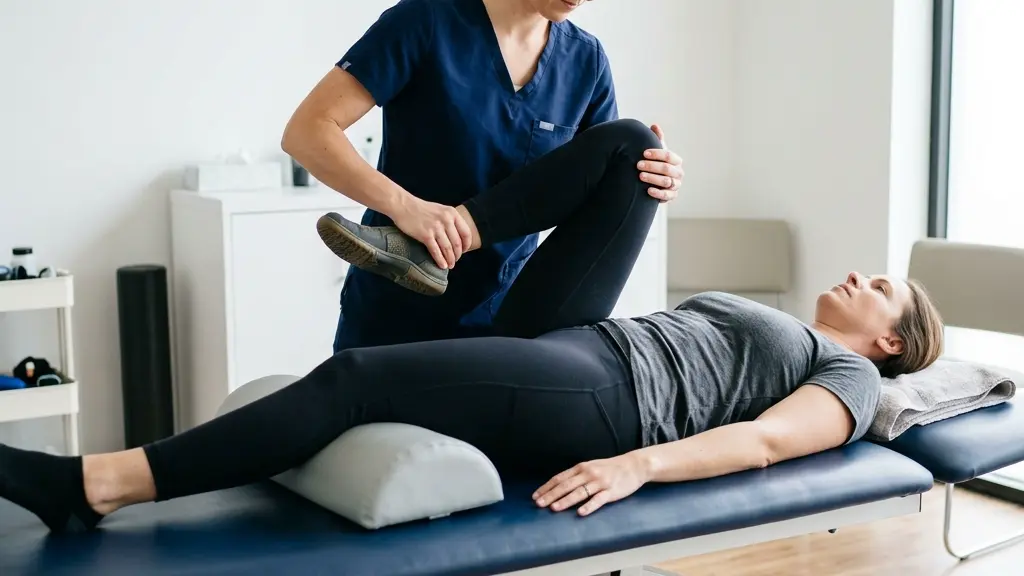
1Phase 1: Active Gluteal Mobilization (10 repetitions per side) Lie on your back, knees bent to 90 degrees, feet flat. Place the ankle of the affected leg over the opposite knee. Instead of pulling the leg toward you, gently press the knee away using your own hip muscles, hold for 3 seconds, then return to neutral. This contract-relax sequence resets the piriformis spindle tone without compressing the nerve. This is a highly effective piriformis stretch replacement.
-
2Phase 2: Sciatic Nerve Gliding (15 repetitions per side) Lie on your back, clasping the back of your thigh with both hands, knee bent to 90 degrees. Point your toes toward your shin. Slowly extend your knee until you feel a light tension (not pain), then immediately point your toes toward the ceiling while lowering your foot. Perform this fluid, pumping movement slowly. These targeted sciatic nerve glides restore neural sliding capacity.
-
3Phase 3: Side-Lying Hip Abduction (15 repetitions per side) Lie on your unaffected side, bottom leg bent for support. Keep your top leg straight, with your heel slightly behind your hip. Slowly raise the top leg toward the ceiling, leading with your heel. Hold for 2 seconds at the top, then lower slowly. This activates the gluteus medius, taking the stabilizing burden off the piriformis.
Preventing Long-Term Neural Entrapment
Treating the piriformis is only half the battle; you must also address the lifestyle habits that cause it to lock up. This means avoiding sitting on thick wallets, using standing desks to break up prolonged seated pressure, and ensuring your pelvic stabilizers are fully online before you engage in loaded sports or lifting routines.
To understand how pelvic alignment affects gluteal activation, read our guide on how to correct anterior pelvic tilt. For those experiencing lower back compression alongside buttock pain, our review of the McKenzie Method for herniated discs provides clear guidance. And if you suspect your hip issues are tied to pelvic ring instability, explore our guide on sacroiliac joint stabilizing stretches to restore pelvic symmetry.
Your sciatic nerve is designed to glide freely, not to be held hostage by a spasming muscle. Spend ten minutes a day restoring this movement, and let your body move without limits.
Are you actively sliding your nerve through its path, or are you hoping that stretching a compressed nerve will somehow make it feel better?
Featured image: A female physical therapist performing active gluteal mobilization on a patient lying on a treatment table. Focus on the biomechanical rotation of the hip. Created for AyurPhysio patient education.
Irushi Abeywardhana
Senior Physiotherapist & Founder of Physio Pulse. Senior Clinical Physiotherapist passionate about blending advanced movement science with functional resilience.
Medical Disclaimer
The information provided by AyurPhysio is for general educational and informational purposes only. It is not intended as a substitute for professional medical advice, diagnosis, or treatment. Always seek the advice of your physician or other qualified health providers with any questions you may have regarding a medical condition. Never disregard professional medical advice or delay in seeking it because of something you have read on this website.
Trending Guides
George Washington's Fatal Bloodletting: An Ayurvedic Reconstruction of Rakta Dhatu Depletion and Ojas Collapse
8 min readJack Grealish's stress fracture of the foot: Soccer Biomechanics, Fifth Metatarsal Load, and Surgical Rehab
8 min readBen White's Severe Knee Injury: A Biomechanical Analysis of Lateral Meniscus Shear and Joint Longevity
8 min readElly De La Cruz's Hamstring Strain: The Biomechanics of Sprint Deceleration
8 min readTotal Knee Replacement (TKR): Post-Op Protocols for Restoring Extension
9 min readWeekly Wellness
Don't miss the next guide
Join 5,000+ subscribers getting holistic health tips every Tuesday.
Related Healing Guides
View All Guides →
Total Knee Replacement (TKR): Post-Op Protocols for Restoring Extension
The Gluteus Medius Connection: Preventing Lumbar Compensation